
- Organize leading commercial automated driving architectures (Tesla, GM, Ford, Mercedes-Benz, Waymo, and others) by SAE level and dissect them at the systems engineering level.
- Consistently distinguish marketing terminology from the SAE automation level a manufacturer actually certifies or claims, especially in the Tesla FSD (Supervised) case.
- Compare Vision-First architectures against LiDAR-inclusive Multi-Modal philosophies, presenting both sides' stated rationale fairly.
- Assess the industry's overall trajectory (expanding L2 capability, cautious L3 rollout, geofenced L4 robotaxi growth) as a synthesis of the full 30-lesson track.
Real-World Systems and Manufacturer Review: Industry Analysis
ASSUMPTION — Assumes solid grounding in SAE J3016 levels (AD-03), sensor physics fundamentals (AD-04), sensor fusion approaches (AD-07), and the legal liability framework covered in AD-26.
In this lesson, you will learn:
- Cross-Industry Comparison Matrix — SAE level, sensor architecture, and liability regime for leading commercial systems.
- The Level 2 Landscape — today’s mainstream: Tesla FSD (Supervised), GM Super Cruise, Ford BlueCruise, and mainstream highway-assist packages.
- Level 3 — Mercedes-Benz Drive Pilot: a narrow but real, certified example.
- Level 4 — Waymo’s commercial robotaxi service and a cautious look at other players in the space.
- The Philosophical Divide — the still-unresolved engineering/business debate between Vision-First and Multi-Sensor Redundancy.
- The Industry’s Trajectory — where things are heading, as a synthesis of the full 30-lesson track.
In the automated driving industry, engineering reality and marketing language frequently collide. Commercial names like “Autopilot,” “Full Self-Driving (Supervised),” or “Hands-Free” can create a dangerous illusion in end users that the system has fully taken over the driving task.
CRITICAL — This lesson’s governing rule is simple: a system’s actual capability is judged not by its product name, but by the SAE level the manufacturer officially claims or has had certified. However bold a name might be (such as “Full Self-Driving”), every system in this lesson is labeled separately as Manufacturer Claim (the marketing name, where applicable) and then its actual SAE level.
1. Cross-Industry Comparison Matrix
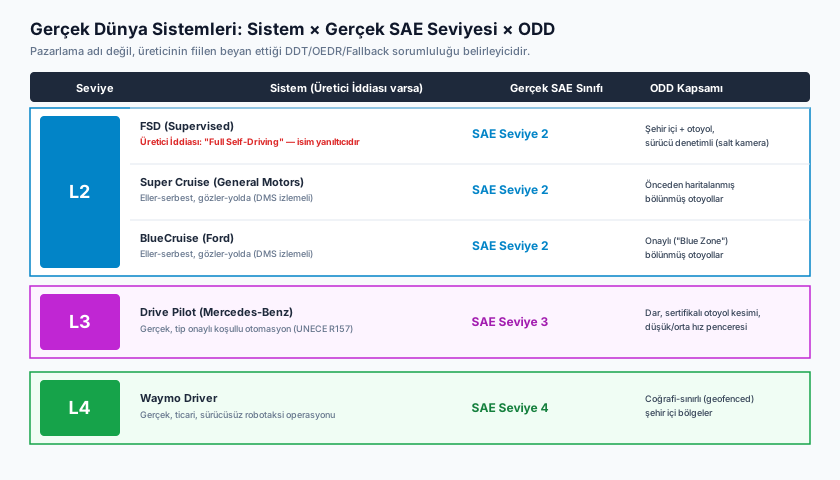
| System | Manufacturer / Developer | Actual SAE Level | Sensor Architecture | Liability Regime | ODD Scope |
|---|---|---|---|---|---|
| FSD (Supervised) (Manufacturer Claim: “Full Self-Driving”) | Tesla | SAE Level 2 | Pure Vision (multiple CMOS cameras; no radar/LiDAR in production hardware) | Human Driver (continuous attention and readiness to intervene mandatory) | Urban & highway, under human supervision |
| Super Cruise | General Motors | SAE Level 2 (hands-free, eyes-on) | Radar + Camera + Pre-mapped precision road data + DMS | Human Driver | Pre-mapped divided highways |
| BlueCruise | Ford | SAE Level 2 (hands-free, eyes-on) | Camera + Radar + DMS | Human Driver | Approved (“Blue Zone”) divided highways |
| Drive Pilot | Mercedes-Benz | SAE Level 3 | LiDAR + Long-Range Radar + Stereo Camera + Road Wetness Sensors + RTK-GNSS | Manufacturer (while engaged) | Specific, approved highway segments, narrow speed/traffic window |
| Waymo Driver | Alphabet (Waymo) | SAE Level 4 | Multiple LiDAR + Multiple Radar + Multiple Cameras + Acoustic Sensors | Fleet Operator (Waymo) | Geofenced urban areas |
FACT — A system’s SAE automation level is determined not by its marketing name, but by the actual/legal allocation of the dynamic driving task (DDT), transition demands, and civil liability between human driver and system (see AD-03, AD-26).
2. The Level 2 Landscape: Today’s Mainstream
2.1 Tesla FSD (Supervised) — Manufacturer Claim vs. Actual Level
- Manufacturer Claim: “Full Self-Driving (Supervised)” — a name that evokes self-driving capability.
- Actual SAE Level: 2. The driver must keep their eyes on the road at all times and remain ready to intervene; ultimate responsibility for the dynamic driving task rests entirely with the driver.
- Architecture: Pure vision perception (multiple CMOS cameras) paired with an end-to-end neural-network-based driving policy. Production vehicles have had radar and ultrasonic sensors removed.
- Engineering assessment: The system can display apparently high capability in complex urban maneuvers, but that behavioral fluency does not change its SAE level — the level is defined by the system’s legal/functional liability boundary, not by how capable it appears.
WARNING — “Full Self-Driving” is a commercial trademark, not a regulatory certification. Concluding from this name that the system drives independently is exactly the mistake this lesson’s core warning addresses: the gap between a product name and its actual SAE level is one of the industry’s most common sources of user-safety misunderstanding.
2.2 GM Super Cruise and Ford BlueCruise — Hands-Free, Still Level 2
Super Cruise and BlueCruise are frequently mistaken for a higher automation level because they are “hands-free” — but being hands-free does not, by itself, change the SAE level. Both systems:
- Are restricted to divided highways that have been pre-mapped with high precision (a narrow, approved corridor, not a broad ODD).
- Carry an eyes-on requirement (continuously monitored via DMS) — the driver may take their hands off the wheel, but not their attention off the road.
- Keep ultimate legal responsibility for the dynamic driving task with the driver.
INTERPRETATION — The distinction between “hands-free” and “eyes-free” (the defining feature of L3, see AD-26 §1.1) is exactly the line that keeps these three systems (Tesla FSD, Super Cruise, BlueCruise) below SAE Level 3. All three automate specific tasks, but in all three, the driver never cognitively disengages from the driving task.
2.3 Mainstream Highway-Assist Packages
Most major OEMs’ highway-assist packages (typically a combination of adaptive cruise control and lane centering) fall into the same category: Level 2, driver responsibility continues, and the system operates only within a specific ODD (typically divided highway, good visibility). This is by far the most widely deployed automation tier on the road today, and the large majority of the industry still sits at this level.
3. Level 3: Mercedes-Benz Drive Pilot
Drive Pilot is this lesson’s clearest example of a real, production, narrowly-certified L3 system.
- Architecture: A multi-sensor fusion combining LiDAR, long-range radar, stereo camera, road-wetness microphones, and RTK-GNSS; steering, braking, and the electrical system are dual-circuit redundant — because at L3, the system, not the human, actively executes the DDT.
- Regulatory standing: Type-approved in select markets under the UNECE R157 framework (see AD-26 §1) and commercially sold as a genuine SAE Level 3 system.
- ODD: Narrow and conservative — restricted to approved highway segments, specific traffic density conditions (typically a congested-traffic scenario), and a limited speed window.
- Liability: While the system is engaged, the driver may legally direct their attention away from the road (e.g., to an in-cabin display); during that window, collision liability rests with the manufacturer — the DSSAD record covered in AD-26 documents exactly when that transition occurred.
INTERPRETATION — Drive Pilot’s unusually narrow ODD is no accident: because the manufacturer assumes legal liability while the system is engaged, it benefits from keeping ODD boundaries as conservative as possible. This is a concrete instance of the AD-26 observation that “regulation sets the floor, the manufacturer can tighten further.”
4. Level 4: Waymo and the Robotaxi Space
4.1 Waymo Driver — Real, Commercial, Driverless
Waymo’s robotaxi service is this lesson’s clearest example of a real, commercial SAE Level 4 system: there is no safety driver on board, full responsibility for the dynamic driving task rests with fleet operator Waymo, and the system operates only within geofenced, heavily pre-mapped urban areas. The architecture reflects a heavily redundancy-first approach combining multiple LiDAR, multiple radar, multiple cameras, and acoustic sensors (such as siren detection).
4.2 Other Robotaxi Players — A Cautious Look
ASSUMPTION — The robotaxi space is an extremely fast-moving sector; a company’s operational status (active, suspended, in which cities, at what scale) can change frequently. The names below are given as examples of companies that have operated or currently operate in this space; no claim of certainty is made — for any of them, their current exact operational status, scale, or current SAE certification should be verified against that company’s current disclosures and local regulatory records:
- Cruise (a GM affiliate) — known to have operated robotaxi service in the US; its current operational scope is not verified within this lesson.
- Zoox (an Amazon affiliate) — known for developing purpose-built (steering-wheel-free) robotaxi vehicles.
- Baidu Apollo Go — a platform publicly reported to offer robotaxi service in multiple Chinese cities.
- WeRide and Pony.ai — China-based companies known to operate in the robotaxi and/or robotruck space.
The purpose of this list is to illustrate the breadth of the space — each company’s current SAE level, city coverage, and commercial/driverless status should be verified independently.
5. The Philosophical Divide: Vision-First or Multi-Sensor Redundancy?
A genuine, still-unresolved engineering and business-strategy debate continues across the industry. This section presents both sides fairly, in their own stated terms, grounded in the sensor physics covered in AD-04/AD-07, without declaring a winner.
[ APPROACH 1: VISION-FIRST (PURE/CAMERA-WEIGHTED VISION) ]
- Example: Tesla's stated approach
- Stated rationale: "If humans can drive the world primarily using vision, sufficiently
  rich camera data plus a powerful neural network can derive speed and depth from
  imagery too. Additional modalities add hardware cost, aerodynamic/styling
  trade-offs, and conflicting signals at the fusion layer (e.g., radar mistaking a
  drainage grate for an obstacle while the camera correctly sees a clear road)."
- Counterpoint: In conditions covered in AD-25 — dense fog, nighttime glare — the
  camera physically loses information; radar/LiDAR's active, illumination-independent
  measurement is simply absent in those conditions.

[ APPROACH 2: MULTI-MODAL / MULTI-SENSOR REDUNDANCY ]
- Example: Waymo's stated approach; most other L3/L4 developers
- Stated rationale: "Camera, radar, and LiDAR operate on independent physical
  principles (AD-04). No optical system is 100% reliable; independent modalities
  must cross-validate each other — especially in driver-out operation, where the
  system must remain safe even if a single modality fails."
- Counterpoint: Higher bill-of-materials cost, aerodynamic drag, sensor-cleaning
  complexity (AD-25 §2-3), and higher power draw.
INTERPRETATION — This lesson’s goal is not to decide which side is “right” — the industry itself has not resolved this. The point is to show you that both sides have a concrete, measurable rationale grounded in the sensor physics you learned in AD-04/AD-07: the debate is not “who is correct” but “what cost/risk balance is acceptable for a given ODD and liability regime.” At Level 2 (where liability remains with the driver), vision-first is a more defensible choice; in driver-out Level 4 operation (where liability rests entirely with the operator), multi-modal redundancy has become the dominant industry choice.
6. The Industry’s Trajectory: A Synthesis of the 30-Lesson Track
With this lesson, the threads running from AD-03’s definition of SAE levels, through AD-04/AD-05’s sensor physics, AD-07’s fusion, AD-16’s ODD, AD-25’s environmental conditions, and AD-26’s legal framework converge. The industry’s overall trajectory can be summarized in three parallel trends:
- Level 2 capability keeps expanding steadily. What began as highway-only adaptive cruise control now extends into urban maneuvering — but the SAE level (and therefore driver liability) stays fixed.
- Level 3 rollout remains cautious and slow. This is not primarily a technical limitation but largely the liability question covered in AD-03: the moment a manufacturer actually assumes the DDT, it also assumes collision liability — which drives narrow ODDs and conservative rollout.
- Geofenced Level 4 robotaxi growth continues, but as a city-by-city, geofence-by-geofence model that scales slowly.
FACT — Read together, these three trends paint a consistent picture: a fully autonomous, drive-anywhere “Level 5” vehicle is not expected to become widespread in the near term; instead, the industry is experiencing the gradual, parallel maturation of distinct automation tiers, each optimized for its own ODD (narrow L2 → broad L2 → narrow L3 → geofenced L4).
Frequently Asked Questions (FAQ)
Q: If Tesla FSD is named “Full Self-Driving,” why is it classified as Level 2?
FACT — Because SAE level is determined by who legally/functionally holds the dynamic driving task (DDT), not by product name (AD-03). While using FSD (Supervised), the driver must keep their eyes on the road at all times and remain ready to intervene, and collision liability remains with the driver — that is precisely the definition of SAE Level 2, regardless of the name.
Q: Why does Mercedes Drive Pilot operate in such a narrow window rather than a broad ODD?
INTERPRETATION — Because Mercedes assumes collision liability while the system is engaged (AD-26 §8); the narrower and more conservative the ODD, the larger the safety margin in sensor range and braking distance. This is more a manufacturer risk-management choice than a strict regulatory requirement.
Q: What is the current status of other robotaxi companies like Cruise, Zoox, and Apollo Go?
ASSUMPTION — This space changes rapidly, and this lesson does not claim a fixed, precise operational status as of any given date. For current information, consult each company’s official disclosures and the regulatory records of the jurisdictions where they operate.
Summary
- A system’s real capability is judged by the SAE level the manufacturer has actually claimed or had certified — not by its product name; this discipline is the central rule of this lesson.
- Today’s mainstream is Level 2: Tesla FSD (Supervised — Manufacturer Claim “Full Self-Driving”), GM Super Cruise, and Ford BlueCruise are all Level 2 systems requiring eyes-on attention and continued driver liability, despite being “hands-free.”
- Mercedes-Benz Drive Pilot is a narrow but real, type-approved Level 3 example; liability shifts to the manufacturer while the system is engaged.
- Waymo Driver is a real, commercial Level 4 example, operating driverless within geofenced areas. Other robotaxi players (Cruise, Zoox, Baidu Apollo Go, WeRide, Pony.ai) operate in a fast-changing space whose current status is not asserted in this lesson.
- The philosophical divide between Vision-First and Multi-Sensor Redundancy remains unresolved; both sides offer concrete rationale grounded in the sensor physics of AD-04/AD-07.
- The industry’s overall trajectory: expanding Level 2 capability, cautious/slow Level 3 rollout, and geofenced Level 4 robotaxi growth — together painting a picture of gradual, parallel maturation rather than imminent full Level 5 autonomy.
Sources and Verification Note
The SAE level classifications in this lesson draw on SAE J3016 terminology, and the legal liability frameworks draw on the UNECE R157 and EU GSR II frameworks covered in AD-26. Manufacturer-specific architecture and marketing detail (Tesla, GM, Ford, Mercedes-Benz, Waymo) is based on public manufacturer disclosures. Statements regarding other robotaxi companies (Cruise, Zoox, Baidu Apollo Go, WeRide, Pony.ai) and certain regional certifications (the Honda example in Japan, see AD-26 §5) are flagged ASSUMPTION; because this space changes rapidly, precise and current operational status should be verified against the relevant companies’/regulators’ current disclosures.
Next Lesson
- AD-28 — Autonomous Driving Safety Cases & UL 4600 Standard: Behind every real system reviewed in this lesson sits a safety case methodology and the UL 4600 standard, providing a systematic, auditable answer to “is this system safe enough” — we examine that framework next.
Technical Diagrams
Quiz
Under operational engagement of the Mercedes-Benz Drive Pilot system within its ODD, where does primary legal liability reside?
Mercedes-Benz Drive Pilot is a certified SAE Level 3 system; the OEM formally assumes legal liability during valid automated operation.
Despite commercial branding, what is the certified SAE automation level of Tesla's 'FSD (Supervised)' system?
Tesla FSD Supervised requires continuous human driver vigilance and instantaneous intervention capability, classifying it strictly as SAE Level 2.
Why is the commercial driverless Waymo Driver platform categorized as SAE Level 4 rather than SAE Level 5?
SAE Level 5 demands unrestricted operational capability across all global roadways and weather regimes; Waymo Driver operates within defined, mapped geofenced ODDs (Level 4).
What constitutes the fundamental safety divergence between 'Pure Vision' and 'True Redundancy' sensor architectures?
Pure Vision posits that cameras alone can achieve autonomy, while True Redundancy mandates distinct, multi-modal physical sensors to safeguard against single-modality optical failures.