
Zuri Taps EdgePerformance to Power Its TD 2.0 Hybrid-Electric Demonstrator
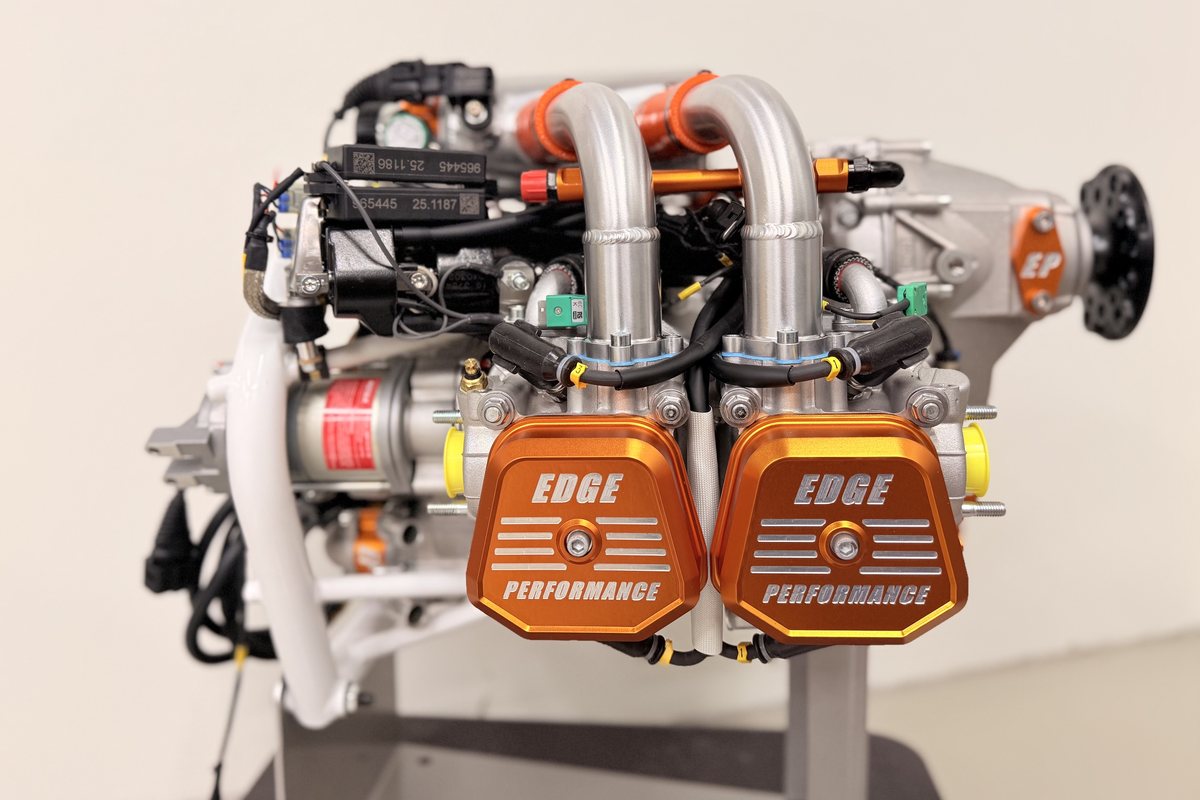
Czech aircraft developer Zuri has handed the propulsion supply role for its Technology Demonstrator 2.0 (TD 2.0) to Norwegian engine specialist EdgePerformance AS. The TD 2.0 is a hybrid-electric tiltrotor platform intended to de-risk the architecture that will eventually underpin Zuri’s planned uncrewed cargo aircraft, and the engine at its heart is a heavily reworked piston unit rather than a clean-sheet design.
EdgePerformance, based in Notodden, started from a factory-new Rotax 912 ULS and rebuilt it to spin a generator instead of turning a propeller. Output is quoted at 93 kW (125 hp), feeding electrical power to the aircraft’s motors, with a battery pack stepping in to cover the most energy-hungry phases of flight such as take-off, transition and landing. The conversion work includes a revised camshaft, new pistons and cylinders, electronic fuel injection and ECU-managed ignition, while the stock gearbox has given way to a direct-drive power take-off sized to run the generator at its required speed.
Fuel flexibility is one of the more unusual aspects of the package. The engine accepts premium automotive petrol as well as ethanol blends anywhere from 1% to 100% ethanol, and it can also burn AVGAS 100LL on an occasional basis — though EdgePerformance cautions that sustained use of leaded fuel would compress maintenance intervals. Cooling has emerged as the central engineering headache: with no propeller out front to push air across the block, the hybrid powertrain needs its own thermal solution, and Zuri has developed a bespoke oil and water cooling system. How much airflow the installation actually needs at full power is still an open question that only further testing will settle.
The engine has already idled on a test rig in Prague, where Zuri verified baseline operation, the cooling circuit and sensor behaviour. After a planned showing at the Future Forces Exhibition and Forum in Prague on 21-23 October, the unit is scheduled for power and thermal testing under load at a dedicated facility. Those runs will burn E85 — 85% ethanol and 15% petrol — which Zuri expects to cut heat generation by 20-30% against standard petrol, a figure that still has to be confirmed. Whatever the data shows will feed back into revisions of the cooling system and fuselage before integration is finalised.
Responsibility is split cleanly down the driveline: EdgePerformance owns the engine and fuel system up to the PTO shaft, while Zuri handles everything downstream, including generator controls, the motor controller and battery integration. Notably, the generator doubles as the starter, removing the need for a separate starter motor. The TD 2.0 exists to validate the architecture for Zuri’s uncrewed cargo VTOL, which carries a design payload of 115 kg and a stated range of 679 km, dropping to 569 km when a 30-minute reserve is factored in. Zuri is aiming for a first flight of the demonstrator in the second quarter of 2027, contingent on how the ground test campaign unfolds.
What do you think?