
Glasgow's Many Bus Brands Hide a Bigger Question — And Electrification Is Making It Urgent
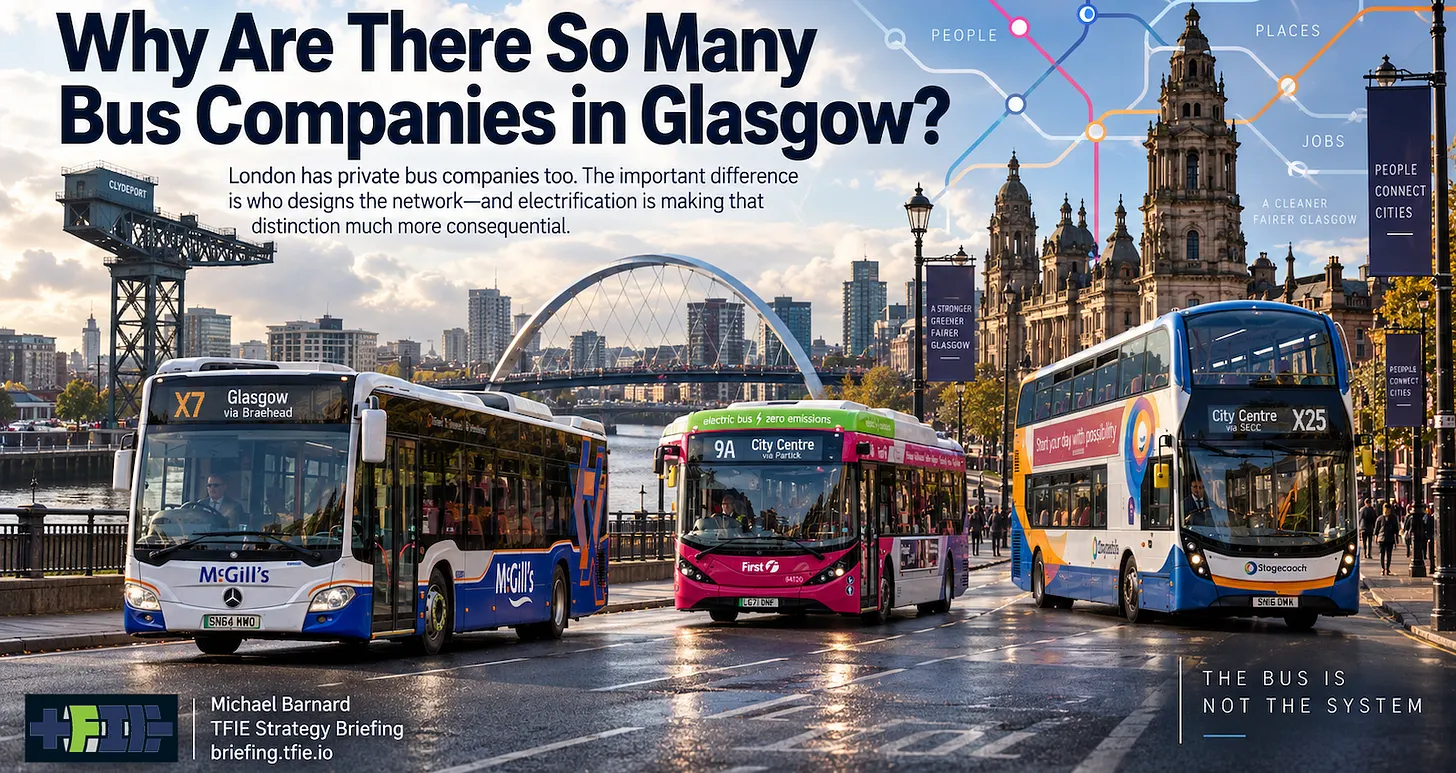
Step into Glasgow and the buses announce themselves with a patchwork of liveries: First Glasgow, McGill’s, Stagecoach and a handful of others, each with its own identity and fleet. The scene suggests a transit system sliced up among competing firms. But the deeper story isn’t about who drives the buses — it’s about who decides what the passenger network should actually look like.
London offers the counterpoint. Dozens of private operators run buses there too, yet riders experience a single Transport for London network: unified fares, unified information, coordinated routes and shared service standards, with private companies bidding for contracts to run specific pieces. The distinction, then, is not public versus private operation. It is who holds responsibility for designing the network passengers depend on.
That question traces back to Britain’s 1985 Transport Act. Outside London, most local bus services were deregulated starting in October 1986, and former public operators were later split from authorities and privatized. In Strathclyde, the early years brought a flood of new operators and thousands of registered service changes, as companies chased commercial opportunities without a metropolitan body redesigning the whole network. London kept route, fare and frequency decisions in public hands while letting private firms compete for contracts.
Why does this matter for electrification? Because passengers don’t buy an efficiently run bus in isolation — they buy a journey. A frequent first leg is useless if the connection runs hourly or stops before an evening shift ends. Glasgow has patchwork fixes like the ZoneCard, which spans participating buses, ScotRail and the Subway, plus SPT support for routes the market won’t serve. Helpful, but a common ticket still doesn’t decide which destinations should be linked or where transfers need rethinking.
The stakes rise sharply with battery-electric fleets. Diesel operations already relied on depots, but electric buses add high-capacity grid connections, charging hardware and control systems whose useful lives stretch far beyond any single contract. A route can be redrawn or a contract re-tendered far more easily than a multi-megawatt grid connection can be relocated. That turns governance into a practical infrastructure question rather than an ideological one.
Comparisons elsewhere reinforce the point. Edinburgh grew around a dominant municipally owned operator within Scotland’s deregulated framework, while Dublin’s National Transport Authority specifies one common network drawing on both public and private operators. Ownership, competition and network planning, in other words, are separate choices — not a single packaged deal. Research on Britain’s first deregulated decade did find real drops in operating costs, and London achieved cost gains through competitive tendering too. Cost discipline, evidently, doesn’t require private control of network design.
Glasgow is now weighing change. SPT is running a statutory franchising assessment for the wider Strathclyde region that could let the authority specify the network while operators compete to deliver it. That process is still ongoing, and franchising alone guarantees nothing about planning quality. The durable lesson from four decades of this natural experiment is narrower: running buses and designing a metropolitan network are different jobs, and electrification raises the price of confusing the two.
Neither option can be assumed correct
What do you think?