
Vessev's Electric Ferry Glides Above the Waves on Computer-Guided Hydrofoils
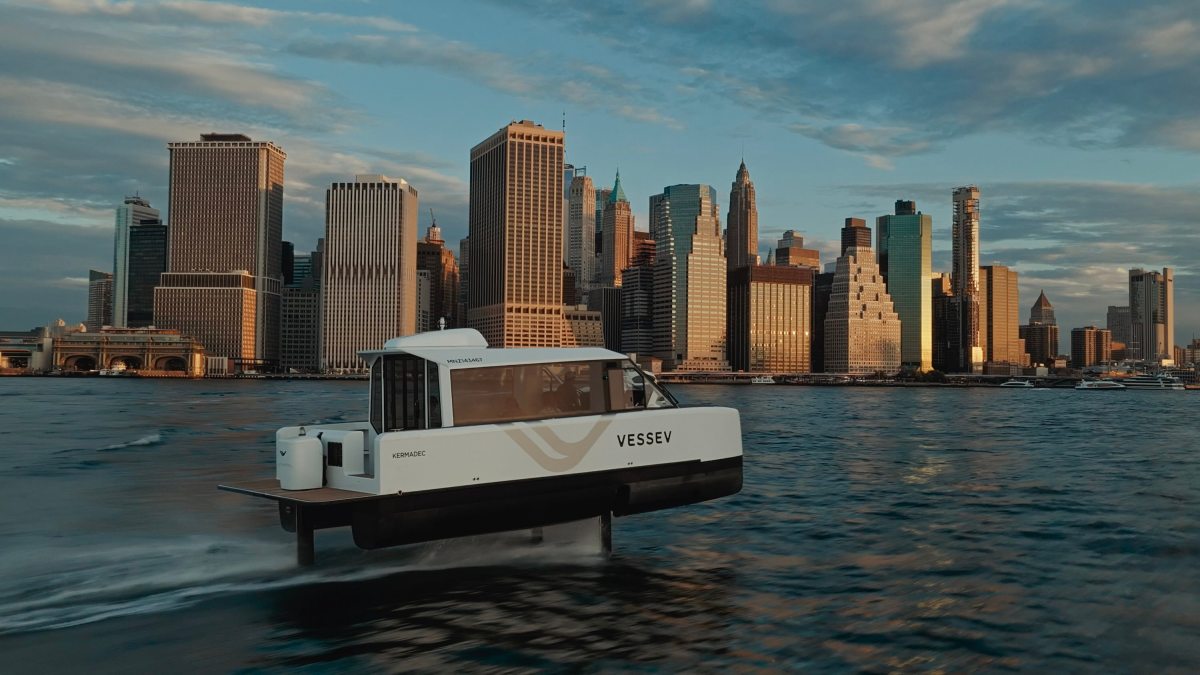
Most electric boats still fight the same physics as their diesel ancestors: the faster they go, the more water they have to shove aside. Vessev, a marine startup, is taking a different route with its VS-9, a roughly 30-foot electric catamaran that rises out of the water on wing-like foils and skims across the surface instead of plowing through it.
On a recent demonstration run from a Brooklyn marina toward Governors Island on New York’s East River, the transition from conventional hull-in-water travel to foil-borne flight was so understated that it barely registered as a milestone. That smoothness is the point. Where an ordinary boat of this size begins to pound and slap the waves as it picks up speed, the VS-9 instead lets its submerged foils take over, lifting the hull clear of the chop. Two wing-shaped structures sit beneath the hull, and computer-controlled flaps constantly trim their angle to hold the ride level. The forward foil carries the bulk of the load, with the rear foil handling roughly the remaining fifth. The rear assembly also houses the electric motor, which Vessev builds itself rather than buying from a supplier. CEO Eric Laakmann’s reasoning is straightforward: production costs eventually have to come in-house anyway, so the company might as well start early. Batteries are the one major component Vessev leaves to others, a nod to how standardized the cell supply has become.
Keeping the hull out of the water is what makes the efficiency math work for an electric drivetrain, where every kilowatt-hour of onboard storage matters. Hydrofoil concepts have been tested by shipbuilders for more than a century, and the appeal has always been the same: less drag and a gentler ride. Vessev’s version charges from a standard EV charger, a detail that could simplify dockside infrastructure. The design does have limits. It performs best in water the boat can clear while foiling, which for the VS-9 means roughly 2.5 feet or 0.75 meters. Taller waves clip the hull, spoiling the smoothness and eating into range. That rules out open-ocean crossings but leaves lakes, rivers, and sheltered bays squarely in play.
Vessev has raised a $19 million Series A and is initially aiming at transit operators, betting that electric propulsion plus foils can lower the cost of running smaller vessels enough to complement urban mass transit. In a city like New York, that could mean moving passengers to Brooklyn or Queens with minimal new infrastructure. Hotels and tour companies form another early market, and Laakmann said public demonstrations have drawn interest from wealthy buyers shopping for a new toy.
The VS-9 that made the Brooklyn run is currently a one-off, but the company intends to build more. Longer term, Vessev may pivot toward selling hydrofoil kits so other boatbuilders can wrap their own hull designs around the technology — a path that could spread foiling far beyond a single startup’s production line. With a full passenger load, the craft is rated for up to 40 nautical miles, or about 46 miles (74 kilometers), per charge.
What do you think?