
The Cheapest All-Wheel-Drive Taycan Is Also the One You Want
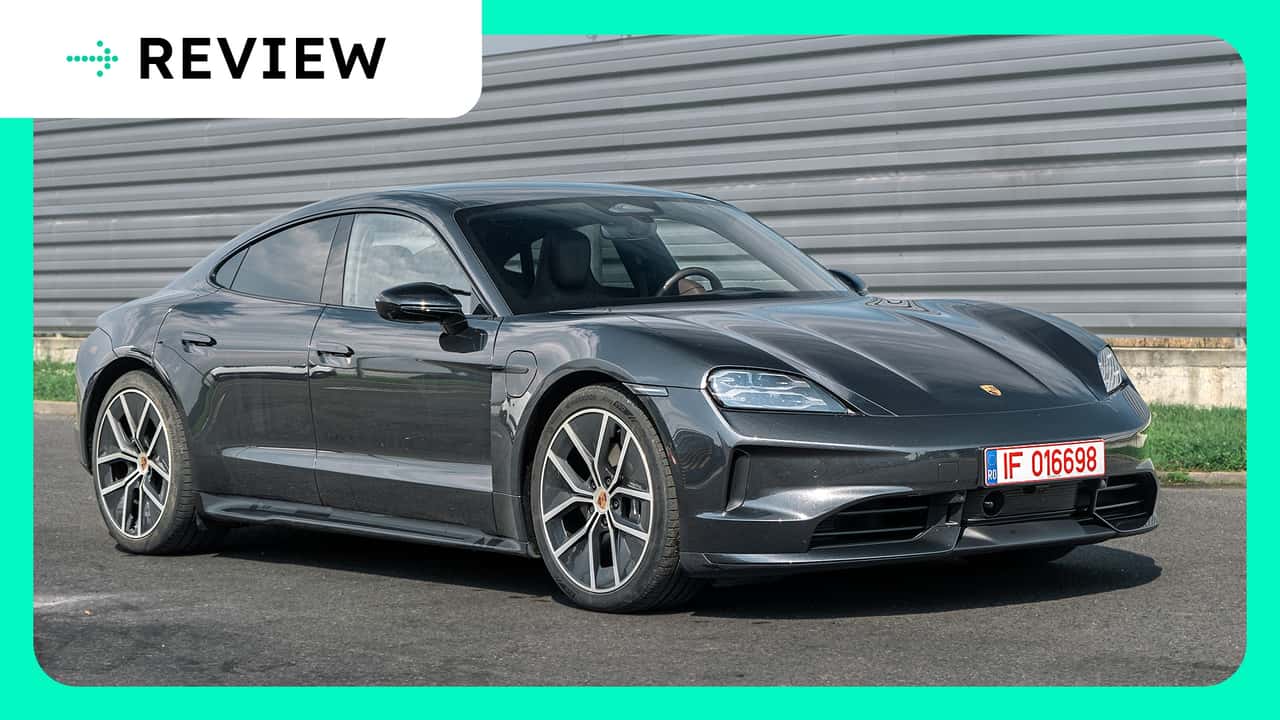
Porsche’s electric sedan has spent the past few years being defined by its headline numbers — the Turbo GT’s four-figure horsepower, the sub-three-second launches. After a 200-mile stint in the entry-level all-wheel-drive 2026 Taycan 4, it’s clear that’s only half the story.
With 429 hp and 449 lb-ft from its dual-motor setup, this is the most modest Taycan you can order with two driven axles. Porsche quotes 0-60 mph in 4.4 seconds with launch control and a 143-mph top speed — figures that look almost tame next to the flagship cars. They also turn out to be entirely beside the point.
The Chassis Does the Talking
What separates the Taycan 4 from the pack has nothing to do with straight-line punch. The steering wheel is round, modestly sized and thin-rimmed — a welcome change from the over-padded rims found in some BMW M and Mercedes-AMG models. You sit low, legs stretched out, with an adjustment range that lets just about anyone find a natural position.
Point it at a corner and the front end answers with exactly the response you’d expect. No exaggerated off-center twitch to fake agility in a car that weighs over two tons.
Through a favorite mountain road in the rain, the Taycan stayed flat and let the driver fine-tune its balance with the accelerator rather than waiting until the exit to get back on the power. Body roll was kept in check even in the firmest suspension settings, and the ride never turned punishing on rough tarmac — a combination that’s genuinely rare.
There’s a two-speed gearbox on the rear motor, with a short first gear for launches and a taller second for cruising. You’ll notice the shift under hard acceleration; otherwise it fades into the background.
Charging and Real-World Efficiency
The Black Edition tester comes with Porsche’s larger 105-kWh pack (97 kWh usable), rated at up to 395 miles on the WLTP cycle. The car supports DC charging at up to 320 kW thanks to its 800-volt architecture, which Porsche says is good for a 10-80% top-up in as little as 18 minutes under ideal conditions. On a 200-kW charger, a session from 54% to 90% added 44.75 kWh in just under 19 minutes, averaging 138 kW.
After a full day that included highway running and a hard mountain-road drive, consumption settled at 2.73 miles/kWh (22.8 kWh/100 km) — leaving plenty of charge for the 70-mile trip home.
One trait worth flagging: the automatic regen setup leans toward coasting rather than strong one-pedal driving. Most of the recuperation happens through the brake pedal, and the handoff between motors and friction brakes is seamless enough that you can’t feel where one ends and the other begins.
The Price of Entry
None of this comes cheap. As tested in Romania, the Taycan 4 Black Edition landed at nearly €150,000. That’s the most sensible Taycan on the menu, and it’s still firmly in dream-car territory for most buyers.
What that money buys, though, is a car whose steering, suspension, brakes and power delivery feel engineered as one piece rather than a collection of impressive specs. The Taycan 4 makes a case that an EV’s character comes from how it manages its mass, not from how quickly it can erase a stretch of road. More power would add little. Less would probably be fine too.
Source: InsideEVs
Curious how this compares to other EVs? Try our comparison tool →What do you think?