
Tesla Switches On Its Fastest Australian Supercharger Hub in Sydney
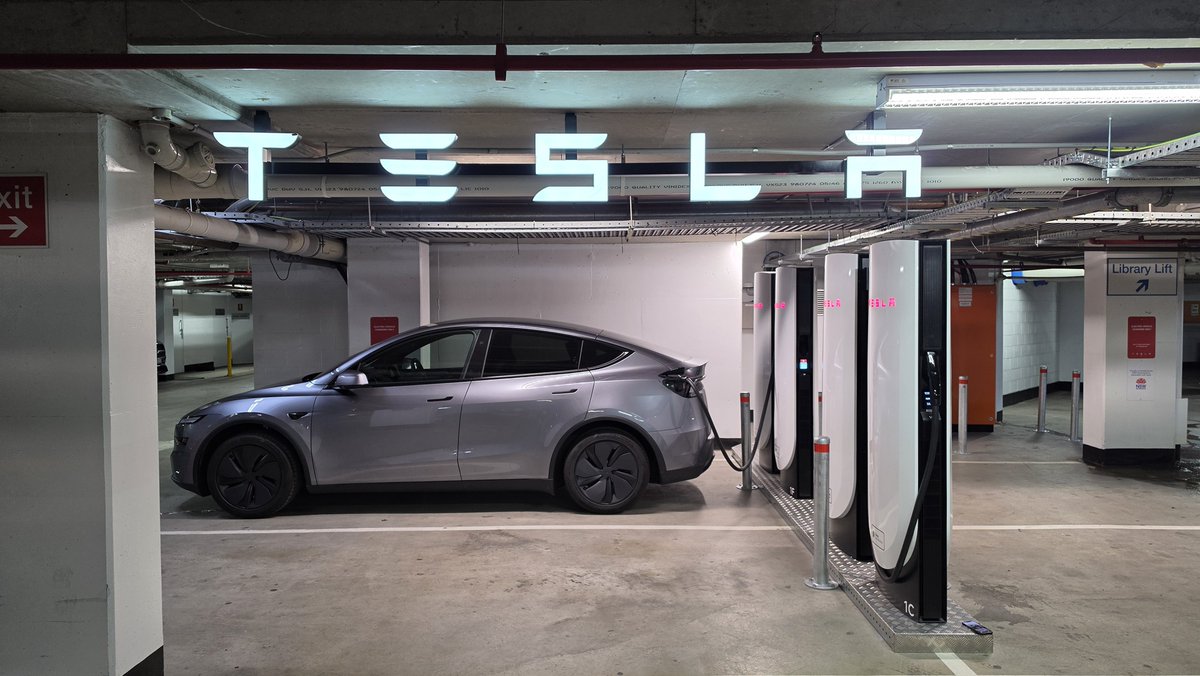
Tesla’s newest charging hardware has landed Down Under. The company has switched on its first Australian site built around the V4 power cabinet, and it sits in Leichhardt, an inner-west suburb of Sydney, with six stalls each rated at 415 kW.
That figure is a clear jump from the 250–325 kW that has become familiar at supercharger locations opened more recently, and it marks the debut of the V4 cabinet setup in the Asia-Pacific region.
Tesla Charging announced the opening on its social channels, and the details were quickly picked up by Supercharger watchers online. One well-known tracker of the network confirmed the site runs on cabinets designed for 400–1,000 volts — the architecture that lets 800-volt vehicles from Hyundai, Kia, Porsche, Xpeng, Zeekr and Tesla itself, Cybertruck included, pull power at their full potential. With a dedicated transformer on site, the hardware can reportedly push as much as 500 kW.
More Stalls, Less Fuss
Beyond raw speed, the V4 cabinet brings practical changes for how Tesla builds out its network. Each cabinet can now serve up to eight stalls instead of four. The electrical layout has also been simplified, which Tesla says trims installation costs and — just as importantly — the footprint each site needs for power equipment. Less space and less complexity add up to faster permitting and quicker builds.
That matters in Australia, where EV registrations keep climbing and the charging map has to keep pace. Tesla is closing in on 160 supercharger locations nationally, and the Leichhardt opening looks like the first of many V4 deployments rather than a one-off showcase.
Tesla has already wound down production of the older V3 cabinets at its New York factory. After roughly seven years and 15,000 units, the line now builds only the current generation. Back in November 2024, the company said the upgraded cabinets would double per-stall charging speeds to 500 kW for compatible cars, and reach up to 1.2 MW per stall for heavy vehicles like the Tesla Semi.
The pricing angle is worth a look too. Leichhardt is charging non-Tesla EVs as little as 48 c/kWh during off-peak hours, while Tesla owners pay just 34 c/kWh. Compare that with some rival high-power networks nudging 90 c/kWh, and the cost gap is hard to ignore.
For Sydney drivers with an 800-volt car, this is the first spot in the country where the hardware can actually stretch its legs. Expect the rest of Australia to follow.
Source: The Driven
Curious how this compares to other EVs? Try our comparison tool →What do you think?