
Tesla's Roadster Finally Flies — Literally — With SpaceX Thrusters, but Production Slips to 2028
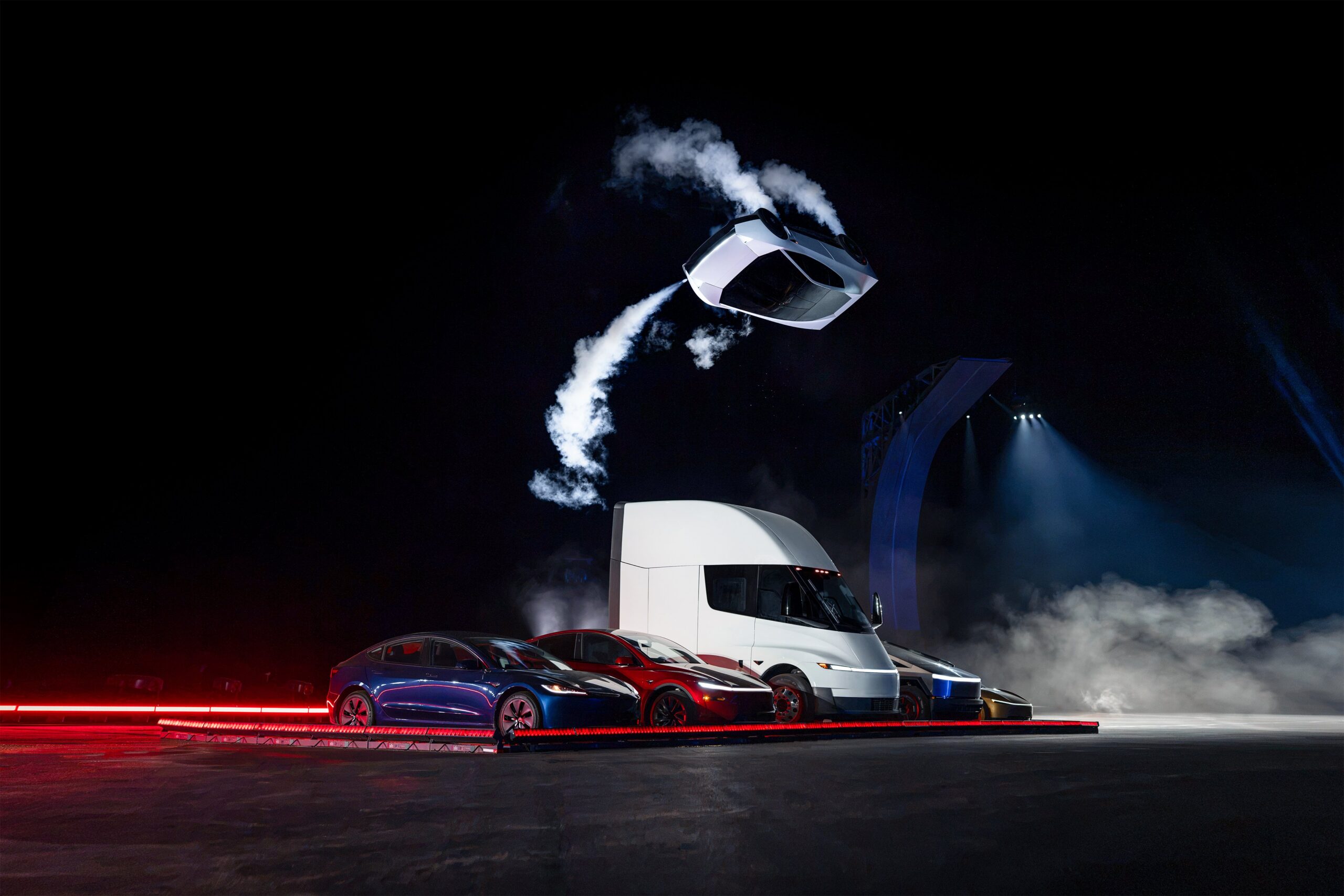
After nine years in limbo, Tesla’s long-teased Roadster made its most dramatic appearance yet — not on a drag strip, but mid-air. At a livestreamed event in Texas hosted by Elon Musk, a remote-controlled white two-door roadster climbed a looping ramp, clung to the surface using suction, then launched, flipped and touched back down on SpaceX thruster power. It sailed over the rest of Tesla’s lineup before landing.
The stunt drew global headlines, but the timeline remains stubbornly familiar. Tesla says the car — first shown to the public back in 2017 — won’t reach customers until 2028. Production was originally slated for 2020 before slipping again and again.
Three Tiers, Three Very Different Cars
The Roadster will arrive in three flavours, according to Tesla:
- Performance: The road-going base model. Active aerodynamics plus a multi-mode suction system that seals the car to the ground for maximum downforce. Tesla quotes a 0-100 km/h run of just over 1.6 seconds, an expected price tag around $US250,000 and a $US50,000 reservation fee.
- Thrust: A track-focused step up that adds SpaceX-developed cold-gas thrusters at the rear, fed by high-pressure air tanks. Tesla claims a 0-60 mph sprint under 0.9 seconds, which works out to roughly one second to 100 km/h.
- Rocket: The wild one. A full flight-system layout with 10 cold-gas thrusters handling forward, upward and lateral rotation, enabling short hops and mid-air manoeuvres. It is not road-legal and will be offered by invitation only.
Reservations are open now, with deliveries pegged for 2028.
A Decade-Long Tease
The maths is hard to ignore. The original Roadster entered production in 2008; the second-generation car was unveiled in 2017, roughly a decade later. Now the gap between reveal and showroom looks set to stretch close to eleven years.
Tesla chief designer Franz von Holzhausen, speaking on a podcast late last year, framed the car as a physics-defying exercise: he described it as a machine that “looks at the limits of physics” and said the team had reached the standard it originally set out.
Whether buyers who put money down years ago are still waiting patiently is another question. The demonstration was undeniably spectacular — and the specs, if they hold, are genuinely absurd. But the Roadster has spent nearly a decade as a promise, and 2028 is still two years out. For now, the flying car exists. Just not in anyone’s driveway.
Source: The Driven
Curious how this compares to other EVs? Try our comparison tool →What do you think?