
2027 Chevrolet Bolt RS Review: The Cheapest EV in America, Living on Borrowed Time
The 2027 Chevrolet Bolt is the most affordable EV you can buy in the United States at $27,600 — and it may not be around much longer. Washington's decision to scrap the federal $7,500 tax credit, combined with loosened fuel-economy and emissions rules and new tariffs pushing production onshore, has pushed GM toward more profitable combustion models. Buyers, not executives, end up paying the price.
That backdrop makes this road test feel a little bittersweet. Underneath the familiar shape sits a genuinely good little electric car.
Powertrain and real-world efficiency
The 2027 Bolt runs a 65 kWh lithium-iron-phosphate (LFP) battery feeding a single 150 kW front-mounted motor. Output is 210 horsepower and 169 pound-feet of torque, routed through a one-speed automatic to the front wheels. The EPA rates range at 262 miles.
Over a 201-mile loop mixing freeway and city streets in Southern California, we recorded 4.0 miles per kWh — genuinely efficient for a car in this class. Charging up on a Level 2 240-volt ChargePoint Home Flex unit, the 11.5 kW onboard charger added roughly 40 miles of range per hour. Hook up to a public DC fast charger and you’re looking at 10-80% in about 25 minutes.
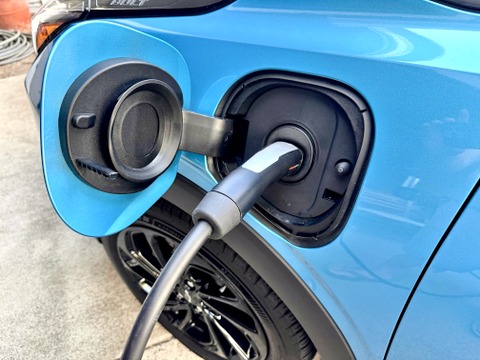
Chevrolet also ships a Dual Level Charge Cord with a swappable plug: standard 120-volt three-prong for Level 1, or 240-volt for Level 2. For plenty of buyers that removes the need to buy a wallbox at all. The charge port is NACS, mounted on the driver-side front fender.
Key Specs: 65 kWh LFP battery · 262 mi EPA range · 210 hp / 169 lb-ft · 11.5 kW onboard charger · DC fast charge 10-80% in 25 min · From $27,600
Behind the wheel
Chevy quotes roughly 6.5 seconds to 60 mph, and the Bolt feels quicker than that around town thanks to the instant torque. We comfortably cruised at 80 mph on open freeway without drama. If this is your first EV, the immediate response at any throttle position — one mph or sixty — takes some recalibration.
The floor-mounted battery keeps the center of gravity low, and the car feels planted in crosswinds or when a big rig blasts past. At 3,776 pounds curb weight, the Bolt rides on 215/50 Michelin Primacy all-seasons wrapped around 17-inch gloss black alloys. Steering isn’t over-assisted, and body roll stays manageable even when you push past posted corner speeds.
Regenerative braking recovers energy on coast and deceleration, and the One Pedal Driving and Regen On Demand modes will quickly become your default way to drive it. You’ll still need the friction brakes in an emergency, of course.
A tall hatchback, not a crossover
Chevrolet redesigned the front and rear fascias and the lighting, but the proportions are familiar — and that’s fine. The Bolt sits tall, which translates into generous head and leg room front and rear. It looks like a crossover and behaves like a tall hatchback. Parked in the driveway, it drew unprompted compliments from neighbors.
LED headlamps, automatic high beams, rain-sensing wipers and power mirrors are standard, and the roof rails, shark fin antenna, mirror caps and wheel trim all come in gloss black. Seven colors are offered, including Atomic Yellow (RS only) and Relic Green Metallic (LT only). Our tester wore Marina Blue Metallic.
Cabin upgrades and one notable omission
Inside, Chevy made real progress: an 11-inch instrument panel, an 11.3-inch touchscreen, new seats and noticeably better materials throughout. Our RS test car came with red contrast stitching on Evotex upholstery — a durable, stain-resistant material — plus an 8-way heated and ventilated power driver’s seat with lumbar, a heated and ventilated manual passenger seat, multi-color ambient lighting and a heated leather-wrapped wheel.
A 7-speaker Bose system handles audio, with AM/FM/SiriusXM and USB-C ports. The catch: no Apple CarPlay or Android Auto. How much that matters depends entirely on how attached you are to those platforms.
OnStar activation is a single button press, connecting you to a GM representative.
Trims, pricing and the clock ticking
Two trims are available, both figures including the $1,395 destination charge:
- Bolt LT — $28,995
- Bolt RS — $32,995
Our RS, with $2,690 in options, stickered at $35,685.
Standard safety gear covers lane change and blind spot alerts, rear park assist with cross-traffic alert, forward collision alert, automatic emergency braking, front pedestrian braking, HD surround vision and a rear-view monitor.
First launched as a 2017 model, the Bolt has surpassed 100,000 global sales — proof that a genuinely affordable EV has a market. It isn’t a premium car pretending to be cheap; it simply is cheap, and it works. The trouble is that at this price, it can’t make Chevrolet or GM any real money. That’s the reason it’s on the way out, and it’s a loss for anyone shopping on a budget.
If you want one, the dealer lot is where to go. Sooner rather than later.
Source: Clean Fleet Report
Curious how this compares to other EVs? Try our comparison tool →What do you think?