
Tesla Opens Home Backup to Model 3 and Model Y — With Strings Attached
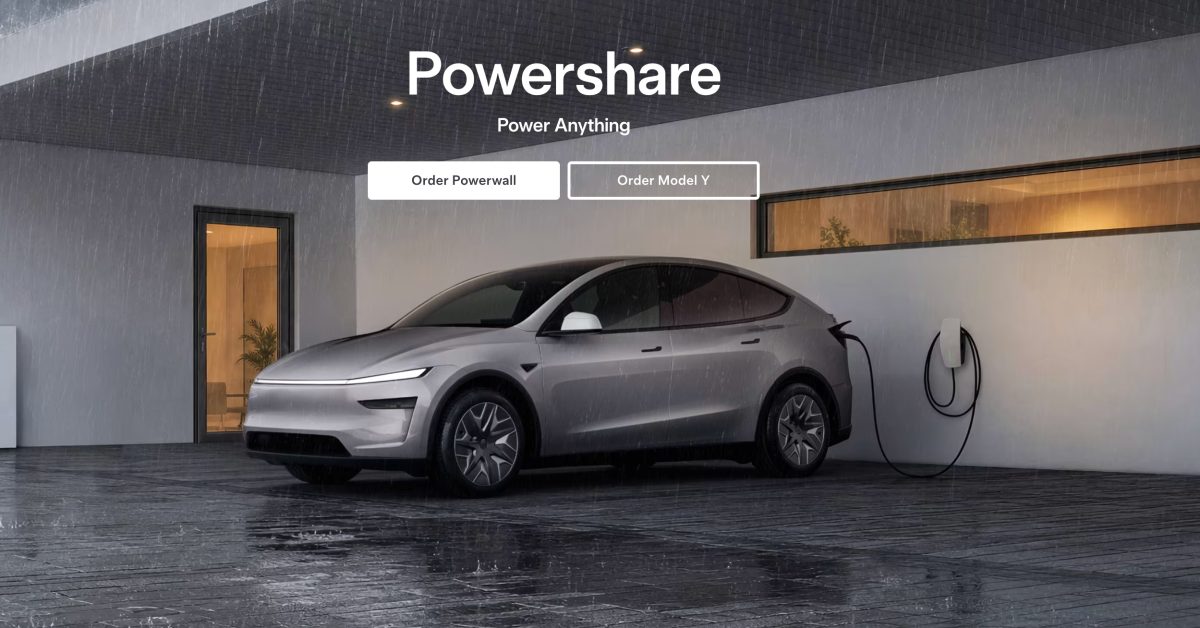
Tesla has switched on Powershare Home Backup for its two best-selling models, giving Model 3 and Model Y owners the ability to keep a house running when the grid drops out. Until now, the Cybertruck was the only Tesla product able to push power back into a home.
The rollout comes with conditions. Buyers must have a Powerwall 3 installed, and Tesla is only guaranteeing the capability on cars ordered in the US and Puerto Rico from October 1, 2026 onward. For vehicles built earlier, the company says only “some, but not all” units have the necessary hardware. That hardware is an inverter Tesla refers to as PCS2 Lite, embedded in the vehicle — but Tesla has not said when each trim began receiving it. Owners can find out by opening the touchscreen menu under Software and then Additional Vehicle Information; if “Powershare Support” is listed as enabled, the car is ready.
Functionally, the setup is straightforward. A Model 3 or Model Y plugs into a Wall Connector or Universal Wall Connector at a home equipped with a Powerwall 3. When utility power fails, the vehicle’s battery extends the home’s backup reserve. Tesla says a car charged to 90% adds more than two days of runtime for a household consuming roughly 30 kWh daily, with standard trims rated at “up to two days.” A Cybertruck contributes over three days. Maximum continuous output for the Powerwall setup is listed at 11.52 kW. Existing Powerwall 3 and Wall Connector owners need no additional hardware, though the feature must be activated by contacting Tesla support. Powerwall 2 and Powerwall+ compatibility is described as “coming soon,” grid export is not supported on the Model 3 or Model Y, and Model S and Model X are excluded entirely.
The feature marks a notable shift from just two months earlier, when Tesla added a 2.4 kW outlet adapter to the Model Y Premium while its website still listed Powershare as unavailable for the Model 3 and Model Y. The Cybertruck’s own Powershare integration only began working with Powerwall 3 last month after repeated delays.
Tesla is arriving late to a segment rivals have occupied for years. Ford introduced home backup on the F-150 Lightning in 2022 with 9.6 kW of output. GM committed in 2023 to bringing vehicle-to-home capability to every Ultium-based EV by model year 2026 and has delivered, with GM Energy’s compatibility list now spanning the Equinox EV, Blazer EV, Silverado EV, the 2027 Bolt, GMC’s Sierra EV and Hummer EV, plus five Cadillacs. Kia offers the function on the EV9 through a Wallbox bidirectional charger. Tesla itself set an internal target and missed it: at 2023’s Investor Day, then-SVP of powertrain and energy engineering Drew Baglino suggested bidirectional charging could arrive within two years, pointing to 2025. Elon Musk said at the same event that he doubted many people would want bidirectional charging unless they owned a Powerwall — and that is essentially how Tesla has now shipped it, tying the capability to Powerwall 3 rather than offering standalone home backup. A third party beat Tesla to the punch as well: Sigenergy demonstrated vehicle-to-home with Tesla vehicles over DC without Tesla’s participation. The upside is scale — the Model 3 and Model Y are Tesla’s volume products, so vehicle-to-home reaches many driveways quickly, and owners already invested in Powerwall 3 and a Wall Connector buy nothing extra, unlike Ford and GM setups that require separate inverter and backup hardware. The trade-off is that millions of older Teslas will remain locked out.
What do you think?