
Stratasys Brings 3D Printing to the Assembly Line, With Toyota Watching Closely
Stratasys is making its play for the factory floor. At Formnext 2026 in Frankfurt, the company will pull the wraps off a polymer 3D printer built for high-volume serial output — a machine aimed squarely at manufacturers who want to print finished parts, not just prototypes. The name stays under wraps until the show opens on 17 November.
The announcement comes with a second headline: the large-format F870 tooling platform, which relies on fused deposition modelling, gets its first European showing at the same event.
Why Toyota’s Name Keeps Coming Up
The F870 prints inside a fully heated build chamber measuring 1,000 x 610 x 610mm and is built to run unattended for extended stretches. That combination is what lets manufacturers produce large jigs, fixtures and tooling on their own site instead of ordering them from outside suppliers.
Toyota has agreed to take the stage on 18 November to walk through how it simulates and validates large-format FDM tooling for vehicle assembly. General Motors will also have factory-floor applications on display at the stand.
Toyota’s presence is the telling part. Tooling is unglamorous work — fixtures, jigs, the scaffolding that holds a car together while robots weld it — but it is where the money and the time sit.
The Pitch: Machines, Not Experiments
Stratasys chief executive Dr Yoav Zeif frames the shift in straightforward terms: additive manufacturing is settling in as ordinary plant equipment, giving manufacturers more flexibility, efficiency and control over production. He points to aerospace, defense, automotive and dental customers moving from one-off applications into full production workflows.
That is a meaningful reframe. For years, 3D printing in automotive was largely confined to rapid prototyping labs and the occasional low-volume bracket. Getting it onto the line, running around the clock, producing the same part to the same tolerance every time, is a different problem entirely.
At a glance: F870 build chamber 1,000 x 610 x 610mm · FDM process · fully heated chamber · unattended operation · European debut at Formnext 2026 · new printer named 17 November
What Automakers Get Out of It
- In-house tooling: Large jigs and fixtures printed on site, cutting dependence on external suppliers.
- Uptime: Unattended runs let a machine keep producing overnight and through weekends.
- Speed to change: Design revisions to tooling can be handled without a lengthy procurement cycle.
None of this is about building whole vehicles. It is about the equipment that builds vehicles — a far less visible market, and a stubbornly expensive one to manage.
The new high-volume machine will be revealed in Frankfurt on 17 November. Stratasys will be hoping the automotive names on its stand do more of the persuading than any spec sheet.
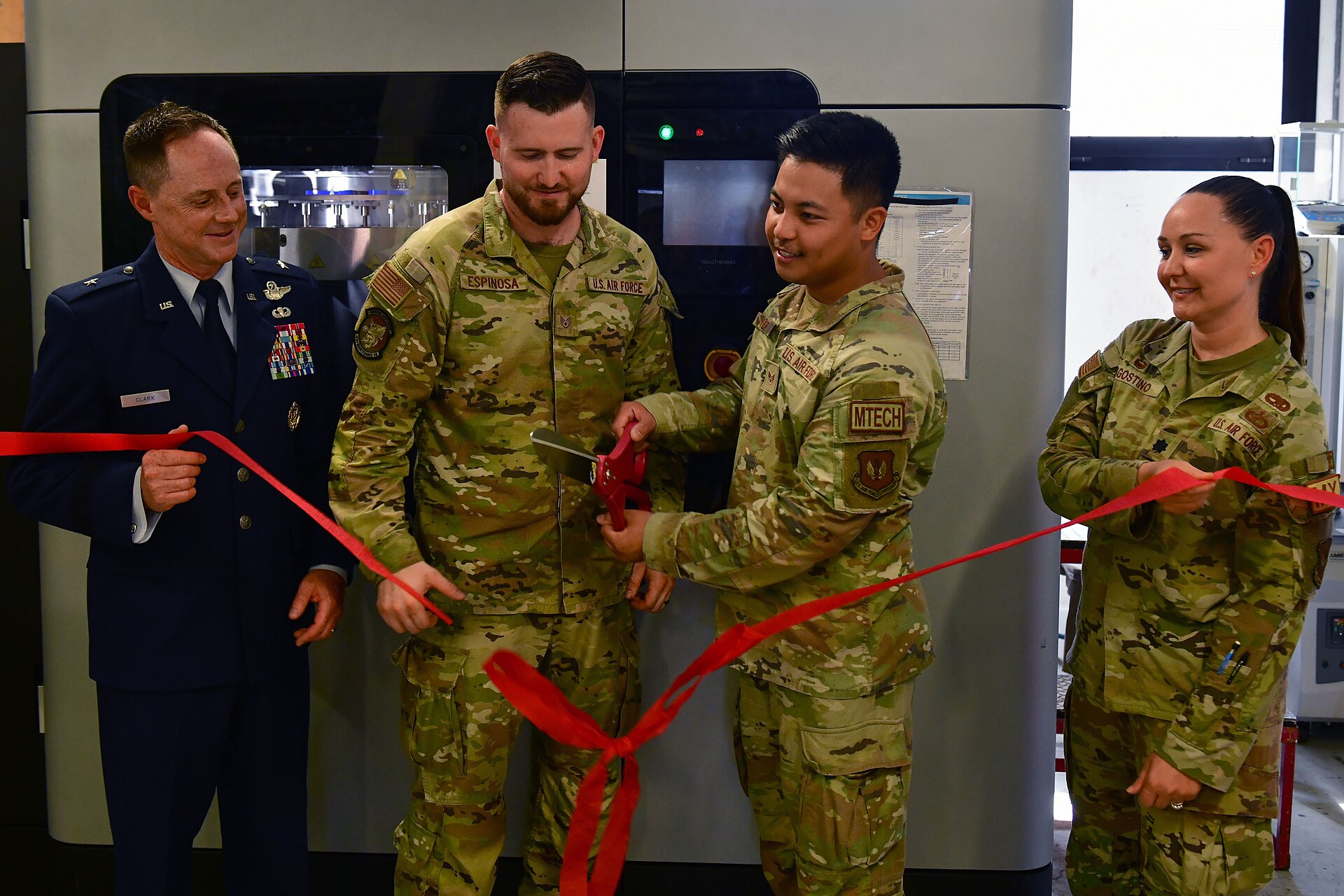
Photo: U.S. Air Force photo by Staff Sgt. Heather Ley · Wikimedia Commons (Public domain)
Source: Automotive World
What do you think?