
SpaceX Closes Record Day With Midnight Falcon Heavy Launch for the NRO
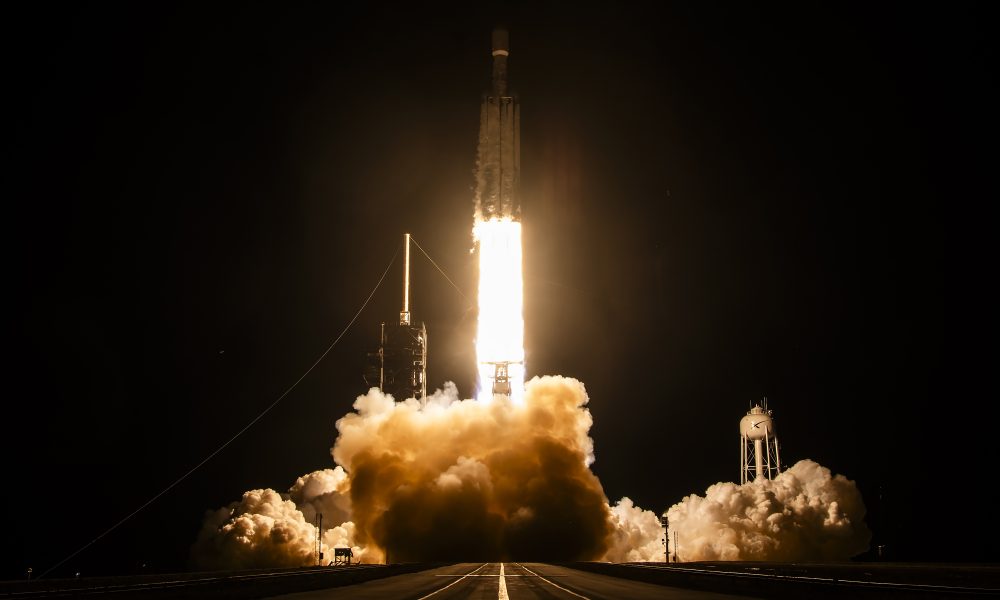
SpaceX wrapped up one of its most productive launch days to date with a Falcon Heavy flight from Florida that lifted off at 11:54 p.m. ET Thursday, carrying a classified payload known as NROL-97 for the National Reconnaissance Office. The mission mattered for more than its late-night timing: it marked the first time the NRO has entrusted a satellite to Falcon Heavy after relying on the single-stick Falcon 9 for 22 previous missions, and it was also the first NRO launch purchased under the National Security Space Launch Phase 3 Lane 2 contract awarded in 2025.
About eight minutes after departing Launch Complex 39A at NASA’s Kennedy Space Center, the two side boosters — B1104 and B1072 — came back to Earth at Landing Zones 1 and 2 at Cape Canaveral Space Force Station, triggering double sonic booms across Brevard County. B1104 was on its second flight and B1072 on its fourth, and both had most recently flown together on NASA’s Nancy Grace Roman Space Telescope mission in late August, making this the shortest gap yet between two Falcon Heavy flights. The brand-new center core, B1106, was intentionally expended over the Atlantic so the payload could be delivered to its high-energy orbit. The fairing, meanwhile, was reused hardware that had already flown on the NROL-95 mission in July.
The twin landings were the exclamation point on a day that saw SpaceX recover four boosters in total — a first for the company. Earlier on Thursday, a Falcon 9 booster returned to Landing Zone 40 after carrying the Crew-13 astronauts toward the International Space Station, while another Falcon 9 launched the Transporter-18 rideshare mission from Vandenberg Space Force Base in California with 130 payloads aboard. The triple-header had been telegraphed in advance, but the clean sweep of landings still represented a new benchmark for turnaround and reuse.
There was an emotional footnote as well: the mission appears to have been the last hurrah for Landing Zone 1, the historic pad where SpaceX first landed an orbital-class booster back in December 2015. The company’s lease on the former Launch Complex 13 site lapsed in 2025 as Florida recovery operations shifted to newer pads at SpaceX’s own complexes, and launch trackers listed NROL-97 as the final landing expected there. Bringing LZ-1 back into service one more time let SpaceX keep its Crew-13 booster at LZ-40 while still recovering both Heavy side boosters on the same night.
NROL-97 also underscores how quickly SpaceX’s national security business is expanding. Since mid-August, the company has flown four Space Force missions from Vandenberg, several of which are believed to carry Starshield satellites, pushing its total Pentagon contract value for 2026 past $8 billion. The timing is notable given the broader shift on the Space Coast — only one launch took place from Florida during all of September as SpaceX redirects more of its East Coast infrastructure toward Starship, which reached orbit for the first time on Flight 14 just three days before this Falcon Heavy flight.
What do you think?