
Rare 1971 Abarth OTAS Grand Prix 1000 Heads to Market After Full Restoration
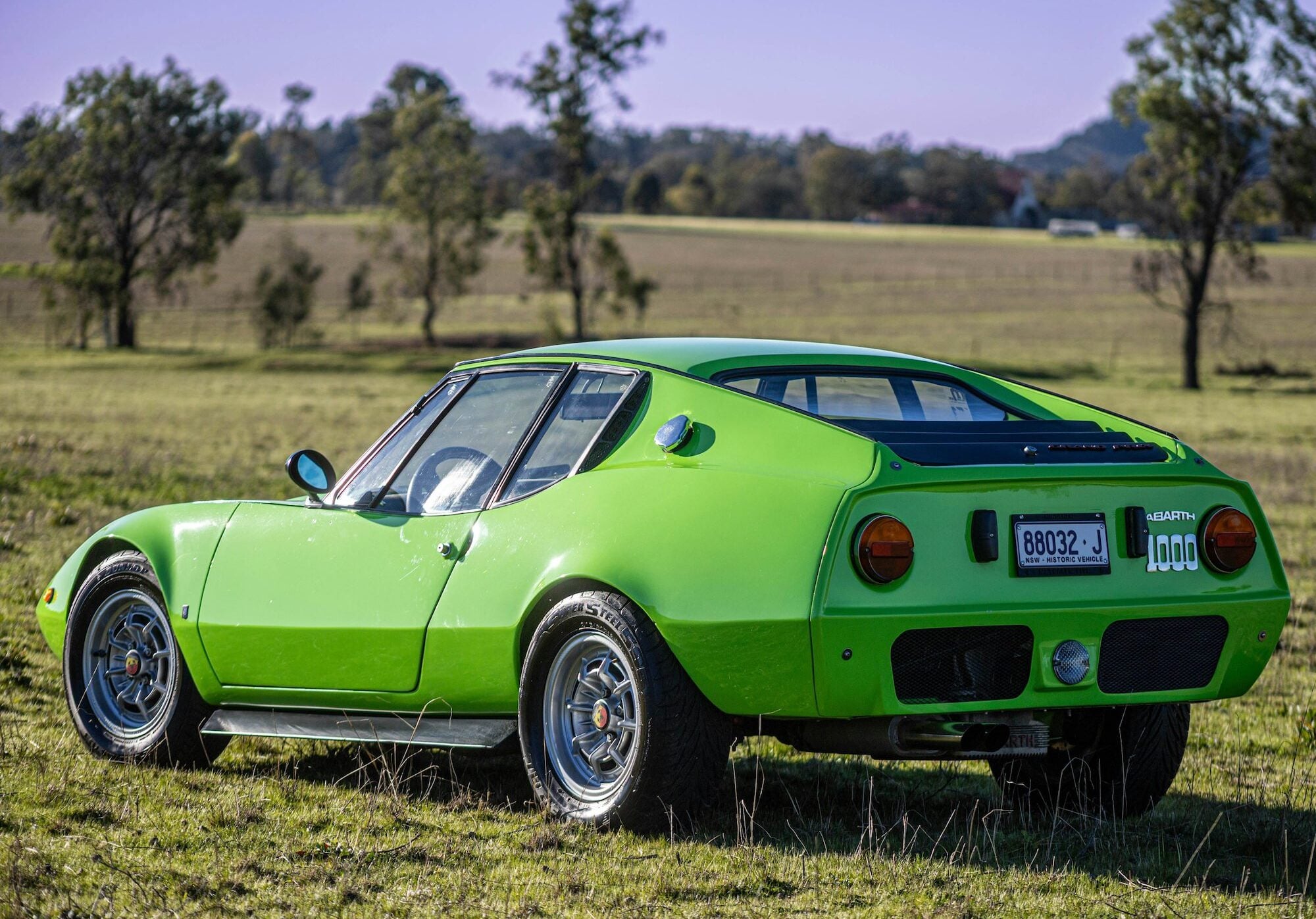
Fewer than a handful of enthusiasts will ever lay eyes on an Abarth OTAS Grand Prix 1000 in the metal. Built in tiny numbers and sold under at least four different badges, this rear-engined Italian coupe remains one of the more obscure chapters in Abarth’s tuning history — a chapter now represented by a restored 1971 example offered for sale from Australia.
The Grand Prix story begins with Carrozzeria Francis Lombardi of Vercelli, founded after the Second World War by a former fighter ace who had previously built light aircraft. Lombardi’s best-known creation, the Grand Prix, debuted internationally at the 1968 Geneva Motor Show with in-house styling by Giuseppe Rinaldi. Underneath, it was essentially a Fiat 850 Special wearing sharper clothes: an 843cc overhead-valve four mounted at the rear, a four-speed transaxle, upper A-arms and a transverse leaf spring up front, semi-trailing arms and coils at the back, disc brakes ahead and drums behind. Pop-up headlights were raised by electric motors, and the package weighed in around 630 kilograms.
The genius — and the confusion — lay in how the car was marketed. Lombardi, Giannini, Abarth and OTAS each offered their own interpretation, depending on who did the tuning and which market it was destined for. Giannini’s take used a stroked 982cc engine rated at 84 bhp. Abarth answered with the Scorpione, swapping in a 1.3-litre Fiat 124 four making 74 bhp and good for roughly 109 mph; the Scorpione S added four-wheel discs and revised suspension, while the SS pushed output to 100 bhp. OTAS, short for Officina Trasformazioni Automobili Sportive, was established in Turin by Franco Giannini to handle sales outside Italy. To keep displacement beneath the 50-cubic-inch threshold that exempted cars from US federal emissions rules, OTAS sleeved the block and shrank the bore from 65mm to 64mm, raising compression and adding a hotter cam, an Abarth exhaust manifold and a single-barrel carburettor for 52 bhp. Fiat cut off platform supply in 1971, ending production after an estimated 500 or so cars across all versions.
This particular car, a US-delivered 1971 model now residing in Australia, is said to have undergone a nut-and-bolt restoration. Its body was stripped to bare metal and refinished in green, while the cabin was retrimmed in dark grey and green Alcantara with fresh carpets. Motivation comes from a rebuilt 1,050cc inline-four derived from the Abarth A112, breathing through a Weber 40 DCOE carburettor and fitted with larger stainless valves, a re-profiled sport cam, A112 70HP ignition, a lighter flywheel, an uprated clutch, an Abarth OT sump, stainless extractors and an MSD Digital 6A ignition. A four-speed open-gate manual sends drive to the rear wheels, and the chassis benefits from Fiat 124 disc brakes. For collectors chasing genuine rarity rather than recognised badge value, it represents a compelling opportunity.
What do you think?