
BMW Nazca: The Mid-Engined V12 Supercar That Stayed a Concept
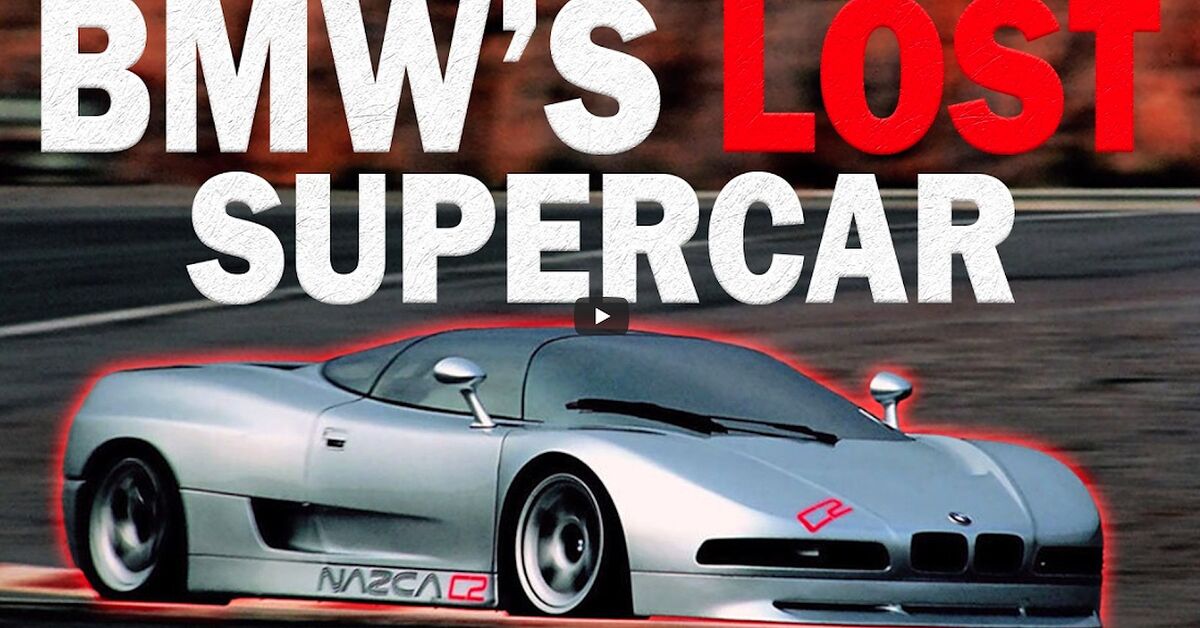
In 1991, Italdesign rolled a striking mid-engined machine onto the Tokyo Motor Show floor: the BMW Nazca M12. Penned by Fabrizio Giugiaro, son of the legendary Giorgetto Giugiaro, it drew on the studio’s earlier Bugatti ID90 study and pushed that idea toward a far more aggressive, motorsport-flavored direction, complete with a stretched silhouette, vast wraparound glass, and a nose low enough to suggest Group C endurance racers.
The engineering behind it was just as ambitious. BMW’s own wind tunnel helped the car achieve a drag coefficient of roughly 0.26 — a striking figure for a mid-engine concept of that era. Carbon fiber was used extensively across both the structure and the body, with the front clip and engine cover each formed as single molded pieces, holding weight to about 1,100 kg. Motivation came from BMW’s 5.0-liter V12, borrowed from the 850i and rated at around 295 horsepower. Modest on paper, but with so little mass to shift, the Nazca had potential the much heavier 8 Series could only dream of. One of its quirkiest details: doors whose lower halves opened conventionally while their glass sections swung upward, fighter-jet style.
A year later, Italdesign returned with the Nazca C2 — an evolution rather than a mere facelift. The nose was reworked and the headlights relocated beside the BMW kidney grille, giving the car a clearer family identity. Alpina then extracted roughly 345 horsepower from the 5.0-liter V12, lifting top speed to a claimed 193 mph while trimming about 100 kg. A final chapter arrived in 1993 with the Nazca C2 Spider, unveiled over the Monaco Formula 1 weekend: removable glass roof panels, a reinforced roll bar, revised bodywork, and the larger 5.6-liter V12 from the 850CSi, good for about 375 hp and paired with a six-speed manual.
So why did none of it reach showrooms? The answer lies largely with the M1. BMW’s first genuine supercar had been a tangled undertaking involving Lamborghini, delays, and shifting racing regulations, and it never delivered the commercial payoff the company wanted. With a healthy, profitable lineup of 3, 5, 7, and 8 Series models already in place, a low-volume carbon-fiber exotic looked like expense and risk without a clear business case. BMW let Italdesign keep developing the Nazca, but never gave it a green light. The result remains one of the marque’s great what-ifs: a lightweight, Italian-styled, German-engineered V12 supercar that could have lined up against the Ferrari 512 TR, Lamborghini Diablo, Bugatti EB110, and Jaguar XJ220.
What do you think?