
Plum Crazy Survivor: A 1971 Dodge Charger Emerges From the Barn
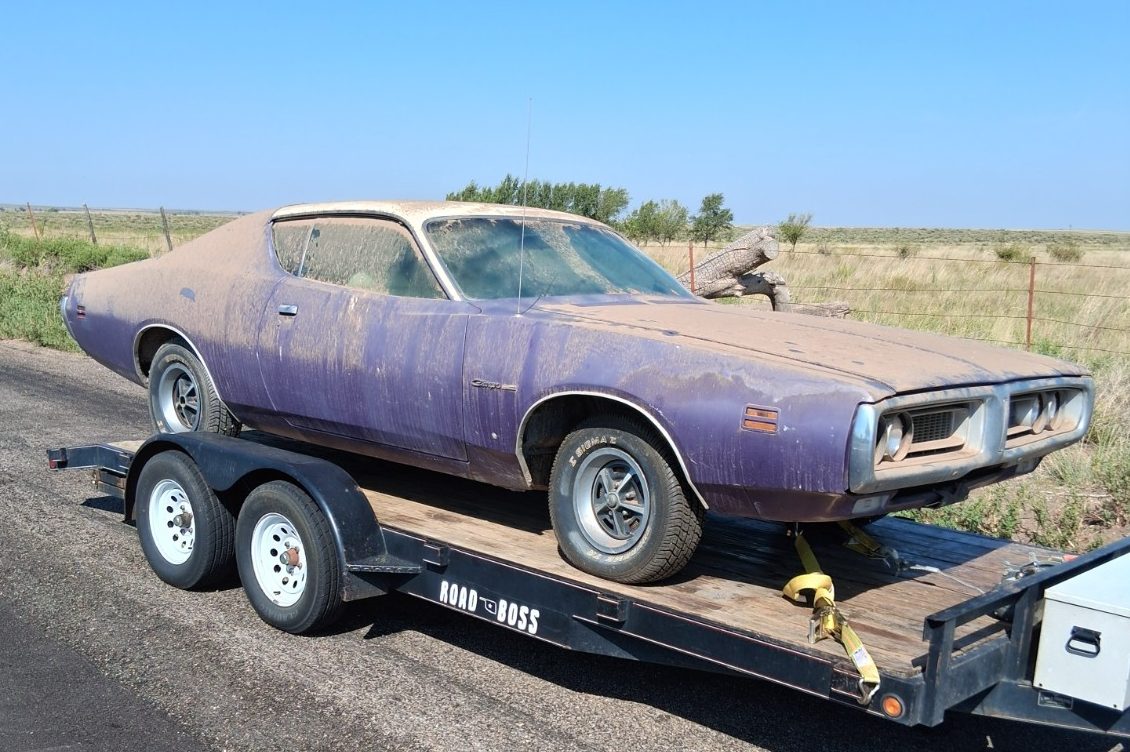
Every barn find carries an element of risk, but the person who pulled this 1971 Dodge Charger out of storage appears to have gotten lucky. Underneath years of caked-on dust sat a structurally sound, unmodified example wearing one of Chrysler’s most celebrated paint colors. According to the seller, the car now starts, runs and drives without drama, and it is currently offered through an eBay listing in Eakly, Oklahoma. Bidding has reached $23,700, a figure that has not yet met the reserve but which suggests strong collector appetite as the auction clock winds down.
Dodge rolled out the third-generation Charger for 1971, the first model to adopt Chrysler’s new “fuselage” design language. That styling gave the car a broad, confident stance, though it split opinions among buyers and the motoring press of the day. This particular example is finished in Plum Crazy, a high-impact shade that ranks among the company’s most sought-after colors. The original owner paired it with a white canopy-style vinyl roof, and the seller notes that only around 800 entry-level Chargers are believed to have been ordered in Plum Crazy — a claim a buyer would want to verify. The fender tag confirms the color is factory-correct, even though a previous owner resprayed the car back in the 1980s after UV damage set in. Four decades later the finish looks matte and carries scratches and chips, but the seller polished one spot on the driver’s-side front fender and found the paint responded well, hinting that a full buffing could bring the car back to a presentable state.
What makes this Charger especially appealing is its body condition. The car has spent its life across Oklahoma, California and Texas, and underside photos reveal only dry surface corrosion — no penetrating rust, past or present. The vinyl top is lifting along one edge, which will need attention before it becomes a moisture trap, and there is some minor trim damage, but the glass is intact and the Charger rides on its original wheels. Under the hood sits the two-barrel 383 V8, rated from the factory at 275 horsepower and 374 ft-lbs of torque, mated to a three-speed A-727 automatic. Power steering is included, while braking comes from unassisted four-wheel drums. Purists will be pleased to learn the car is numbers-matching.
The history adds character to the story. The original Californian owner drove the Charger regularly before parking it a few years prior to her death, leaving it to her niece. The niece sold it to a Texas owner, who rebuilt the engine around 2010, drove it home from the shop and then tucked it into a barn, where it remained until the current seller found it. A second revival followed, bringing the motor back to life. Some work remains: the seller notes it likely needs a front-end alignment, and there are minor fluid seeps from the power steering and transmission, though nothing appears seriously wrong.
Inside, the white trim matches the vinyl roof and has held up well, with a seam separation on the driver’s side as the worst defect and slight yellowing in a couple of areas — nearly unavoidable with this color. The headliner shows a few mouse holes near the rear window, and the cracked dash pad is probably the biggest cosmetic concern; a cover would hide it cheaply, while a replacement pad runs around $410. The air conditioning is complete but does not blow cold, the speedometer reads inaccurately and the AM radio is dead. Otherwise, everything functions. Whether to preserve the patina or pursue a full cosmetic restoration is the classic dilemma, and this Charger makes a strong case for simply polishing what is there and driving it.
What do you think?