
NYC E-Bike and Scooter Death Headlines Leave Out the Other Vehicle
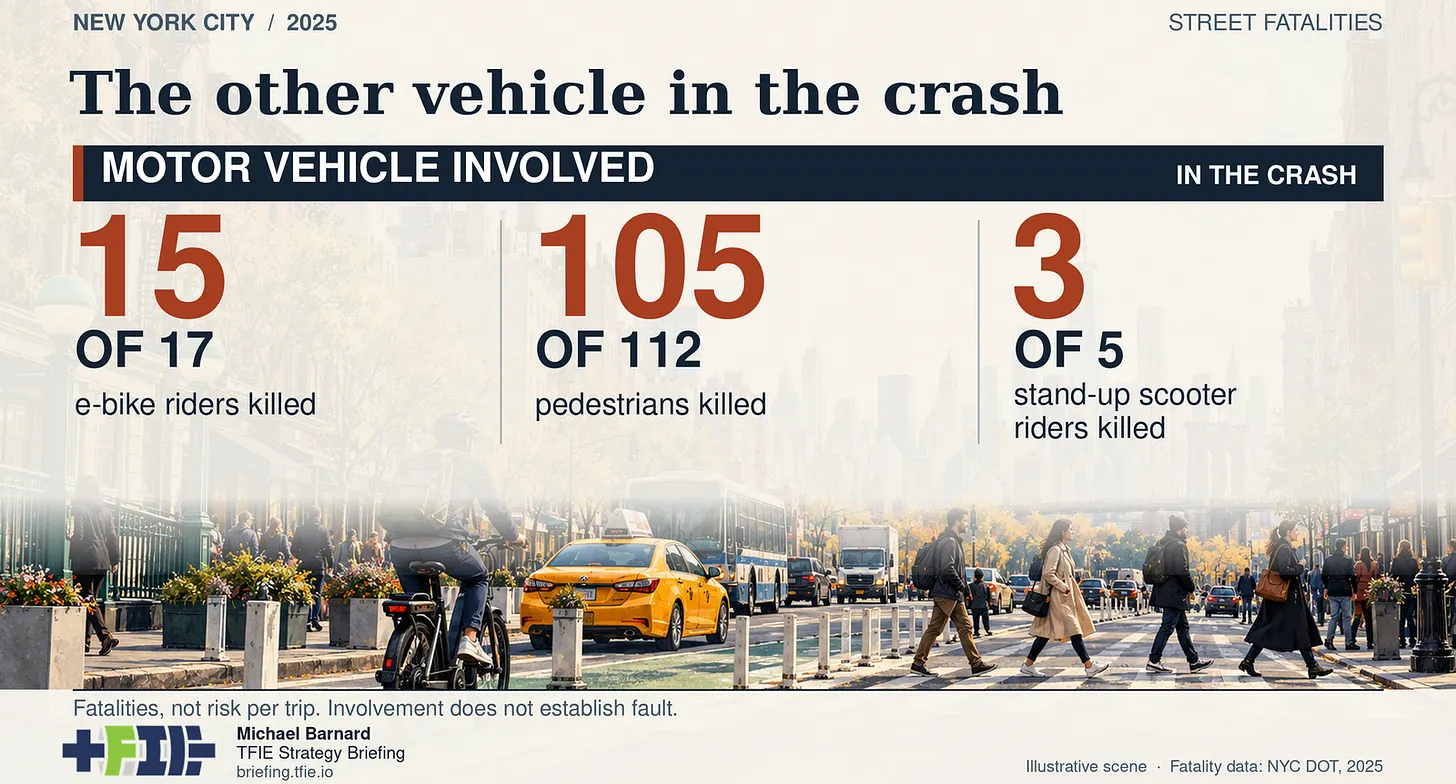
When the New York Times reported that e-bike and electric scooter deaths in New York City had hit a record high, the word “record” did a lot of work. It pulled attention toward the small two-wheeled machines people were riding — and quietly away from the four-wheeled vehicles that were also in the frame. According to the most recent full-year NYC DOT crash figures, 17 riders died on e-bikes in 2025, and 15 of those deaths happened in collisions that involved a motor vehicle. Five stand-up scooter riders were killed, three of them in crashes with a car or truck. Among pedestrians, 112 people died in 2025, and 105 of those deaths involved a motor vehicle. None of this settles who was at fault in any single case. What it does settle is that framing these tragedies as an “e-bike problem” or a “scooter problem” paints a misleading picture of where danger on city streets actually comes from.
A record, after all, is a fragile thing when the underlying numbers are small. If stand-up scooter fatalities move from five to six in a year, that is technically a 20% jump — but the real change is one human being. That does not make the death any less serious; it makes the denominator matter. Electric Citi Bike logged more than 29 million trips in 2024 alone, and that is before privately owned e-bikes and scooters enter the math. A rising fatality total can simply reflect far more people riding, without proving that any individual trip has grown more dangerous.
There is a real safety issue buried in the data, though. In an August 2026 enforcement announcement, New York said that of the 45 e-bike rider deaths recorded from 2017 through 2025 — 54% of the total — the device involved was capable of exceeding 25 mph. For stand-up scooters, 14 deaths, or 52%, involved machines capable of going over 20 mph. Capability alone does not reveal impact speed or assign blame, but it is more than enough to justify going after sellers of illegal high-speed equipment and reckless operators. Taking that seriously does not require treating every lawful e-bike as a souped-up menace.
Then there is what these rides replace. In the East Bronx scooter pilot, participants said some trips would otherwise have been taken by car, car-share or ride-hail. A wider travel-diary study across 48 cities estimated median reductions of roughly 0.15 car miles per shared-scooter trip and 0.25 car miles per bike-share trip, e-bikes included. Not every electric trip displaces a drive — some replace walking or transit — but a meaningful share clearly does. Substitution like that has consequences that seldom sit next to a fatality headline: no tailpipe emissions along the route, far less energy consumed. New York puts motor vehicles at roughly 28% of local nitrogen oxide emissions and 11% of fine particulate emissions, and the city health department ties about 320 premature deaths a year to traffic-related fine particles.
Noise, road space and urban freight tell a similar story. An e-bike idles silently and has no exhaust note; removing a gasoline vehicle removes an engine noise source. Delivery workers treat e-bikes as tools of the trade, and New York’s microhub pilot cut more than 3,000 truck trips in its first year by shifting goods onto handcarts, cargo bikes and small electric vehicles. A comptroller analysis covering 2020 through 2023 found motor vehicles in 434 of 449 pedestrian deaths, with e-bikes and stand-up scooters in six. Cities can and should regulate illegal high-speed machines, investigate every fatal crash and improve infrastructure. But the safety accounting should also name what struck whom, separate rider deaths from pedestrian deaths, and weigh annual fatalities against the scale of travel.
What do you think?