
Nose Down: A 1960 Lincoln Continental With Slanted Eyes and a Rebuilt 430 V8
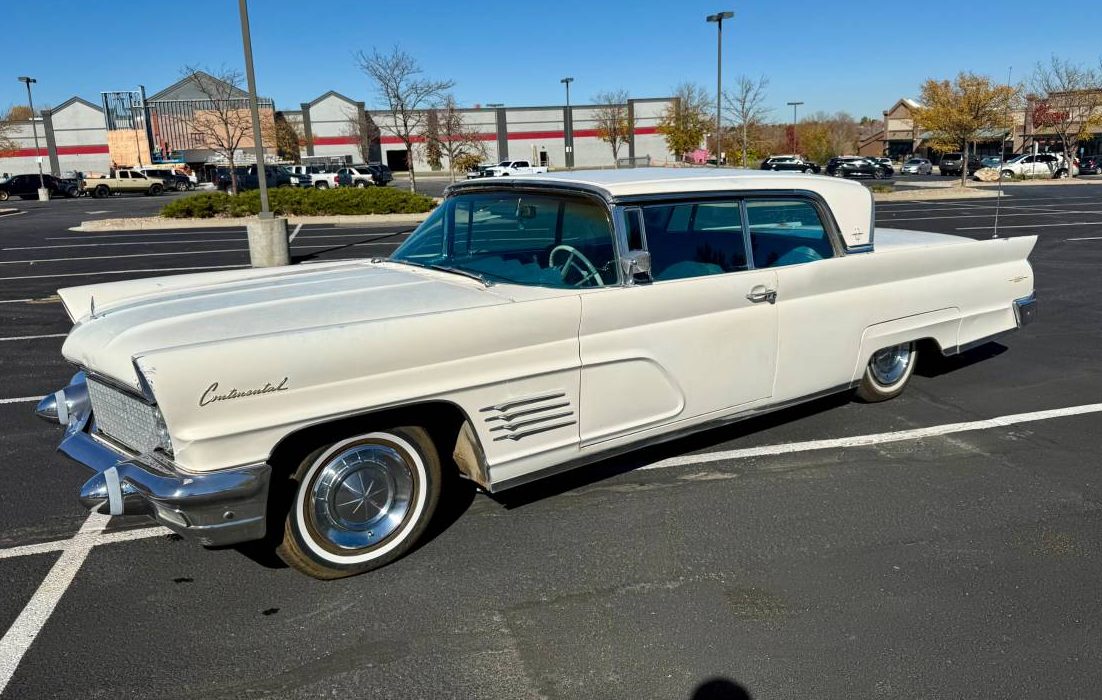
Few American cars from the tail-fin era provoke a reaction quite like the 1958–1960 Lincoln Continental. Inside Ford’s design studios, the car earned the less-than-flattering nickname “Slant-Eyed Monster,” a jab at its canted headlights and the bug-like face they created. History has been kinder to the Cadillac Eldorado and the Imperial LeBaron of the same period, yet the third-generation Continental remains one of the boldest stylistic statements Detroit ever committed to metal.
This particular example is a third-year coupe out of Lafayette, Colorado, listed for sale at $13,000. Power comes from Lincoln’s 430-cubic-inch “MEL” V8, which has reportedly been rebuilt and runs a four-barrel carburetor. The seller notes that additional recent work has been performed but doesn’t spell out exactly what it covered, so a buyer would be wise to ask before committing. The odometer shows 72,000 miles, and in an era when engines rarely saw six figures, that figure goes a long way toward explaining why the V8 needed attention in the first place.
The car is said to have spent its early life in California, which likely accounts for its relatively solid condition after more than six decades. The body is described as good, the paint as merely okay — possibly original — and the interior as usable, though the wide front bench is currently hidden under a blanket, hinting at upholstery work still to come. The seller is open to negotiation on price but has no interest in trades.
Dimensionally, this Lincoln was in a class of its own. Its 131-inch wheelbase was the longest Ford Motor Company had ever produced, stretching to 227 inches overall. The reverse-slant roofline allowed for the retractable “Breezeway” rear window, a feature Mercury would later borrow during the 1960s. Production of the Continental hovered between 11,000 and 12,000 units annually across its three-year run, with coupes like this one averaging roughly 1,500 examples per year — a reminder that these cars were never common, even when new.
For collectors drawn to the excess and eccentricity of late-1950s American luxury, this Continental sits in an intriguing middle ground: a driver-quality car that could be enjoyed as-is, though a full restoration would be a costly undertaking given the car’s size and complexity. It is a surviving piece of a moment when Lincoln, Cadillac, and Imperial all competed to see who could build the most audacious machine — and this one makes a persuasive case that Lincoln won.
What do you think?