
A Grandson's Tribute: The 1972 Volvo 144 That Was Restored to Remember, Not to Win Trophies
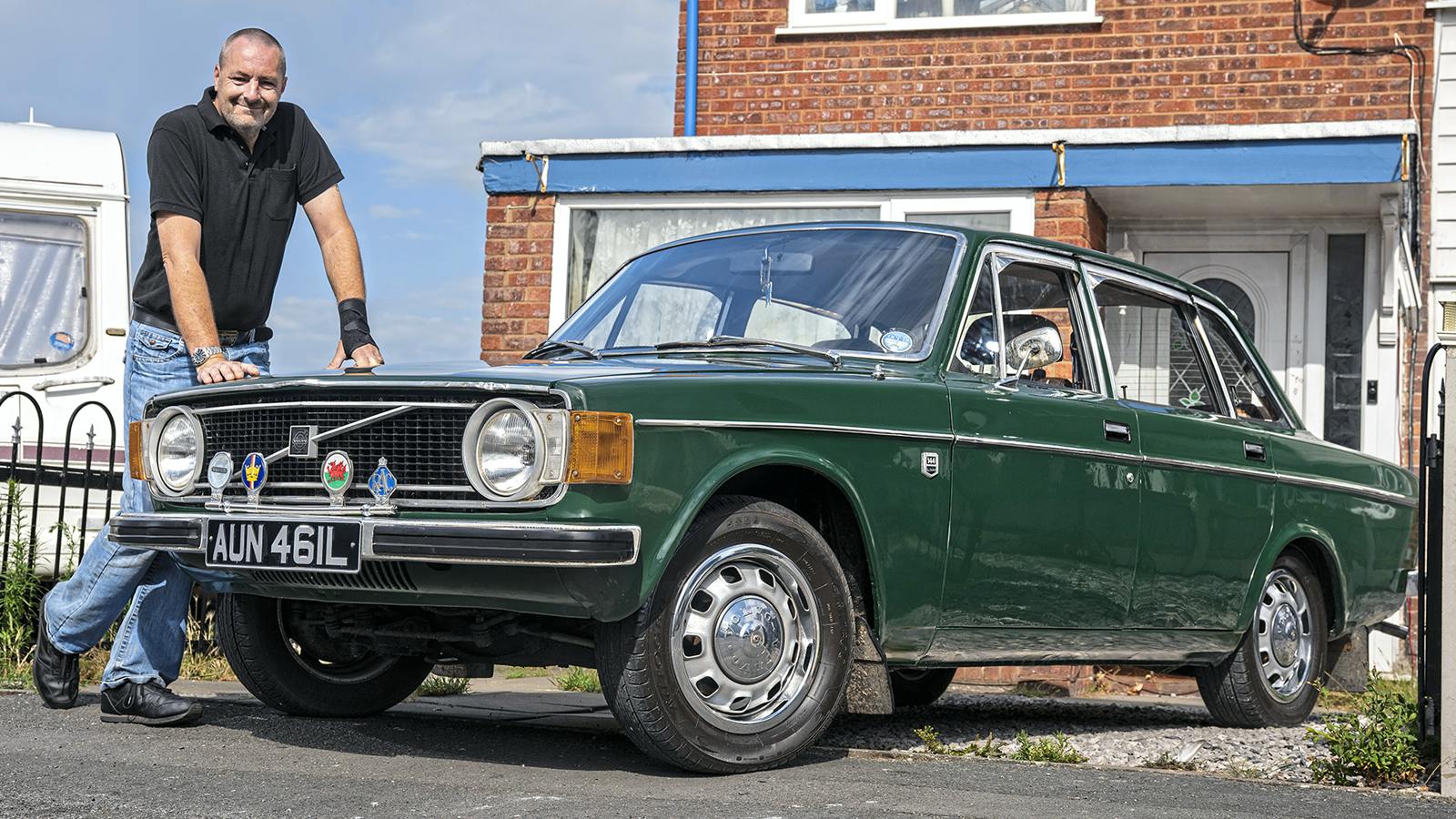
When most enthusiasts talk about a “restoration”, they mean a car taken apart, stripped of its history and rebuilt into something better than new. Chris Horton had a different idea. His 1972 Volvo 144 — a pre-facelift car bought new from Pensarn Motor Company by his grandparents Eric and Vera — was never meant to end up looking like a museum piece. It was meant to still feel like the car he grew up around.
The story begins in North Wales. Eric, a Merchant Navy man, barely used the Volvo at first: he was away at sea between 1972 and 1974 and passed away in 1979, leaving the car to Vera. She drove it until the late Nineties, when she handed the keys to her grandson. He ran it as a daily for about a year until a leaking radiator and a failed water pump sent it into retirement — first in his garden in Prestatyn, and then across three further house moves, always on a trailer. In total, the Volvo spent roughly 25 years off the road. It has, by Chris’s own reckoning, left Wales only about four times in its life.
What makes this rebuild unusual is what Chris chose not to erase. A creased chrome strip on the bonnet carries two distinct dents: one from Vera misjudging the tight garage and its workbench, the other from the bench itself. A small ding in the passenger door dates back to a windy day on Rhyl Promenade, when a ten-year-old Chris opened it into the wing and earned himself a telling-off. There is a Beetle-related crease behind the rear bumper and a shallow indent from a car park knock. All of it was deliberately left alone. “Nobody else is ever going to own it while I’m alive,” he reasons, “so I don’t care that it’ll never be perfect.”
The car also functions as an accidental time capsule. Inside, Chris found — and kept — a half-empty packet of Players No.6 cigarettes in the glovebox, his grandmother’s spectacles in the door pocket, and the Merchant Navy crest still mounted on the badge bar. He even has cinefilm in the loft of himself learning to walk with the Volvo parked in the background.
The mechanical side was a far bigger undertaking. Work finally began in October 2022, prompted partly by an inheritance from his paternal grandfather, and it was carried out mostly in a small lock-up at Chris’s workplace plus his home driveway. As a working mechanic who grew up in the 1980s, welding was second nature to him, which was just as well: inner and outer sills, rear arches, lower quarter panels, the spare wheel well, scuttle panel, bulkhead top and boot lid all needed attention on a car that had weeds growing through the front scuttle. A donor 144 found on Anglesey, which had been sitting in a hedge for a decade, supplied the lower side panel and numerous body cuts, while Brookhouse Volvo Parts provided new-old-stock items including a bonnet. Some of that original bonnet metal was even seam-welded back into the floorpans, so parts of the car are, in a roundabout way, still the ones it left the factory with.
The project was not without a sour note: boxes of parts stored in the car, including the original purchase receipt, were stolen at the outset. That only hardened Chris’s resolve. The result is a Volvo that is structurally sound and fully usable — he drives it regularly, and it now benefits from a 240-spec cooling setup — yet never pretending to be concours. It is, in the truest sense, a family car that stayed in the family.
What do you think?