
Moya Aero's Cargo Drone Nails Full Transition Flight in Brazil
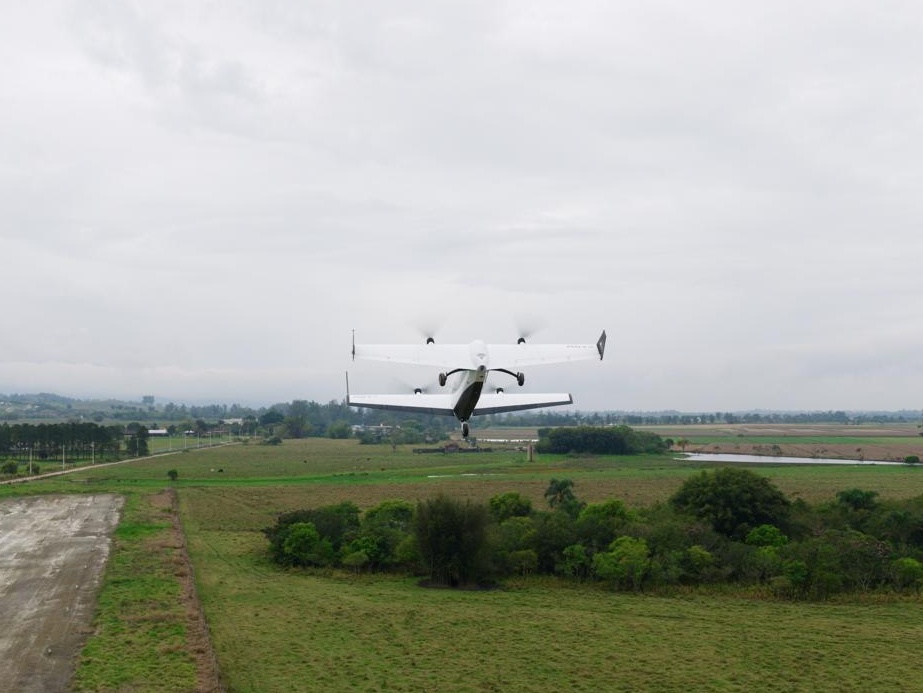
Brazilian planemaker Moya Aero has pulled off a complete transition flight with its Moya 256, an autonomous electric cargo aircraft that lifts off straight up, shifts to wing-borne cruise, then settles back into a vertical landing.
The milestone matters because it proves the same propulsion hardware can handle both phases of flight on a full-scale airframe. Moya says the test validated its propulsion, aerodynamics and flight-control software across take-off, forward cruise and descent.
Nearly 200 Flights Logged
The company has been methodical about its test campaign. The Moya 256 alone has now racked up close to 200 flights, while the broader programme — including subscale and special-purpose aircraft — sits near 500.
Flight-Test Tally: ~200 flights with the Moya 256 · ~500 across the wider Moya programme
Alexandre Zaramella, Moya Aero’s chief executive, points out that engineers working on this class of aircraft are short on reference material. “Few studies exist for this type of aircraft,” he said, adding that the company sees itself among the first anywhere to fly a design like this at full scale.
The architecture is deliberately simple: one propulsion system serves vertical lift and horizontal cruise. Wings take over once the aircraft is airborne, which lets it fly efficiently without sacrificing payload. Moya says the drone can work from tight spaces — a football pitch is the benchmark it cites.
Where the Cargo Missions Fit
Moya is aiming the aircraft at medical and humanitarian drops, industrial logistics, e-commerce fulfilment and agriculture. The common thread is getting goods into places where a conventional runway isn’t an option, and doing it without a pilot aboard.
There’s a bigger sibling in the works, too. The Moya 760 is designed for heavier loads, and a production-conforming prototype has already entered build. Across its portfolio, Moya says it holds 119 letters of intent from prospective operators.
- Shared architecture: battery modules and flight software carry over between the 256 and 760
- Fleet logic: operators can scale up without learning an entirely separate aircraft system
- Funding: Brazil’s innovation agency FINEP backs the development work
Beyond the airframes, Moya is building an AI-driven ground control system for beyond-visual-line-of-sight operations — the piece that would let cargo drones fly routine routes without a human watching the feed.
For now, the transition flight is a technical checkpoint rather than a commercial launch. But in a sector where plenty of cargo drone concepts stall at hover tests, flying the full envelope on one powerplant is a real data point.
Source: Mikro-mobilite Sektörü (Zag Daily)
What do you think?