
Archer Maps Out Electric Air Taxi Corridors Across the Texas Triangle
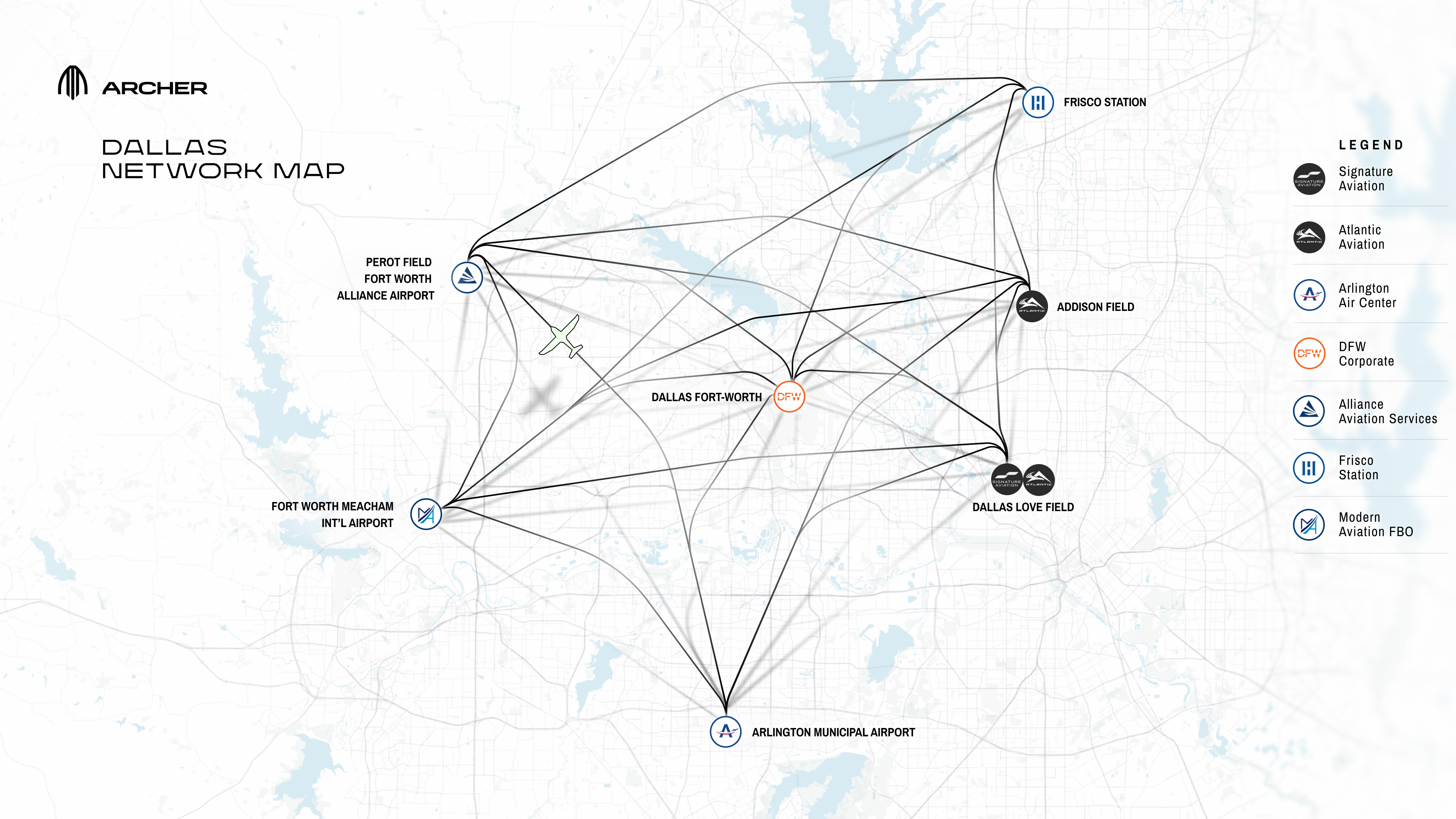
Archer Aviation wants to put its Midnight aircraft to work over the Lone Star State. The company has laid out a proposed web of electric air taxi routes spanning Austin, Dallas–Fort Worth and Houston, tying airports to downtown districts, sports complexes and the Gulf coast.
Nothing is flying commercially yet. These are blueprints, drawn up as Archer positions itself for possible Texas operations under the US government’s Electric Vertical Takeoff and Landing Integration Pilot Program, known as eIPP.
What Each City Would Get
The three networks are built around existing aviation gateways, with short hops replacing long highway slogs.
- Dallas–Fort Worth: Hubs at DFW, Love Field, Addison, Arlington Municipal, Fort Worth Meacham and Fort Worth Alliance, with a stop planned at The Star in Frisco — the Dallas Cowboys’ headquarters and practice site.
- Houston: Links between George Bush Intercontinental, William P. Hobby and Sugar Land Regional, plus a helipad at the downtown Thompson Hotel and a coastal point in Galveston.
- Austin: Austin-Bergstrom and Austin Executive connected to the helipad at Circuit of The Americas, home of the Formula 1 United States Grand Prix.
Archer reckons trips that chew up 60 to 90 minutes behind the wheel could shrink to roughly 10–20 minutes in the air. That math is central to the pitch — and also the part that depends entirely on certification, landing rights and public acceptance.
The Pitch in Short: Road journeys of 60–90 minutes → flights of about 10–20 minutes, using Archer’s all-electric Midnight aircraft.
A Texas Showcase, Then Los Angeles
The Texas plans land right as Archer is putting its Midnight on display at the Formula 1 United States Grand Prix in Austin, running 22–25 October 2026. The company has also been flying demonstration sorties over San Francisco Bay, and it aims to bring similar showcases to Los Angeles before the 2028 Olympic and Paralympic Games.
Charging Is the Quiet Hurdle
Aircraft are only half the equation. Archer teamed up with BETA Technologies and Macquarie Capital to form the America’s Consortium for Electric Skyways (ACES), which is chasing interoperable charging at as many as 250 aviation sites nationwide by 2030. The group is already talking to the Texas Department of Transportation and other partners about where plugs could go in the state.
That infrastructure work may matter more than any route map. An air taxi network is only as useful as the pads it can reach — and those pads have to charge aircraft from more than one manufacturer to make economic sense.
Source: eVTOL Insights
What do you think?