
Mazda's CX-6e EV Can Broadcast Custom Messages To Pedestrians — With No Filter
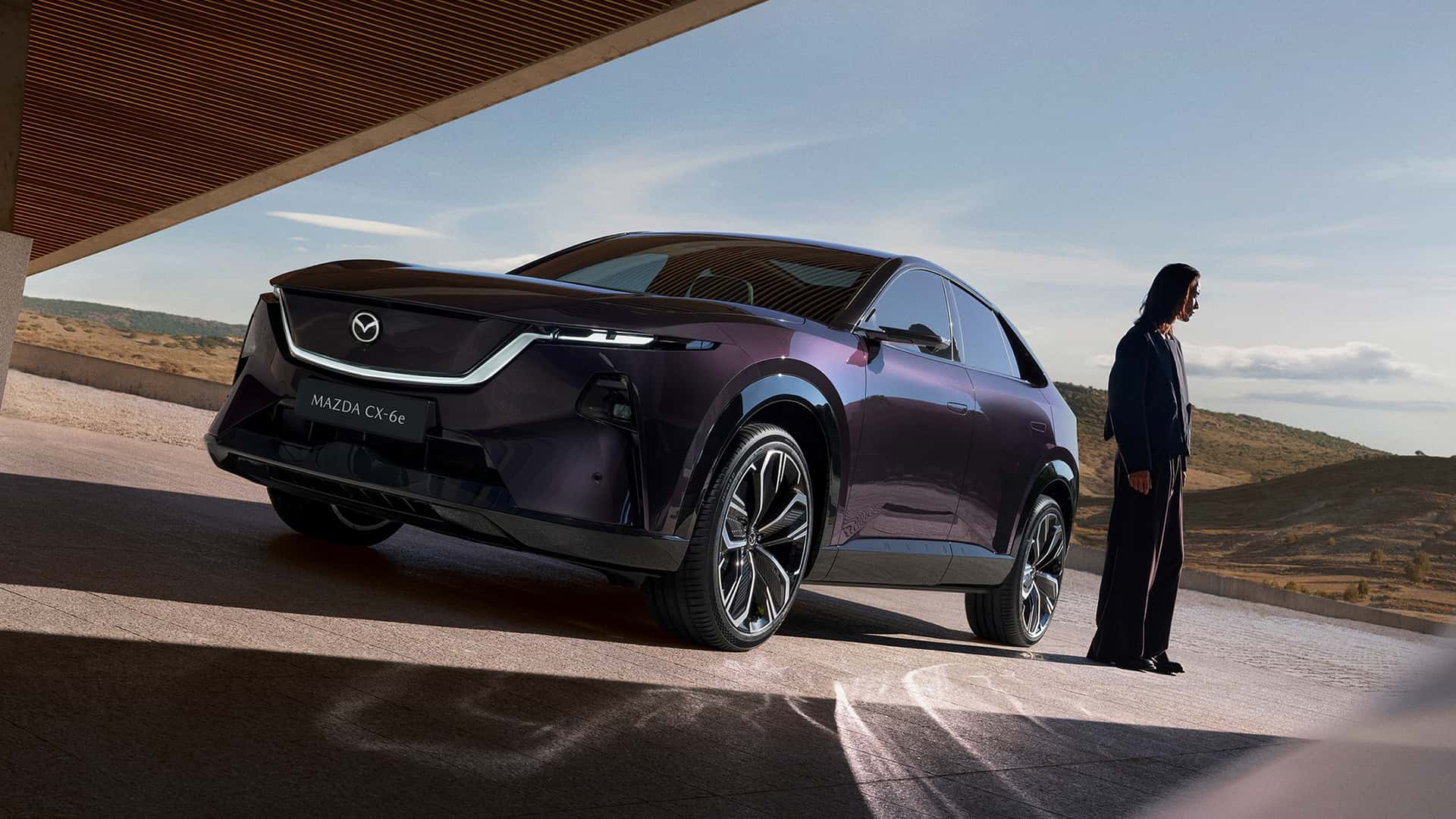
Mazda’s first serious global electric crossover arrives with a feature that has nothing to do with range or charging speed: an external loudspeaker that lets the driver speak directly to the world outside the car. The CX-6e, now launching in Australia and various European markets, carries over the “External Announcement” system already seen on the related Deepal S07 sold in China. Drivers pick from pre-recorded phrases — polite prompts like “Hey, I’m here” or reminders for cyclists to stay focused — or type their own wording on the car’s enormous 26.45-inch central screen. The problem, as Australian motoring journalists quickly discovered, is that Mazda apparently never built a profanity filter. Whatever the driver types gets played, out loud, to anyone within earshot.
The feature clearly started from a safety-minded place. Giving an EV a voice helps compensate for how quiet electric drivetrains are, particularly in parking lots and dense urban traffic where cyclists and pedestrians may not hear a vehicle approaching behind them. Tesla tried something similar with its Boombox function before regulators in the United States pushed back, and that episode is a reminder that pedestrian-facing audio sits in a regulatory gray zone. Mazda’s version goes a step further than Tesla’s by accepting arbitrary typed text rather than a fixed set of sounds.
Beyond the novelty, the CX-6e is a meaningful model for Mazda. Roughly the size of a Tesla Model Y, it runs a single powertrain: a 255-horsepower (190 kW) rear-mounted motor drawing from a 78-kilowatt-hour lithium iron phosphate battery. Mazda quotes up to 300 miles (484 kilometers) of WLTP range and DC fast charging at up to 200 kW. The hardware shares its foundations with the Deepal S07, the result of Mazda’s engineering collaboration with Chinese partner Changan — a relationship that has become central to the brand’s electrification plans outside the US.
That is a sharp contrast with Mazda’s previous American EV attempt. The MX-30 crossover offered only around 100 miles of range, sold in California only, and was dropped after roughly 600 units found homes. The CX-6e is a far more conventional proposition aimed straight at the heart of the electric crossover segment, and its availability in Australia and Europe rather than the US reflects where Mazda believes it can compete today.
For now, the unfiltered messaging remains live until Mazda ships a software update, which seems inevitable. It is easy to imagine the feature becoming a running joke among owners — a loud hello in a supermarket car park — but also a genuine headache for a brand trying to be taken seriously as a premium-adjacent EV maker. Whether Mazda keeps the custom-text capability, restricts it to canned phrases, or disables it in some regions will say a lot about how the company balances personality against liability.
What do you think?