
Kermit Green Project: A 1972 Mercedes-Benz 250 Looking for a New Home
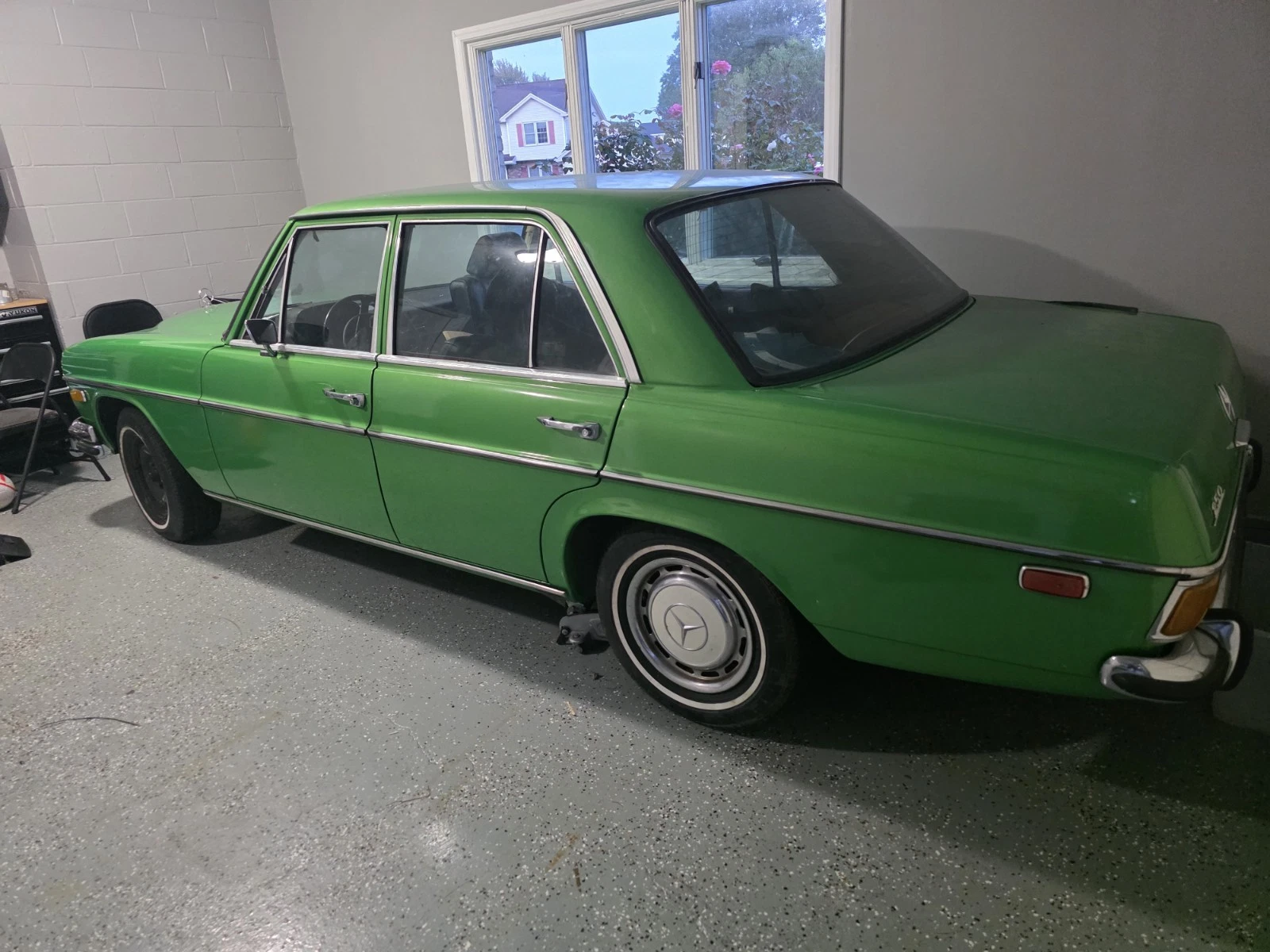
Few nameplates in the luxury segment command the same long-running respect as the Mercedes-Benz E-Class, a car that has spent decades setting the standard for comfortable, dependable executive transport. The model’s ancestry runs deep, and one of its most important forebears was the W114/W115 family, sold through the late 1960s and into the 1970s. A 1972 example of that lineage, a 250 sedan, has now surfaced for sale as a project, and it comes with a color choice that is hard to miss.
The car wears a vivid, almost amphibian shade of green rather than anything Mercedes-Benz ever offered from the factory. That is worth noting, because the company did market a green finish during this era, but it was a much deeper, muted tone closer to forest undergrowth than to this bright, lively hue. Purists may object, yet the seller clearly likes it enough to keep the car garaged rather than parked outside. The cheerful paint sits alongside black upholstery, and the color carries through into the door jambs, which at least suggests whoever sprayed it did not cut corners.
Mechanically, the 250 is a non-runner at the moment. Buyers are not left empty-handed, however: the sale includes a spare engine and transmission as well as a second car that can serve as a parts donor. Power in these sedans generally came from inline-six gasoline engines, with diesel variants appearing occasionally in the range. Output for the six was modest by modern standards, in the neighborhood of 130 brake horsepower and 147 lb-ft of torque, so nobody should expect electrifying acceleration. This is a relaxed cruiser, and once sorted it should be an easy car to live with day to day.
The asking price sits at $9,500 or best offer, a figure that looks optimistic when the condition of both vehicles and the work still ahead are taken into account. Enthusiasts would likely want a meaningful reduction before committing to haul home a green project car plus a parts carcass. Cosmetic details matter too: the chrome bumpers already help the profile, and swapping in European-market headlight lenses would sharpen the front end considerably. With a proper refurbishment and a set of period-correct wheels, the package could turn into something genuinely striking rather than merely eccentric.
Beyond this individual car, the W114/W115 generation occupies an interesting place in the market. It is the direct predecessor to what became the E-Class, and it was built primarily as a sedan, though a pillarless coupe version was also produced. Values for either body style remain accessible today, which makes the platform appealing to hobbyists who want classic German engineering without a six-figure entry fee. That affordability is precisely why a green project like this one can make sense for the right buyer, provided the price reflects the paintwork and mechanical sorting still required.
What do you think?