
Junkyard Survivor: 1974 Ford Courier Hiding a Cologne V6 Swap
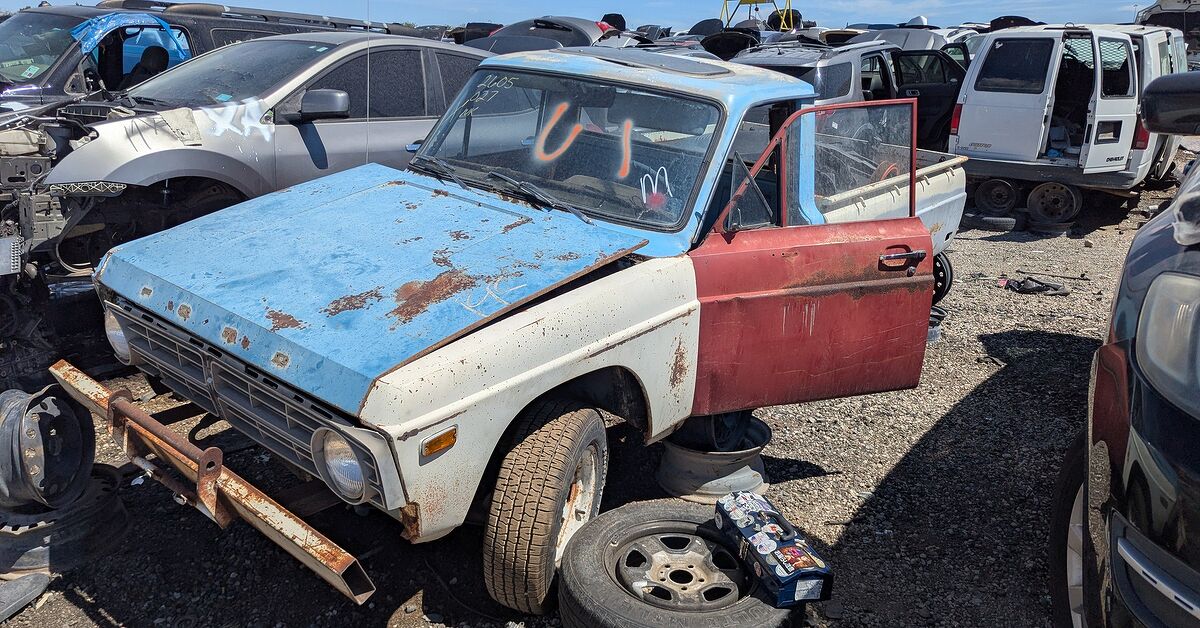
Few of America’s 1970s mini-trucks combined durability with genuine muscle, and Ford’s Courier sat squarely in that awkward middle ground. Built as a rebadged Mazda Proceed (the B-Series to most buyers), the Courier served U.S. showrooms from 1972 through 1982 before the homegrown Ranger nudged it aside. Ford borrowed the name from its 1950s sedan deliveries, but the hardware underneath was pure Mazda.
That dependency explains the power problem. Buyers could only choose between Mazda’s single-overhead-cam 1.8-liter four and, later, Ford’s 2.3-liter “Pinto” four. For 1974 the lone option was the 1.8, rated at just 74 horsepower — modest even by the low standards of the early Malaise Era, and tasked with moving a 2,515-pound curb weight. By comparison, the lightest new pickup sold in America today tips the scales more than a half-ton heavier than this Courier did.
A Colorado wrecking yard recently produced a fascinating answer to that sluggishness: a Courier whose owner had stuffed a Ford Cologne V6 under the hood. The swap makes perfect period sense. A straight-six would have stretched too far without firewall surgery, and a 90-degree V8 or V6 would have been too wide to plumb affordably. Ford’s Cologne unit, by contrast, is a narrow 60-degree design with compact overhead-valve heads — so compact that Ford itself dropped it into the Pinto.
Ford’s corporate parts bin made the upgrade easy and cheap. Mercury dealers began offering the 2.6-liter Cologne in the Capri for 1972, stepping up to 2.8 liters by 1974, the same year the Mustang II adopted it; Pinto and Bobcat buyers could order the 2.8 starting in 1975. That flood of donor engines meant wrecking yards were full of them, usually bolted to four-speed manuals, though five-speed manuals and three-speed automatics existed too. The swap in this truck feeds a four-speed, and output likely lands somewhere between 90 and 105 horsepower depending on the donor’s state of tune.
Other period touches survive as well: a rope-wrapped steering wheel, one of those aftermarket sunroofs that were all the rage in the 1970s and 1980s even though virtually every one of them leaked, and the absence of factory air conditioning — a rare option on the ‘74 Courier that apparently didn’t tempt this owner. The grime caked around the fusebox tells its own story of decades parked outdoors through Colorado winters, a slow decline that eventually delivered the truck to the crusher’s waiting grasp. What remains is a snapshot of how enthusiasts once solved the Malaise Era’s power deficit with nothing more than junkyard ingenuity.
What do you think?