
How PXI-Based Fault Insertion and Sensor Simulation Are Reshaping ECU Testing
Modern vehicles rely on Electronic Control Units (ECUs) to manage everything from anti-lock braking to battery management, and in electric vehicles these controllers oversee systems where a single undetected fault could put occupants at risk. For test engineers, that means proving an ECU behaves predictably under every conceivable good and bad condition — ideally without waiting for a physical prototype or exposing costly hardware to damage. Hardware-in-the-Loop Simulation (HILS) has become the standard answer, letting teams validate controller behavior against a simulated operating environment long before a vehicle reaches the road.
The mechanics of HILS are fairly intuitive. Real signals from the controller are wired into a test platform that emulates the final system. Stimulus instrumentation stands in for the ECU’s real-world sensors using electronic simulators, while measurement instrumentation captures and checks the controller’s outputs. The aim is dual: verify the ECU works correctly under known-good conditions, and confirm it still protects the vehicle when something fails. A wheel-speed sensor that drops out mid-braking is a classic example — the ECU must still bring the car to a safe stop. HILS makes it possible to recreate that failure and countless other fault combinations without staging the physical scenario, saving cost, time and risk.
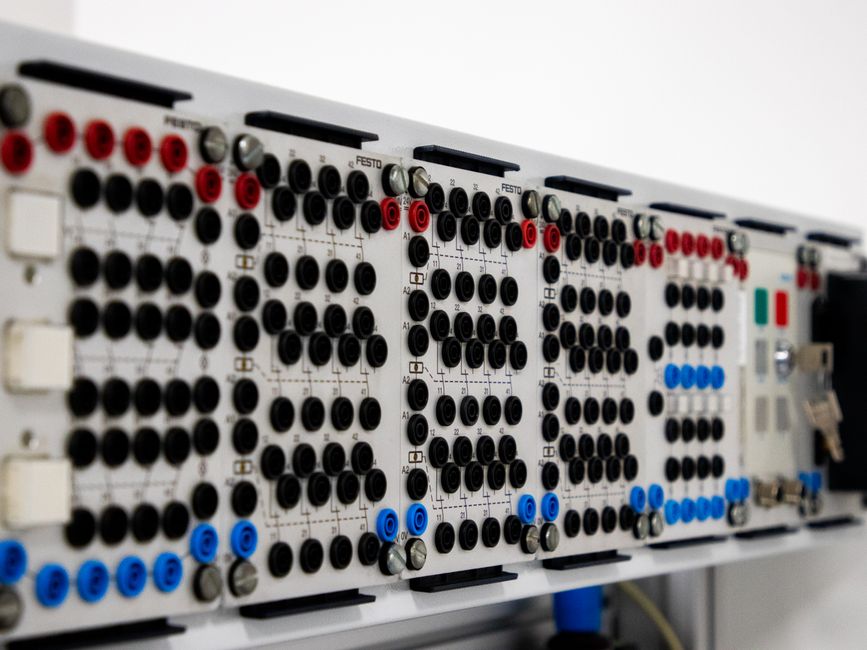
Historically, engineers injected these faults through manual patch panels, disconnecting lines to simulate opens or tying them together to mimic shorts to ground, voltage or adjacent I/O. The approach has well-known drawbacks: patch panels eat bench space, manual switching is too slow for high-volume work, human intervention undermines repeatability and traceable reporting, and maintenance and labor costs climb steadily. Automating fault insertion through PXI changes the economics. Switching modules sit between the simulator and the device under test, either passing signals through or applying faults on command — open circuits, pin-to-pin shorts, shorts to ground or power, and resistive faults. Because PXI is rugged, modular and scalable, with chassis-level triggering that supports deterministic real-time behavior, teams can assemble best-in-class modules rather than locking into a proprietary single-application HILS system.
Sensor simulation rounds out the picture. PXI modules cover the common transducer types found in automotive and EV designs: millivolt simulators for thermocouples across 8 to 32 channels, single-slot LVDT/RVDT/resolver simulators handling up to four 5/6-wire channels, analog output modules emulating 4–20 mA current loops, cell simulators for battery management systems accurate to ±5 mV from 1 V to 7 V with a 750 V isolation barrier, and programmable resistors with better than 0.1% accuracy. Scaling from prototype to production is supported by BRIC-format fault insertion matrix modules that expand in multiples of 20 or 31 channels, all driven by a consistent software interface so test code doesn’t need rewriting as systems grow.
What do you think?