
Hillcrest's ZVS Inverter Slashes Motor Voltage Overshoot by Over 90%, Peer Review Confirms
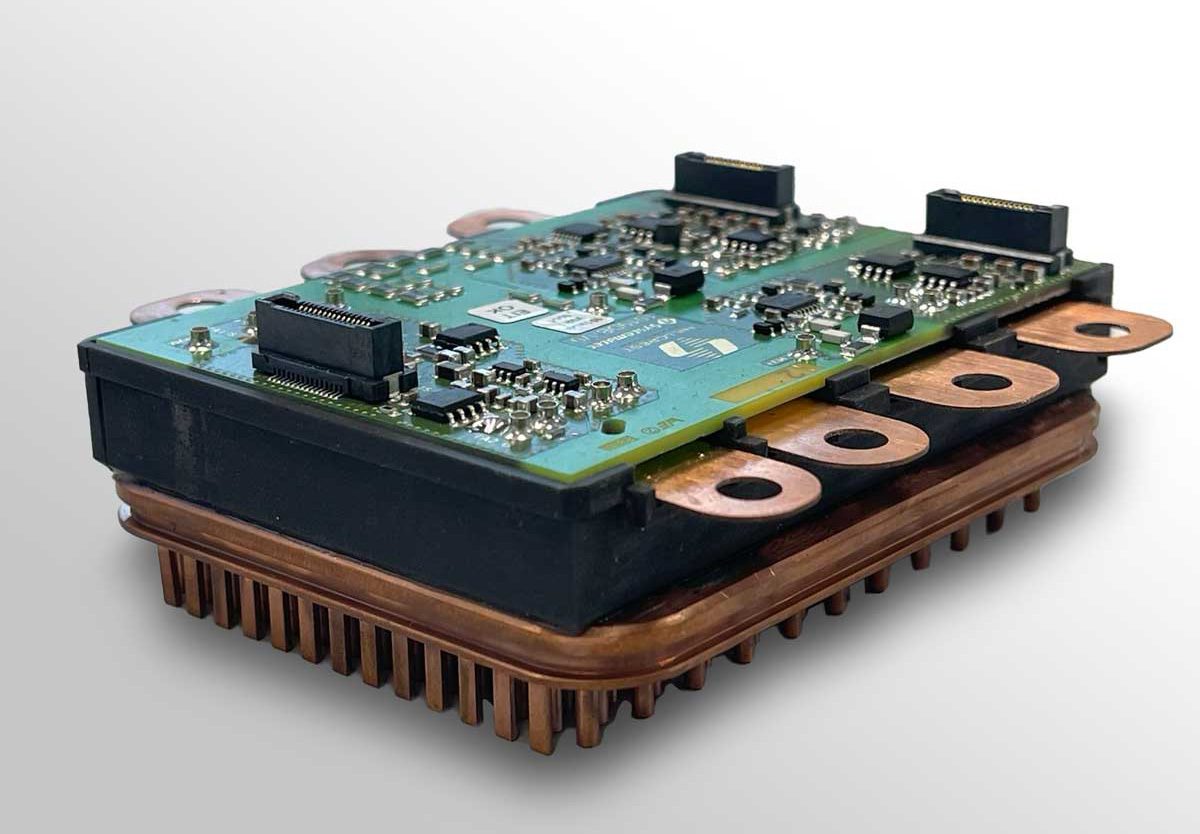
Hillcrest Energy Technologies has published peer-reviewed figures showing that its zero-voltage-switching inverter reins in motor-terminal overvoltage far more effectively than a conventional hard-switched silicon carbide unit. In matched tests, the ZVS design held overshoot to just 4% above the DC-link voltage, versus roughly 50% for the SiC benchmark — a reduction of more than 90%.
How the test was set up
The comparison ran an 80 kW motor through a 2-meter shielded cable, with the DC link at 400 V and switching at 20 kHz. Pushed harder — 470 V DC and 40 kHz — the numbers got more interesting still.
Key Specs: 80 kW motor · 2 m shielded cable · 400 V DC @ 20 kHz baseline · Overshoot cut from ~50% to 4% above DC-link voltage · dv/dt down from ~16 V/ns to 1.4 V/ns · Emissions above 5 MHz roughly 25 dB lower
At that elevated operating point, voltage slew rate dropped from about 16 V/ns to 1.4 V/ns. Radiated emissions above 5 MHz came in around 25 dB lower. The work is detailed in the paper “High-Performance ZVS Inverter for Traction Systems Under Reflected Wave Conditions,” accepted for IEEE ECCE 2026 in Vancouver.
Why fast switching causes trouble
Silicon carbide devices switch quicker than their silicon predecessors, and that speed has a side effect. Impedance mismatches across inverter, cable and motor set off repeated voltage reflections, so the motor terminals can see close to double the DC-link voltage — even when the cable is only a few meters long.
That overvoltage does not announce itself. It slowly wears down winding insulation, and eventually windings fail. The usual fix is passive filtering at the motor terminals or inside the inverter cabinet, but filters bring extra cost, bulk and losses along with them.
Hillcrest’s approach is different in principle: commutate each device while the voltage across it sits near zero. The company says this stretches the voltage transition roughly tenfold, attacking the source rather than the symptom.
Cable length is the real-world test
Worst-case double-pulse testing with a 50-meter cable at 470 V DC kept peak load voltage at approximately 920 V — below twice the DC-link voltage. For the configuration analyzed, Hillcrest puts the critical cable length at about 18 meters.
- Overshoot: from ~50% to 4% above the DC link
- Slew rate: ~16 V/ns to 1.4 V/ns at 470 V DC / 40 kHz
- High-frequency emissions: ~25 dB lower above 5 MHz
- Critical cable length: roughly 18 m in the analyzed setup
Emanuel Serban, Hillcrest’s Vice President of Engineering, framed the result as a matter of root cause: controlling dv/dt at the switching event eliminates the problem instead of treating its symptoms, he said, adding that both theory and bench data point to meaningful cuts in EMI and terminal overvoltage in cable-fed systems.
CEO Don Currie aimed his comment at the audience that matters commercially — drive manufacturers, who he said need peer-reviewed validation before they will commit to a new power conversion architecture.
What to watch
Peer review is a milestone, not a design win. The next question is whether Hillcrest can move ZVS from a lab comparison into traction systems that ship, and whether the gains hold across the cable lengths and power levels OEMs actually specify. For now, the company has a documented, reproducible result to take to those conversations.
Source: Charged EVs
Curious how this compares to other EVs? Try our comparison tool →What do you think?