
Finland Gets Its First Public Megawatt Charging Session, Courtesy of Plugit and Volvo
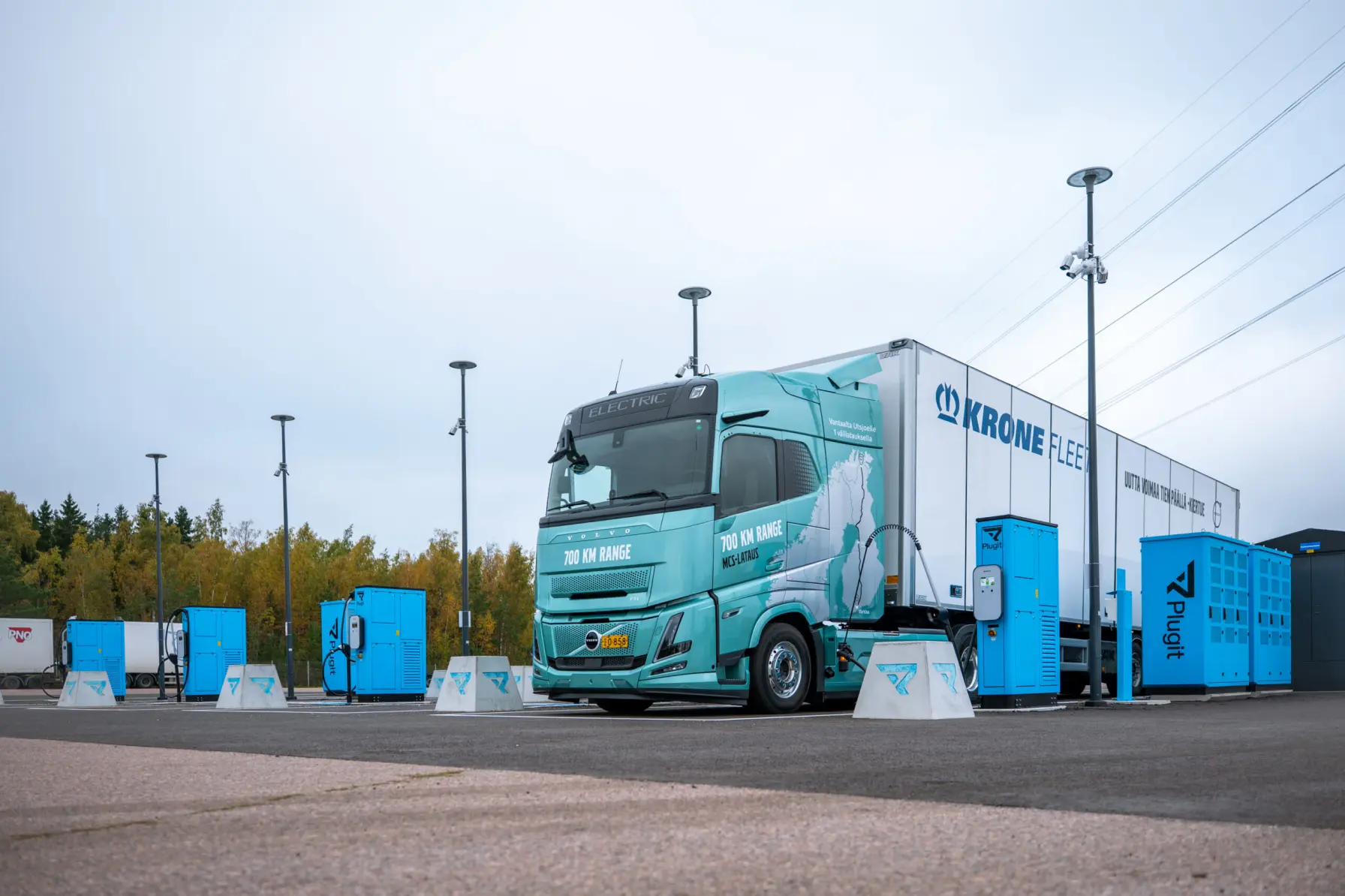
Plugit has plugged Finland into the megawatt era. The charging operator ran the country’s first public MCS (Megawatt Charging System) session, topping up a Volvo FH Aero Electric at its PRO station in Kotka.
The milestone matters most for the long-haul crowd. MCS was drawn up specifically for heavy-duty rigs, letting their oversized battery packs take on serious energy during a driver’s mandatory rest stop — the same window that once belonged to a coffee and a stretch.
Key Specs: Volvo FH Aero Electric · Up to 700 kW charging · Up to 700 km range
Both halves of the handshake worked as intended: the truck drew power through Volvo’s Open Charge service while Juice’s cables did the physical work. Two separate systems, one seamless session.
Where the megawatt plugs actually live
Plugit’s MCS-ready footprint in Finland runs to two sites — Kotka and Lieto — which gives hauliers a northern corridor rather than a one-off stunt charger. The company’s wider network numbers roughly 350 public charging points.
Among those, nine are built for heavy-duty vehicles. A tenth heavy-duty site is going up in Eskilstuna, Sweden, so the build-out isn’t stopping at the border.
Smaller fleet operators aren’t left out either. Delivery vans and light commercial vehicles can use the same Plugit network, which should keep the service economics sensible while truck traffic ramps up.
Why a single session counts
It’s easy to wave off one charging stop as a photo op. The reality is less glamorous and more useful: charging standards only convince fleet buyers once someone proves them in public, at a real station, on a real truck.
- Location: Plugit PRO station, Kotka, Finland
- Vehicle: Volvo FH Aero Electric
- Software side: Volvo Open Charge service
- Hardware side: Plugit charging cables
Volvo’s positioning is clear. Janne Silvonen, the company’s Product Manager for Electric Trucks, framed the Kotka session as a meaningful step for electrifying heavy goods transport in Finland — and pointed to the combination of long operating range and fast MCS charging as what makes electric trucks workable on longer journeys.
That pairing is the crux. Fast charging alone doesn’t sell a truck, and range alone doesn’t either. Put them together at a public site with a driver’s break built into the schedule, and the arithmetic starts to shift.
What comes next is density. Two MCS-enabled sites and a tenth heavy-duty build in Sweden won’t electrify a continent on their own. But every public session like this one chips away at the objection that electric trucks only work on short, predictable loops. Diesel didn’t lose its grip on freight in a day, and MCS won’t win it in one either.
Source: Charged EVs
Curious how this compares to other EVs? Try our comparison tool →What do you think?