
Half-Finished 1966 Ford Mustang V8 Swap Project Asks $7,000
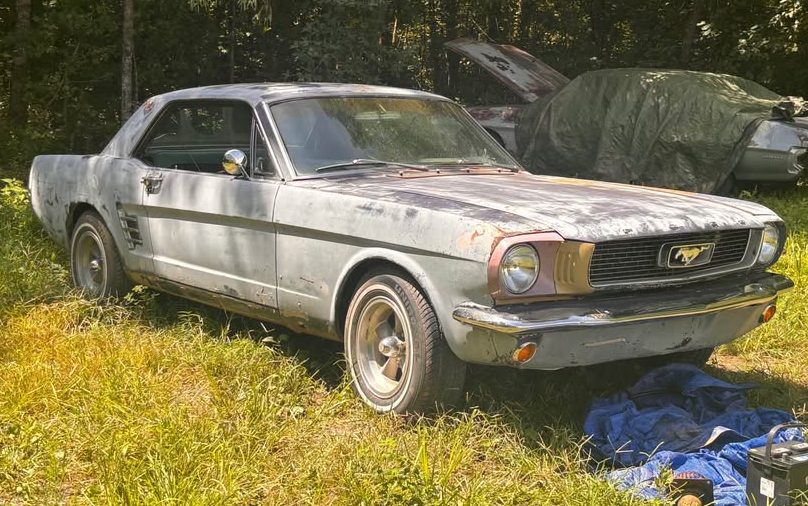
There’s a particular kind of gamble lurking in the classifieds: the abandoned project car. A 1966 Ford Mustang currently listed on Facebook Marketplace in Alpharetta, Georgia, fits that description exactly — a rolling shell parked in a field, partway through a drivetrain transformation that clearly stalled somewhere along the way, with an asking price of $7,000.
When new, this Mustang almost certainly left the factory in far humbler form. Ford moved a record 607,000 Mustangs in 1966 alone, following 559,000 in 1965 and roughly 121,000 during the 1964 launch year, and the bulk of those cars carried a 200-cubic-inch inline-six paired with an automatic transmission. That original six-cylinder drivetrain is long gone here. In its place sits a 302 V8, an engine the seller dates to 1968 or later, backed by a four-speed manual of uncertain vintage. The odometer reads 185,000 miles, though how much of that applies to the replacement powertrain is anyone’s guess. There’s no shifter in the car, but the clutch, flywheel, and driveshaft are all described as new, and the engine reportedly received fresh gaskets and other attention, possibly before installation.
The list of already-replaced hardware extends well past the engine bay: starter, distributor, tune-up components, headers, a correct pedal box, a front disc brake conversion, a new gas tank, and front suspension work. The wheels are also worth noting, as they use a five-lug pattern rather than the four-lug setup that came on six-cylinder cars, meaning the hubs have already been upgraded. On the downside, the rear undercarriage is rotted through and needs replacement, while the floor and trunk pans have already been repaired or patched. Rust remains elsewhere awaiting paint, the chrome is pitted, and the interior will need a thorough overhaul. The seller holds receipts covering most of the completed work, which at least offers some documentation trail for a build whose stopping point is otherwise unclear.
The bigger picture is why a rough, incomplete Mustang still draws attention at all. The early pony cars reshaped what American buyers expected from an affordable performance coupe, and the 1966 model year represents the high-water mark for the nameplate. Values for finished examples have climbed accordingly, which is partly what makes unfinished projects like this one so tempting — and so risky. Anyone taking this on inherits both the seller’s progress and the unanswered questions surrounding it, from the four-speed’s provenance to the true condition of metal they can’t see. For a buyer with the skills and patience to sort it out, though, the bones of a genuine ‘66 fastback-era classic are still in there, waiting for someone to finish what was started.
What do you think?