
GM's Closed-Loop Battery Pilot Puts Recycled Minerals Into New Cadillac and Chevrolet EVs
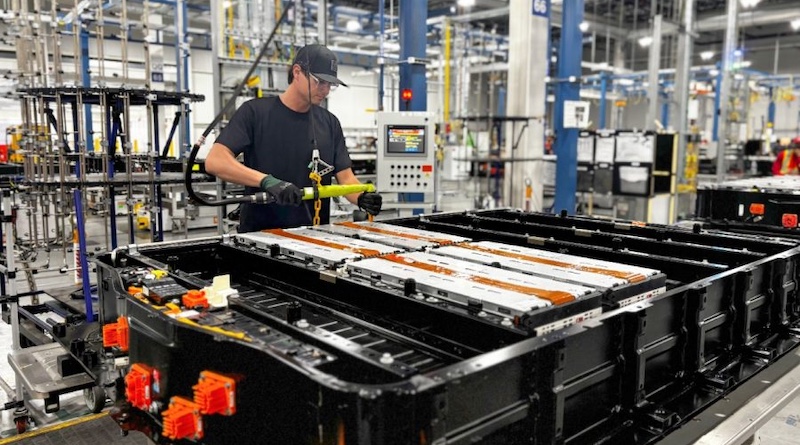
General Motors has finished a recycling pilot that sends old EV battery minerals straight back into fresh cells — and the first cars carrying them are already leaving the factory gates.
The program recovered 80 end-of-life GM battery packs, pulled out their nickel, cobalt and manganese, and turned that material into cathode active material for brand-new cells. GM says this is the first time its vehicles have been built with cells using 100% recycled nickel, cobalt and manganese.
The initial batch of vehicles includes the Cadillac LYRIQ, LYRIQ-V, VISTIQ, ESCALADE IQ and IQL, plus the Chevrolet Silverado EV Trail Boss and GMC Sierra EV AT4. Cells were assembled into modules and packs at Factory ZERO and Spring Hill, with final assembly split between Spring Hill Assembly and Factory Zero.
GM isn’t claiming recycling is an easy win. The company says it took years of work across engineering, quality control, logistics and manufacturing, with partners Cirba Solutions, Ultium Cells and LG Energy Solution involved at different stages.
How the loop actually works
The process starts with collection. Cirba Solutions took in the 80 retired packs and broke them down into “black mass” — the mixed-up mineral concentrate left after a lithium-ion battery is disassembled and separated.
That black mass then had to become cathode material, the part of a cell that largely decides its cost, safety and performance. More than 12 metric tons of new cathode active material came out of this step, all of it with 100% recycled nickel, cobalt and manganese.
Before anything went into a production cell, the material had to clear the same quality, safety and performance bar as virgin feedstock. Only after testing showed the recycled-content cells matched conventional ones did Ultium Cells build the new cells.
Recovery rates are worth noting here. GM puts today’s recycling processes at up to 95% for nickel, cobalt and manganese and up to 80% for lithium, though the exact figures move with process conditions and battery chemistry.
Recycling is the last chapter, not the second
GM frames recycling as the final act in a longer battery lifecycle strategy. Refurbishment and remanufacturing programs are designed to reuse more than 70% of pack components, stretching a pack’s useful life before it ever reaches the shredder.
Between those two stages sits stationary storage. With Redwood Materials, GM is deploying roughly 10,000 second-life batteries into real-world energy infrastructure, including what the company describes as the largest second-life battery microgrid in North America.
Why bother with all this? Raw materials are among the biggest cost drivers in a battery cell. Recovering them can chip away at battery costs over time, cut reliance on newly mined material and give supply chains more slack when markets get tight.
GM is candid that the pilot is a foundation rather than a finish line. More packs will reach end-of-life across the next decade, and the company says the data and experience gathered here will feed into scaling the approach. The automaker plans to discuss the work further at Climate Week NYC, where it is a title sponsor of the Nest Campus.
Source: CleanTechnica
Curious how this compares to other EVs? Try our comparison tool →What do you think?