
GM Pledges Two-Year Vehicle Development and a 40x Brain for Its Next Cars
General Motors opened its Onward tech showcase this week with a message aimed squarely at Silicon Valley and Shenzhen: the Detroit giant wants to be judged like a software company, not a legacy automaker.
The headline promises are hefty. GM says it can halve vehicle development time, fit a central computer up to 40 times more powerful than today’s hardware, and put eyes-off autonomous driving into its best-selling trucks and SUVs.
Whether any of that lands on schedule is another question. GM has been talking up over-the-air updates and smarter cockpits for years, and the results have been uneven at best.
Cutting the clock in half
Four- to five-year product cycles used to be normal in this industry. They no longer fit a market where Chinese rivals refresh software on a monthly cadence.
GM’s answer is what it calls digital thread virtualization — pulling design, engineering and manufacturing into one connected digital workflow from the first sketch instead of passing work between separate teams. The target is a two-year development window.
The company’s battery team already ran the experiment. Engineers simulated more than 300,000 virtual battery designs before a single physical prototype existed, then landed on a lithium manganese rich (LMR) chemistry and moved from concept to formal approval in about a month.
Those LMR cells are headed for GM’s fourth-generation EV platform, built by Ultium Cells — the LG Energy Solution joint venture — at its Spring Hill, Tennessee plant. GM claims 33 percent more energy density than comparable lithium iron phosphate cells at similar cost, plus a 20 percent efficiency gain per kilowatt-hour.
Key Specs: LMR chemistry · 33% higher energy density than LFP · 20% efficiency gain per kWh · 40% fewer drivetrain parts · 30% less wiring · 40x compute uplift
There’s more on the hardware side. The new drive units carry 40 percent fewer internal components and take up less space, which should free up cabin room for passengers and cargo.
One box replaces dozens
GM’s electrical architecture has long been a patchwork of scattered control units and heavy harnesses. The fix is a single liquid-cooled central computer linked by high-speed lines.
Fewer parts, fewer failure points — that’s the theory. In practice, drivers should notice quicker screens, better voice recognition and updates that don’t take an eternity to install.
The first production home for this brain is the 2028 Cadillac Escalade IQ, the same SUV GM named last year as the debut vehicle for its hands-free, eyes-off highway system.
But the tech isn’t staying behind a six-figure price tag. GM confirmed the eyes-off highway feature will spread across the lineup, covering both electric and combustion models.
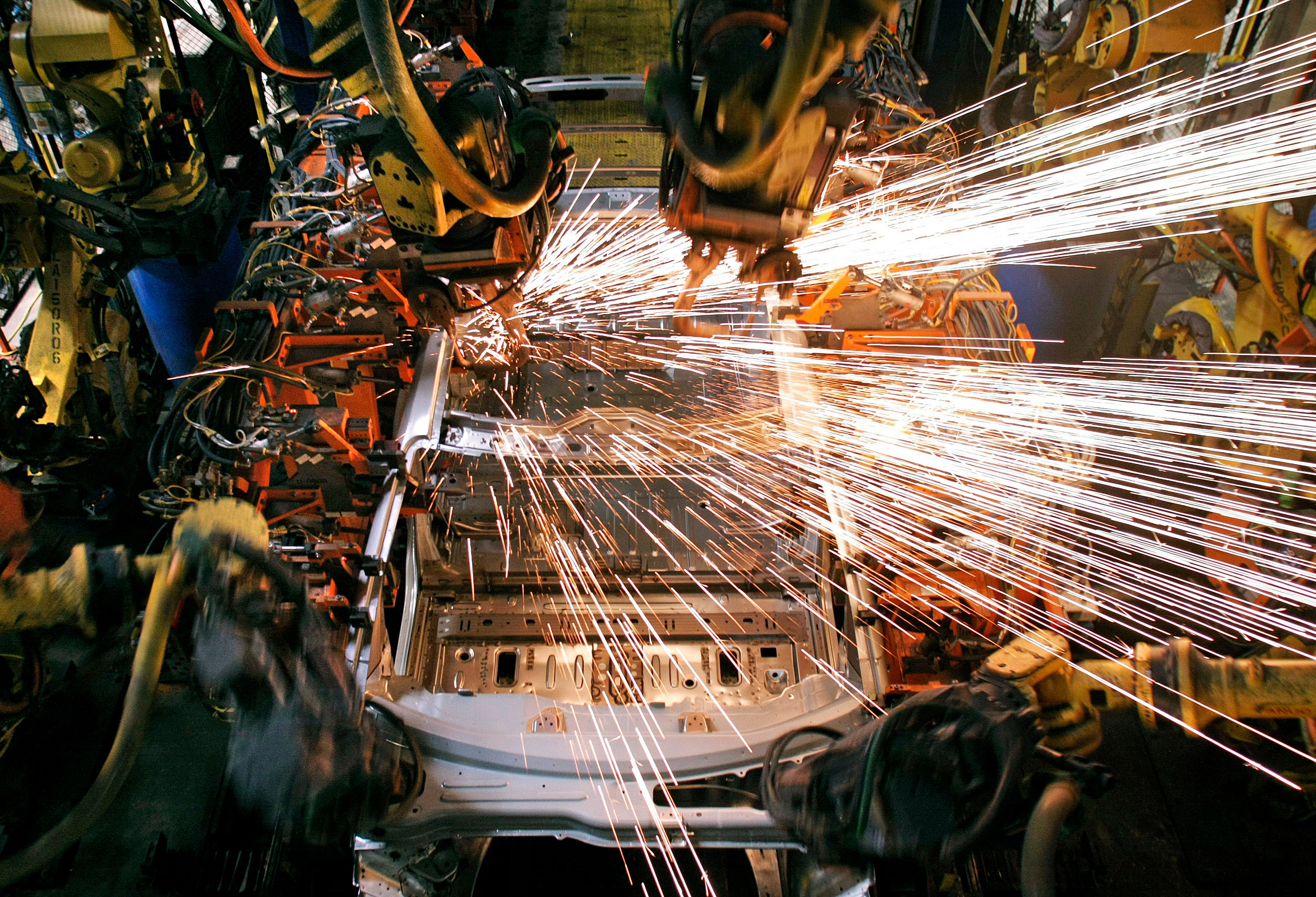
On the factory side, a project awkwardly styled “PlantBrAIn” pairs live production data with digital-twin simulations across stamping, casting, welding, painting and assembly, so bottlenecks can be spotted in the virtual model before they stop a real line.
A dry-cleaning run with nobody aboard
The most eye-catching slide of the day wasn’t hardware. GM sketched a future where a vehicle drives itself to collect groceries or pick up dry cleaning while the owner stays home.
Our vision is to build vehicles that can drive themselves or their occupants anywhere they need to be — including handling mundane tasks like heading out into bumper-to-bumper traffic to pick up groceries or dry cleaning.
An empty truck idling at a drive-through window is a fun image. It’s also the kind of claim that needs a real-world demo before anyone takes it seriously.
GM paired that with “Concept Horizon,” an interior study that treats the cabin as open space for working or unwinding rather than a driver’s workstation.
OnStar gets a voice
OnStar turns 30, and GM is using the birthday to reposition it from a red emergency button into an always-listening assistant. A “Hey OnStar” wake phrase can adjust cabin temperature, open the glovebox, release the charge port or read out tire pressure and battery diagnostics.
It’s a sensible pivot. Roadside rescue is a low-frequency touchpoint; a voice assistant is something owners could use every single day.
The risk is the same one that has plagued GM’s software story so far — complexity nobody asked for. If the assistant works, it’s a genuine selling point. If it stumbles, it becomes one more reason to reach for the phone instead.
Source: The Verge - Transportation
What do you think?