
Global Bus Procurement Records Show Battery-Electric Dominance Over Hydrogen
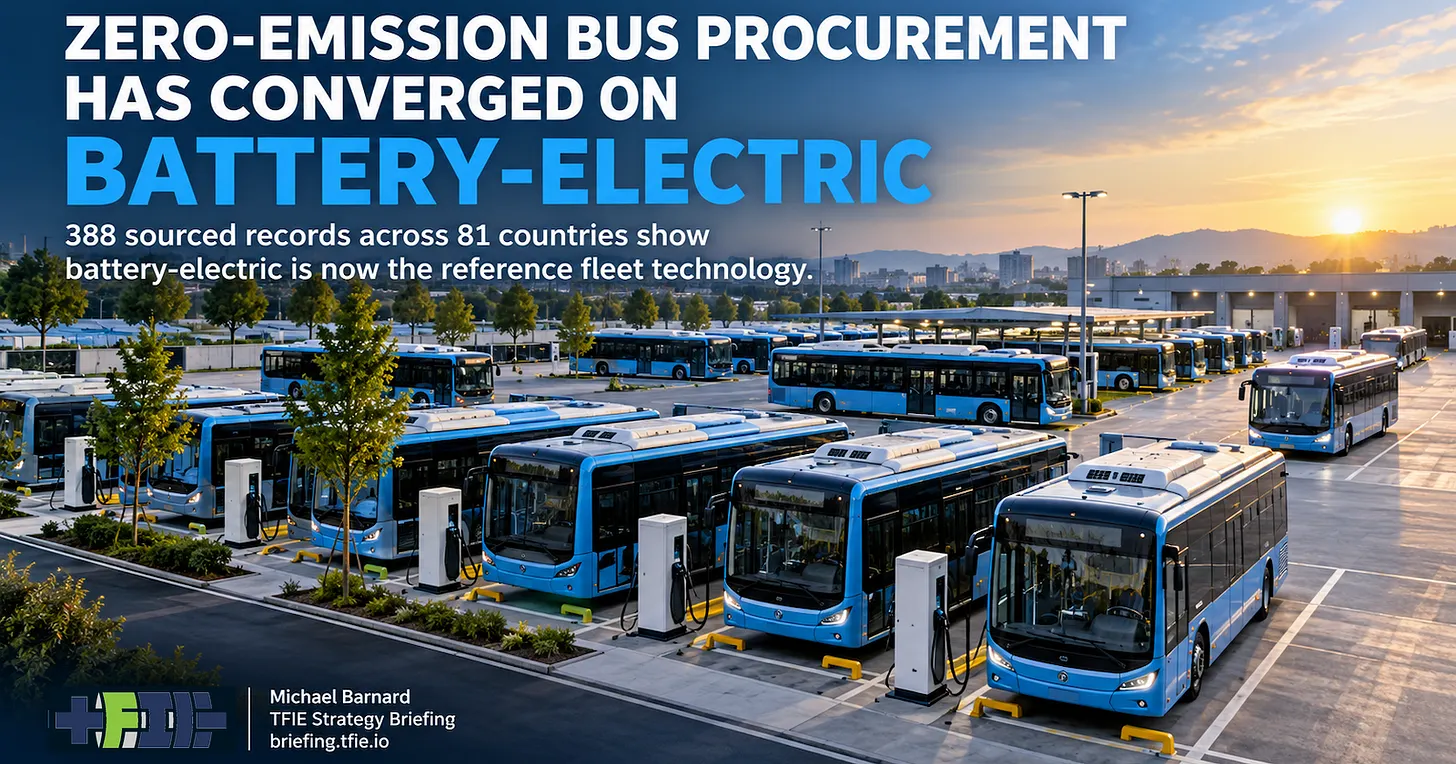
When transit agencies decide how to decarbonize their fleets, the procurement paperwork tells a clearer story than any policy speech. A sweeping global register of bus purchasing decisions now reveals that battery-electric technology has become the overwhelming favorite, leaving hydrogen fuel-cell buses as a niche solution struggling to gain real traction.
The data comes from an analysis of 388 sourced procurement records spanning 81 countries. By separating firm orders and contract awards from vague tenders and unfunded options, the picture becomes stark: 13,165 confirmed battery-electric bus orders against just 65 hydrogen fuel-cell buses. That works out to roughly 200 battery buses for every hydrogen bus, with battery-electric accounting for about 99.5% of firm acquisitions captured. The breadth is equally telling. Battery orders come from 55 separate purchasing bodies around the world, while all 65 hydrogen buses trace back to just two buyers.
That concentration matters. Procurement announcements are notoriously messy, with tenders, awards and deliveries often describing the same purchase multiple times. By counting only firm orders, the register reflects identifiable buying decisions rather than optimistic press releases. The forward pipeline reinforces the trend: thousands of additional battery-electric buses are visible in open procedures, while the hydrogen pipeline remains comparatively tiny.
The two hydrogen buyers do deserve a fair look. Qingyang in China is intentionally building a municipal hydrogen ecosystem, coordinating buses, fuel supply and refueling infrastructure as part of a larger development plan. Krefeld in Germany offers a stronger commercial example, as the operator already runs hydrogen buses and chose to buy more after gaining real operating experience. Yet what these cases do not show is replication. After years of demonstrations, subsidies and manufacturer development, the firm procurement record still boils down to one Chinese municipal program and one German operator making a repeat purchase.
This does not mean battery-electric fleet conversions are easy. Depot power often requires new substations and multi-megawatt connections, utility interconnection can take years, and charging systems and software must work reliably enough to get buses on the road every morning. These are real constraints, but they are deployment problems tied to the technology agencies are overwhelmingly choosing, not signs that the propulsion decision remains evenly balanced. For normal urban and suburban bus procurement, battery-electric should now be the default reference technology, with hydrogen treated as the exception that must prove its case against a very high bar.
What do you think?