
Europe's Battery Supply Chain Has a Real Chance — If the IAA Stays Firm
Europe’s battery ambitions have taken hits in recent years, but the region is far from starting from zero. A fresh analysis from Transport & Environment (T&E) argues that the Industrial Accelerator Act (IAA) is the missing push that could turn announced projects into operating factories — and it pushes back hard on industry claims that a massive supply gap looms.
Roughly a quarter of the EU’s announced cell capacity has been scrapped or paused since 2022, with Germany’s 2035 pipeline cut in half. Non-European firms, mostly from South Korea, still run over 72% of active cell manufacturing on the continent. Still, more than half the cells inside EVs sold in the EU are already made locally, and Europe is on track to pass 100 GWh of LFP output by 2030 — potentially 140 GWh if every planned project materialises. By 2027, according to T&E, EU cells alone could cover corporate EV demand, and by 2030 they could serve both corporate and subsidised private buyers.
The report also challenges ACEA’s headline claim of a 150 GWh shortfall in 2028, calling the figure inflated by restrictive accounting that ignores exported cells and misreads real manufacturing capacity. Delayed or weakened rules, T&E warns, would be self-defeating: watered-down requirements and carmakers’ fleet-booster proposals would strip away the demand signals that battery and cathode projects need to reach final investment decisions. Cathode active material remains a weak link — Europe holds just 3% of global output — while precursor CAM (pCAM) capacity is even more exposed, with only 217.9 GWh of the 552.6 GWh announced for 2030 still on track.
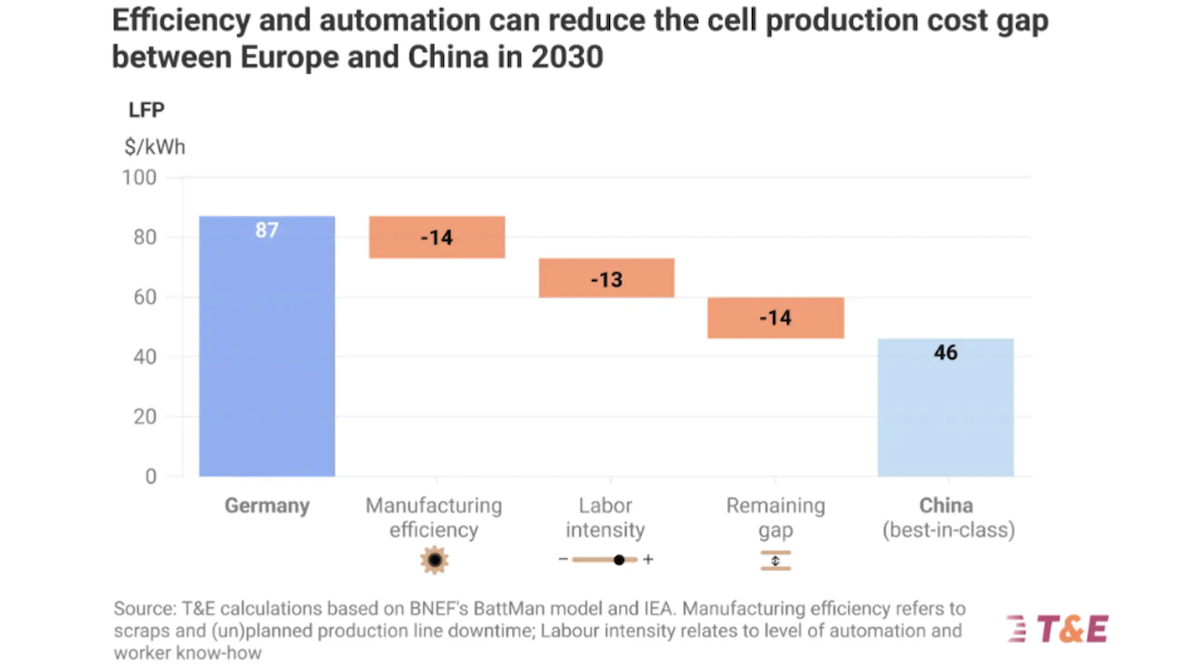
T&E’s prescription: keep the 2027–28 cell mandate intact, retain 2030 CAM requirements while adding trusted partners, and set minimum thresholds for midstream inputs — 20% for pCAM and 10% for anode active material by 2032. It also calls for mandatory Made-in-EU batteries in small BEVs from 2029/30 and rejects the fleet-booster compromise outright. On cost, the group projects the EU–China cell price gap will shrink by 70% by 2030, adding only around €500 to an average EV — a far cry from industry’s dire warnings.
What do you think?