
EU Company-Car Rules Could Add €48 Billion and 344,000 Jobs, Study Finds
European regulators are weighing a rulebook that would push large companies toward zero- and low-emission company cars — and a new Fraunhofer ISI model suggests the payoff could be substantial. Commissioned by Transport & Environment (T&E), the analysis puts the potential value creation at up to €48 billion and 344,000 jobs by 2030.
The policy at stake is the Clean Corporate Vehicles Regulation (CCVR). It would set binding minimums for large fleets’ new registrations: 69% zero- and low-emission vehicles EU-wide by 2030, with at least 45% fully zero-emission. A companion provision, Article 4, adds teeth — from 1 January 2028, member states could only direct financial support (tax breaks, subsidies, fleet incentives) at corporate cars that qualify as ZLEVs.
The “Made-in-EU” Fine Print
That support would come with a second condition: the vehicles must count as made in the EU under the related Industrial Accelerator Act (IAA). Crucially, the origin test goes beyond where the car is screwed together. The IAA sets minimum EU-content shares for batteries, e-powertrains and electronics as well.
So the regulation is doing two jobs at once — cleaning up fleets and steering investment toward European supply chains. The modelling suggests carmakers will localise only what the law actually demands.
Fraunhofer ran three versions of the future: a baseline where company cars electrify simply at the pace of the EU’s revised CO₂ standards (47% by 2030), a moderate case (52%) with a softer Article 4 effect, and a strong case reaching the full 69%. The headline benefits belong to the strong scenario.
What It Means for Volkswagen
The clearest illustration comes from the EU’s biggest carmaker. Volkswagen commands more than a quarter of new registrations in the bloc, yet its operating result more than halved in 2025. Under the moderate scenario, its EU corporate BEV sales would grow by roughly 99,000 units by 2030 — offsetting about 14% of the 700,000-unit production cut it has planned.
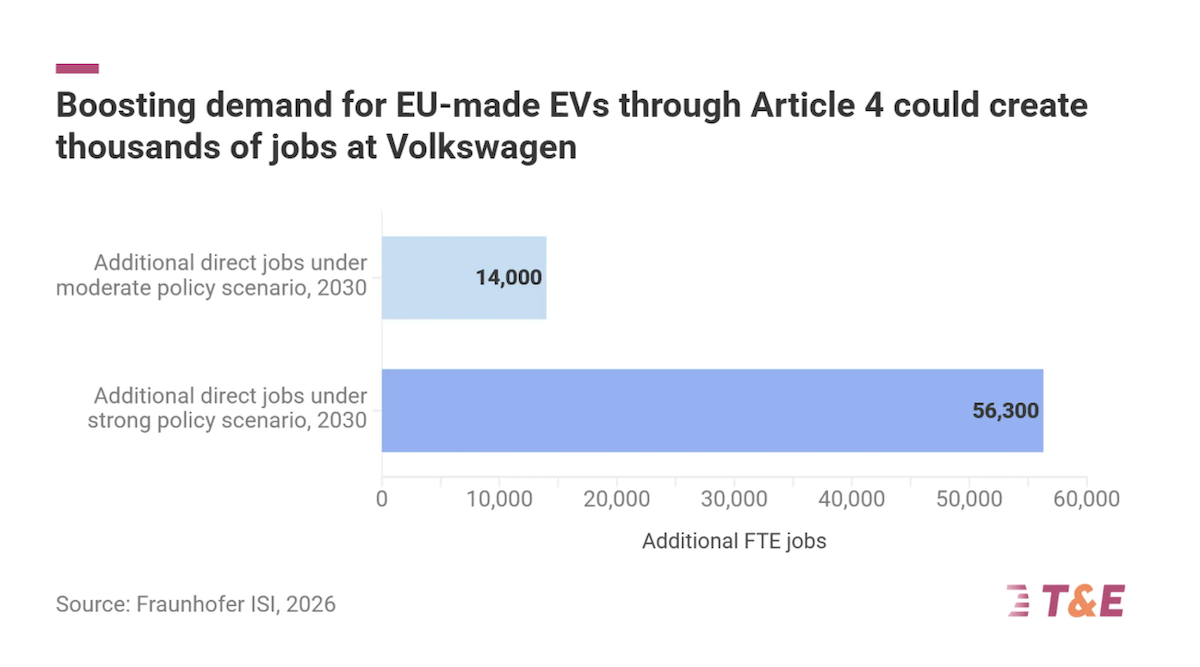
In the strong scenario, that bump climbs to nearly 590,000 vehicles, covering 84% of the cut. It would support some 14,000 direct full-time jobs, largely in vehicle assembly, alongside about €760 million in extra investment between 2026 and 2030. Germany’s four sites that VW’s Future Plan 2030 says cannot be secured from 2031 — Emden, Zwickau, Hannover and Neckarsulm — could account for 6,300 of those roles. Under a strong Article 4, the gains could reach 56,300 direct jobs, including 25,400 at those plants.
The gains would not spread evenly. They follow where automotive and battery capacity already sits, which happens to concentrate in member states whose governments are loudest about defending car-industry jobs.
T&E’s asks are blunt. Keep Article 4 strong, since its incentive mechanism drives nearly all the extra economic benefit. Don’t water down or delay the Made-in-EU criteria. And get the rules into force by 2028, pulling the gains forward to 2030 — precisely when anxiety about job losses runs highest. The full briefing and study are published by Fraunhofer ISI.
Source: CleanTechnica
What do you think?