
E-Trucks as Rolling Power Banks: SPIRIT-E Wraps Up With Promising Numbers
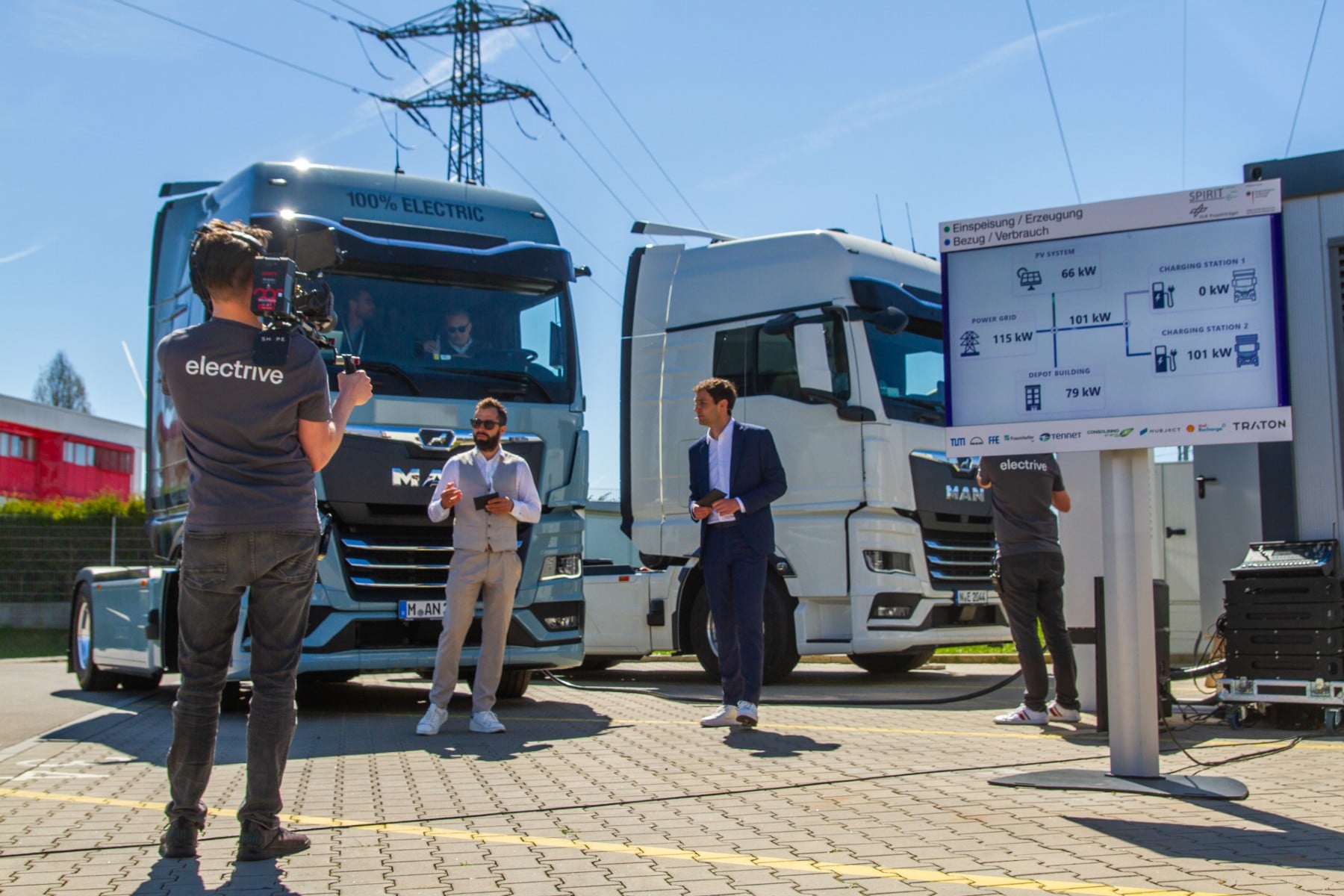
After three years of digging into the practical side of heavy-duty electrification, the German SPIRIT-E research consortium has closed the books with a clear verdict: a parked electric truck can do far more than soak up electricity — it can give it back, and make money doing so. The project, which ran from August 2023 until October 2026 and was coordinated by the German Aerospace Center (DLR), presented its findings at a public online wrap-up event.
The headline demonstration came in spring 2026 at logistics firm Schmid in Obertraublingen, near Regensburg, where a MAN eTGX with 480 kWh of usable battery capacity became the first electric truck anywhere to be shown pushing power back into the grid in a live setting. Using a bidirectional DC charger built by Shell Business Recharge Solutions (SBRS), the truck discharged at up to 350 kW.
Key Specs: MAN eTGX · 480 kWh usable battery · up to 350 kW bidirectional discharge · ISO 15118-20 communication
Three ways a truck can pay its way
The field trial covered the full spread of Vehicle-to-X use cases:
- Vehicle-to-Vehicle: one truck topping up another,
- Vehicle-to-Site: the battery supporting the depot’s own power demand,
- Vehicle-to-Grid: energy sold back to the public network when prices are favourable.
Communication between vehicle and charger ran on the international ISO 15118-20 standard, and the consortium — which also included the Technical University of Munich as lead partner, Fraunhofer IEE, TenneT, Hubject, Consolinno Energy and others — built out the interfaces linking trucks, chargers, energy management systems, electricity traders and grid operators.
What the fleet data actually showed
TUM’s accompanying research leaned on real driving records from six German heavy-duty fleets, covering 2.15 million kilometres. A few numbers stand out:
- Charging reservations: booking public charge points in advance on long-haul routes cuts the time penalty versus diesel to roughly 1–4 per cent in the median.
- Depot plus PV plus storage: combining private depot charging with solar and stationary batteries saves 25–44 per cent more than a plain switch to electric trucks.
- Smart grid and market integration: total fleet costs fell by an average of 1.7 cents per kilometre.
- Adding bidirectional charging: that figure climbed to 6.1 cents per kilometre.
The researchers see roughly a ten per cent cut in energy costs as realistic. For a truck covering 100,000 kilometres a year, that is about the energy cost of driving 10,000 of them for free. Regional haulage, where vehicles return to base regularly, is the sweet spot.
The bottlenecks have moved
Technical feasibility, the team stressed, is no longer the main obstacle. Grid connection capacity at many depots simply isn’t sized for larger e-fleets, and flexible connection agreements, buffer batteries or shared charging hubs are the suggested workarounds. Just as pressing: there are no uniform standards for selling stored power — many providers rely on proprietary setups that don’t talk to each other — and it remains unclear how roles and revenues should be split between hauliers, truck makers and electricity marketers.
Prof. Markus Lienkamp, who heads TUM’s Chair of Automotive Technology, put the conclusion plainly: heavy-duty electric trucks can be “much more than just new electricity consumers”, and the next job is to standardise and scale what has been tested into business models that actually work.
Photo: MAN / electrive.com · Official Press Kit / Editorial (Editorial / Press Kit)
Source: electrive.com
Curious how this compares to other EVs? Try our comparison tool →What do you think?