
Citroen Revives the 2 CV as a Lightweight Electric Concept for the Paris Motor Show
Few cars carry as much everyday folklore as the Citroen 2 CV. Born in 1949 out of a Europe still rebuilding after the war, it was engineered around the simplest possible answers: a tiny air-cooled flat-twin of just 375 cc making a modest 9 horsepower, a fan bolted straight to the crankshaft, and suspension travel generous enough to shrug off the cratered roads of postwar France. Owners could fix almost anything themselves, and that honesty sold more than five million examples before production finally ended in 1990, by which point displacement had crept to 602 cc and output had climbed to a still-humble 29 horsepower.
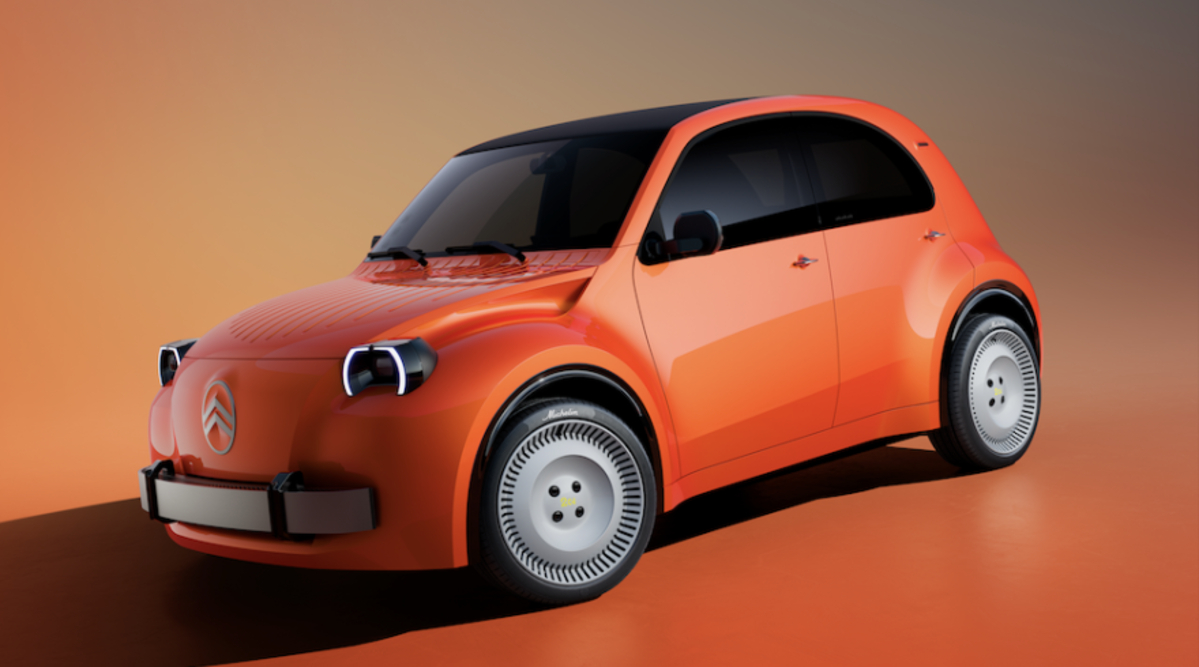
Now Stellantis is bringing the nameplate back, this time with a battery and an electric motor. The company will pull the wraps off a 2 CV Concept at this year’s Paris Motor Show, positioning it as a modern and deliberately ingenious answer to tomorrow’s mobility challenges. The concept measures 3.76 meters long and is built around the same values that defined the original: affordability, lightness, practicality, versatility, and a character you simply do not find elsewhere on the road. Citroen CEO Xavier Chardon framed the exercise as reinvention rather than replication, saying the goal is to carry the spirit of simplicity, accessibility and freedom into the present and make electric mobility feel simpler, more human and more desirable.
The design leans hard into that heritage. Early coverage describes a bubbly silhouette and a cheerful face, with LED light arches rising out of pronounced fenders, a chrome bumper jutting from the front bodywork, and indented vertical lines across the hood. Inside, the cabin is unapologetically French and playful: bench seating trimmed in puffy yellow plaid cushions, a removable wicker basket standing in for a center console, small lanterns strung around the large fabric sunroof opening, and straps instead of conventional door handles. The bench itself can be lifted out of the car for use at a picnic, and a detachable sound system mounted under the dashboard doubles as a portable speaker, while the screens adopt a hand-drawn, comic-book-inspired interface.
None of that whimsy is decoration for its own sake. Substituting a cloth roof for steel and stripping the interior back to pure function are calculated moves aimed at keeping weight barely above 2,000 pounds, which in turn allows a smaller and cheaper battery pack to do the job. It is a formula aimed squarely at low-cost, dependable urban transport rather than long-distance touring, and it sits in contrast to the bloat that often accompanies electrification.
Patience will be required. A production version is still at least two years out, expected to land at around €15,000 and to comply with the forthcoming European M1E small electric car standard. No technical specifications accompanied the concept’s debut, though it is a safe assumption that the new 2 CV will offer considerably more than 9 horsepower. Whether a panel van variant or even a one-make racing series eventually follows, as they did for the original, remains to be seen. Citroen would no doubt be delighted if this reinterpretation stayed on sale for anything close to the 45 years its ancestor managed.
What do you think?