
China's Domestic Auto Sales Plunge 28% as Beijing Cuts EV Export Rebates
China’s passenger vehicle market posted its steepest monthly contraction of the year in September, with retail sales dropping 28% year-on-year to 1.62 million units according to data from the China Passenger Car Association (CPCA). The decline marks the twelfth consecutive monthly fall, effectively erasing any benefit from the traditional “Golden September” sales peak. Internal combustion vehicle deliveries were hit hardest, tumbling 43%, while new energy vehicle retail sales slipped 16.7% to 1.08 million units. That figure nevertheless pushed NEV penetration to a record 67% of the market, although that milestone was reached more by default than through genuine momentum.
A CPCA dealer survey cited by Reuters suggested buyers are responding to economic uncertainty by postponing purchases and weighing price more carefully than before. The association noted that part of the September shortfall stems from timing quirks — an earlier Mid-Autumn Festival holiday and an unusually strong comparison base from last year, when consumers raced to lock in provincial subsidies before they expired. Analysts at Nomura pointed to the scaling back of trade-in incentives and the winding down of EV purchase tax breaks as additional headwinds. Even allowing for those temporary factors, cumulative nine-month retail sales remain 21.7% below last year at 13.33 million units, indicating the weakness runs deeper than any single calendar effect.
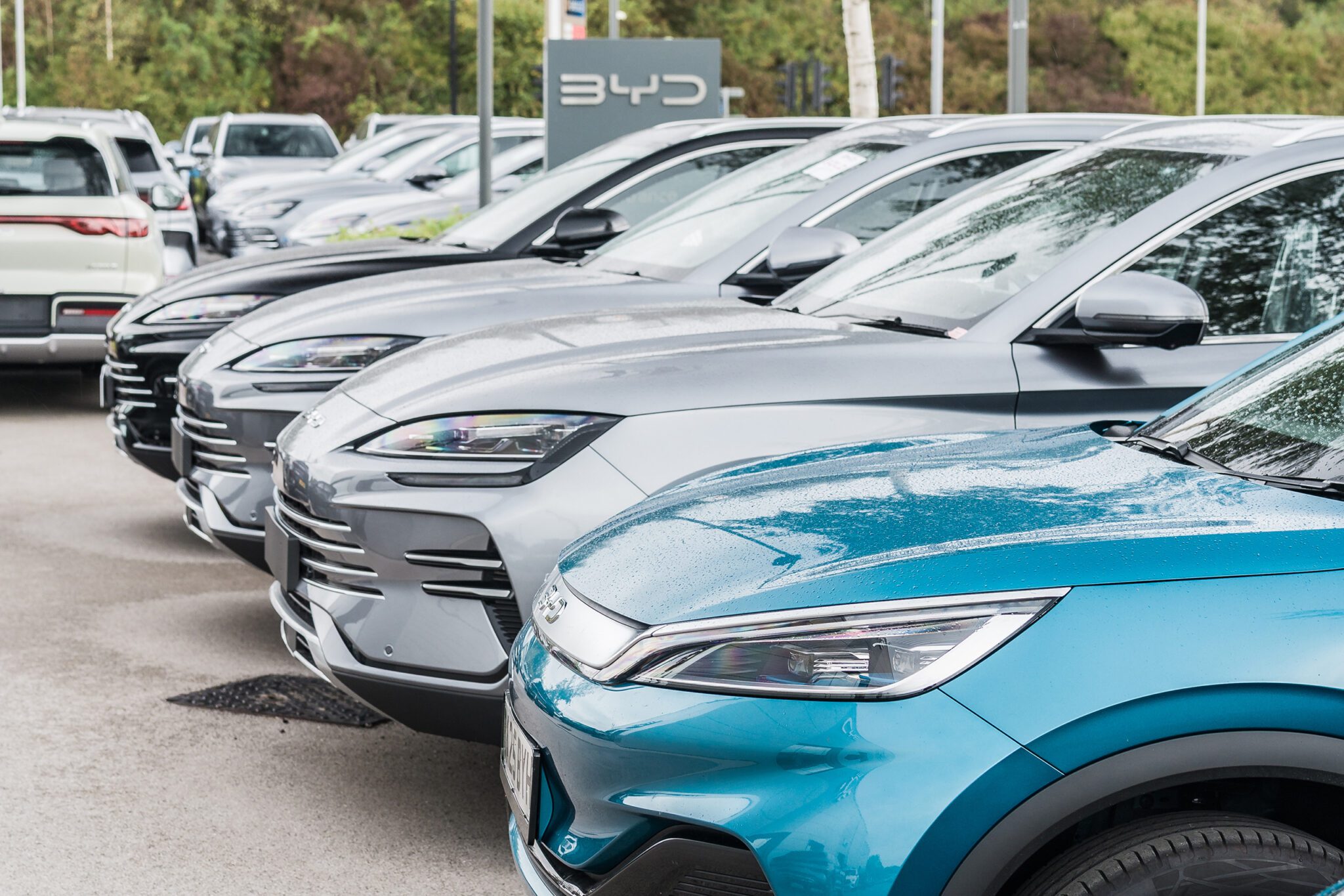
With the home market shrinking, exports have become the primary growth engine for China’s automakers. Passenger vehicle exports climbed 73.7% in September to 917,000 units, while NEV exports jumped 163.5% to 558,000. The country’s largest manufacturers are now expanding almost entirely through overseas channels. BYD recorded a 154% surge in foreign sales while its domestic volumes fell 13%, and Geely posted a 162% overseas gain against a 20% decline at home. BYD’s overseas deliveries totalled 1.34 million units through the first nine months of the year, representing roughly 43% of its overall wholesale volume, according to Deutsche Bank estimates.
That export dependence makes the timing of Beijing’s latest policy adjustment particularly significant. The government confirmed that the export VAT rebate on battery-electric and plug-in hybrid vehicles will be reduced from 13% to 9% starting in April 2027. Deutsche Bank calculates the change will trim BYD’s net profit by approximately CN¥5,000 (US$743) on every exported vehicle. The move follows the elimination of rebates on solar products earlier this year and a reduction for batteries that will be phased out entirely in January — steps that economists associate with Beijing’s broader effort to discourage destructive price competition.
Europe is simultaneously preparing its own restrictions, with a 350,000-unit annual cap on Chinese hybrid imports scheduled to take effect in December. CPCA Secretary-General Cui Dongshu has argued that targeting plug-in hybrids will have minimal impact given the dominance of battery-electric models in China’s export mix, but recent figures complicate that assessment: PHEV exports climbed 220% in September to 219,000 units, making them the fastest-growing category. Nomura expects overseas shipments to provide only a limited cushion against soft domestic demand. Ultimately, policy is tightening at both ends — weaker incentives at home, reduced rebates abroad, and proposed validation rules designed to slow rushed model launches. The likely outcome is not a decline in export volumes but a squeeze on export profitability, which will fall hardest on manufacturers lacking BYD and Geely’s scale or their established overseas production footprints. By the second quarter of 2027, when the rebate reduction coincides with a full year under the EU quota, the industry consolidation that China’s brutal price war has so far failed to trigger may finally take hold.
What do you think?