
CATL Pairs Swappable Batteries With a Range-Extender for Heavy Trucks
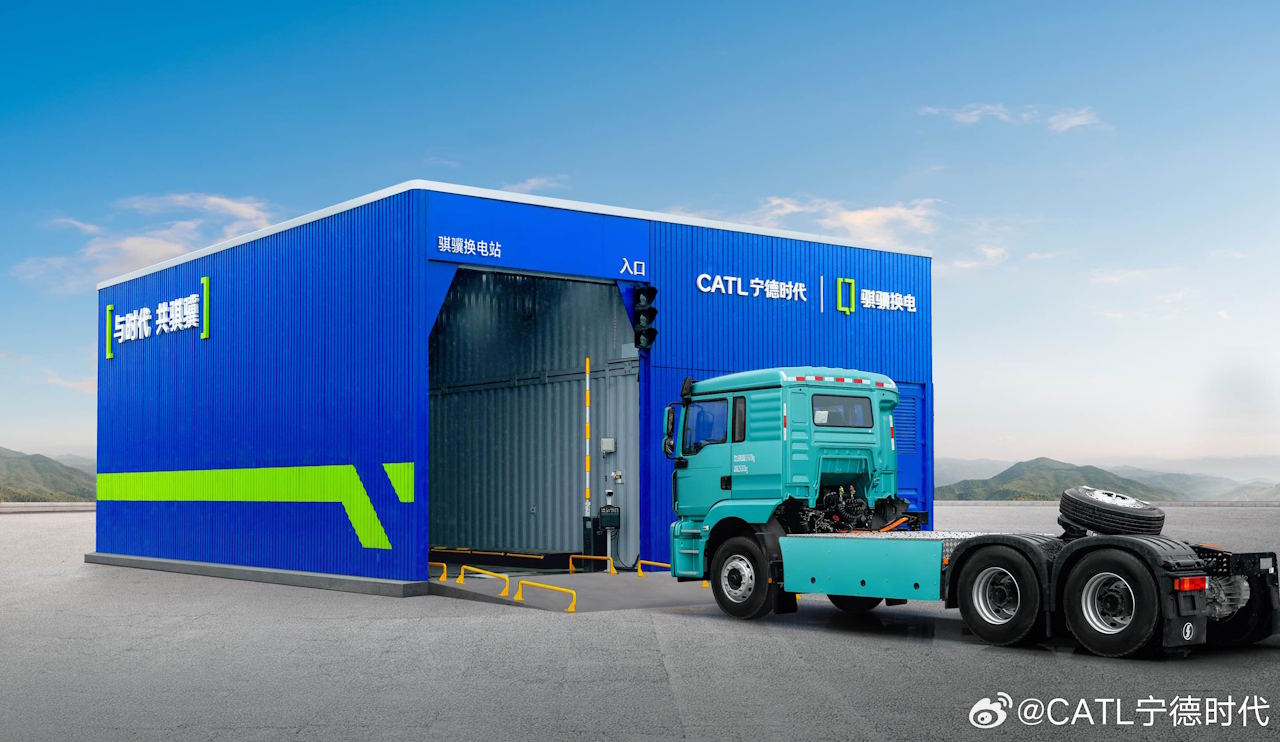
CATL is betting that electric heavy trucks will swap packs more willingly if a small backup battery is riding along. The Chinese battery giant — the largest in the world by output — has unveiled a dual-battery layout aimed at pushing road freight electrification forward faster.
The idea is simple on paper. A main swappable pack sits in the chassis, while a second, smaller range-extension battery is mounted behind the cab. The backup keeps the truck moving once the main pack is nearly flat.
That matters because fleet drivers have a habit of playing it safe. Under conventional battery-swap setups, they tend to hand back packs with capacity still left inside, unwilling to risk running the main battery down to empty on the road. CATL puts typical depth of discharge at roughly 70 percent.
With the range-extender in place, that figure climbs to more than 95 percent, according to the company. In other words, trucks come back to the swap station with under 5 percent charge remaining — squeezing far more usable energy out of every pack.
When the main battery gets to that point, CATL’s switching hardware hands power delivery over to the backup in milliseconds, so there is no break in the supply.
The 1+X Idea
The first advertised pairing teams a swappable pack with a 77 kWh range-extender battery supporting 3C charging. But CATL frames the concept as a “1+X” architecture — a main battery plus a tailored extender that can be tuned per use case. Cold-climate fleets could opt for low-temperature resistance, long-haul operators for maximum energy density, or heavy-load routes for ultra-high power.
One practical upside: the two packs can be developed and upgraded separately, each following its own technical roadmap without dragging the other along.
Initial Specs: Main swappable pack + 77 kWh range-extender · 3C charging on the extender · Depth of discharge up to 95%+ · Power handover in milliseconds
The system leans on CATL’s truck swapping network, run through subsidiary QIJI, which is pushing standardization, new infrastructure and a full commercial ecosystem.
Alongside the dual-battery reveal, QIJI added two standardized swappable packs to its lineup: the 260# at 432 kWh and the 300# at 513 kWh. They join the existing 75# unit rated at 171 kWh.
QIJI says a swap takes about five minutes, with a first-time success rate of 99.99 percent. The company is installing 900 swap stations by the end of this year, with 2,000 more planned for 2027 and a long-term goal of 10,000 across China.
The commercial case is the one to watch. Range anxiety is less of a worry for freight than uptime — a truck parked at a charger earns nothing — so anything that speeds turnover at the swap bay has real value for operators.
Source: The Driven
Curious how this compares to other EVs? Try our comparison tool →What do you think?