
BYD Taps Inokom to Assemble EVs Locally in Malaysia
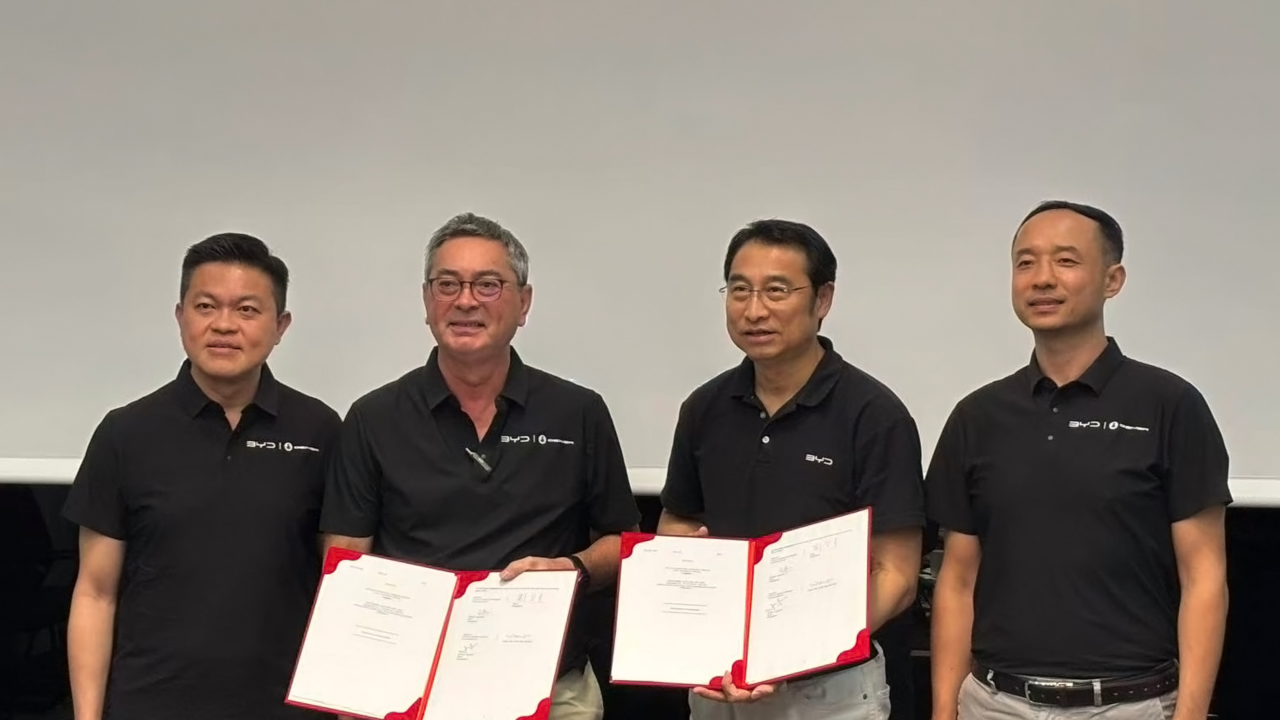
BYD is taking a decisive step toward localized manufacturing in Malaysia, naming Inokom Corporation Sdn. Bhd. — a Sime Motors subsidiary operating out of Kulim, Kedah — as its assembly partner for completely knocked-down (CKD) vehicle production. The arrangement was sealed with a Memorandum of Understanding signed at BYD’s global headquarters in Shenzhen, China, with Liu Xueliang, BYD Vice President and General Manager of the Asia Pacific Auto Sales Division, and Dato’ Jeffri Salim Davidson, Group CEO of Sime, putting pen to paper. BYD Malaysia Managing Director Jacob Ma and Sime Motors Southeast Asia Managing Director Jeffrey Gan were among the executives on hand for the ceremony.
Inokom was not picked at random. BYD says it weighed Malaysia’s domestic market dynamics alongside local manufacturing capabilities before settling on the Kulim-based assembler, whose existing vehicle assembly infrastructure and seasoned workforce offer a ready-made platform for scaling local operations. Rather than constructing new plants, BYD can plug into established national automotive resources — a shortcut that keeps capital expenditure in check while still satisfying localization mandates.
The move carries strategic weight beyond logistics. Malaysia’s Ministry of Investment, Trade and Industry requires foreign EV makers to either set up domestic assembly or partner with local industrial groups if they want to keep long-term market access. Local production also opens the door to tariff reductions and lighter transport dependencies, which in turn allows manufacturers to sharpen retail pricing. BYD leadership framed the decision as evidence of a long-term commitment to the Malaysian market, with the partnership intended to weave the company’s new energy vehicle and battery know-how into the domestic automotive sector while exploring deeper local investment.
Malaysia’s policy backdrop makes the timing logical. Under the National Energy Transition Roadmap, the government is chasing a 15 percent EV penetration rate of total industry volume by 2030, rising to 38 percent by 2040. Today, EV registrations account for roughly 3 percent to 5 percent of annual sales, propped up by tax exemptions on imported units and focused charging infrastructure spending. Distributed through Sime Motors, BYD currently controls the largest slice of Malaysia’s EV segment — somewhere between 40 percent and 44 percent of pure electric passenger car sales. Its local lineup runs from the compact Atto 3 crossover, the brand’s volume leader, through the entry-level Dolphin hatchback and mid-size Seal sedan, up to the Sealion 7 crossover and the M6 multi-purpose vehicle.
Sime executives said the selection underscores the strength of Malaysia’s assembly expertise, workforce, and supply chain network, and expects the tie-up to bolster the local automotive ecosystem, support domestic businesses, and drive skills development. BYD’s CKD approach mirrors a wider pattern across Southeast Asia, where automakers are increasingly leaning on existing regional facilities instead of greenfield factories. Further details on the local assembly program will be shared at a later date.
What do you think?