
BYD Opens Blind Pre-Orders for a Bigger, Punchier Second-Gen Seagull in China
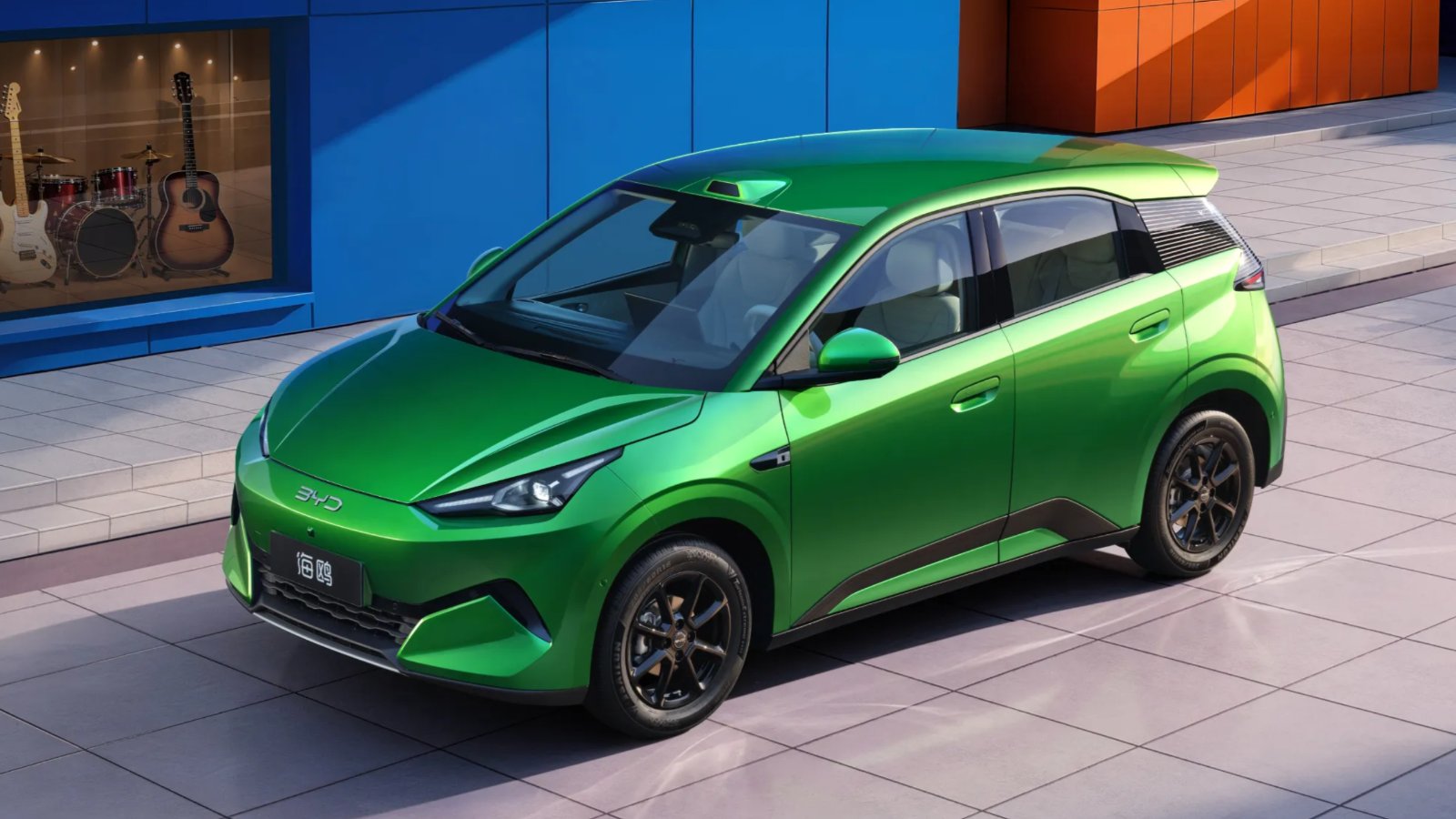
BYD has begun accepting reservations in China for the next generation of its Seagull, the small battery-electric hatchback that has long served as one of the Ocean lineup’s volume leaders. The move was shared on Weibo by Zhang Zhuo, who runs sales for the Ocean range, and came without any pricing information — a so-called blind pre-order, a tactic Chinese automakers frequently use to gauge demand before an official launch. Alongside the announcement, BYD showed off six exterior paint choices: green, pink, orange, blue, white and gray.
The most obvious change is size. According to earlier filings with China’s Ministry of Industry and Information Technology, the new Seagull stretches to 4,205 mm long, 1,810 mm wide and 1,570 mm tall, riding on a 2,650 mm wheelbase. That represents 425 mm of added length and a 150 mm longer wheelbase compared with the outgoing car, and it lets the model seat five instead of four. In practical terms, the hatchback now sits much closer to the larger Dolphin in footprint.
Output gets a substantial bump as well. Both variants listed in the regulatory filings use a permanent-magnet synchronous motor rated at 95 kW (127 hp), up sharply from the 55 kW of the current version, paired with lithium iron phosphate batteries. One of the two variants can be specified with LiDAR and extra radar hardware — technology BYD already brought to the Seagull earlier this year on the 2026 model. A redesigned nose with trident-style lighting headlines the visual updates, while cabin features include a column-mounted gear selector, power-adjustable front seats, a massage function for the driver and a 94-liter front trunk. Folding the rear seats opens up as much as 1,380 liters of cargo room.
The stakes are clear when looking at sales. The Seagull moved 38,650 units in September, up 11.75 percent year-on-year and 7.05 percent over August — its second straight month of year-on-year gains. Even so, volume across the first nine months reached 265,901 vehicles, a 33.22 percent decline from a year earlier, though the recent rebound has narrowed that gap from 37.50 percent at the eight-month mark. For context, the model shifted 529,537 units in 2025, and cumulative sales since its April 2023 debut total roughly 1.55 million through the end of September, based on data compiled by CnEVPost.
BYD has not named a launch date, but Zhang said in an August interview that the car would arrive in China before the year is out. Pricing remains the open question: the current 2026 Seagull, introduced in May, starts at 69,900 yuan ($10,380) and runs to 85,900 yuan, with LiDAR costing extra on select trims. Whether the bigger, more powerful successor stays near that band will shape how effectively BYD can defend its position in China’s increasingly crowded small-EV segment.
What do you think?