
Budget Survivor: A 1959 Edsel Villager Wagon Up for Grabs
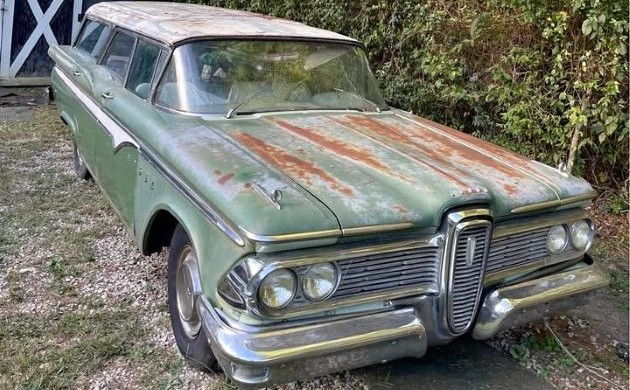
Few nameplates in American automotive history carry the weight of failure quite like Edsel. By the time the 1959 model year arrived, Ford’s ambitious mid-priced division was already bleeding, hobbled by shaky build quality, thin dealer support and a front-end design that shoppers either loved or openly mocked. Ford’s response was a hard reset, and the 1959 Villager station wagon stands as one of the clearest artifacts of that late-inning strategy shift.
The Villager was a survivor in the most literal sense: of the seven Edsel models launched for 1958, only three remained for 1959 — the entry Ranger, the pricier Corsair and the Villager wagon. Advertising leaned hard into value, pitching the lineup as the country’s best car in the low-price bracket. The wagon came in both six- and nine-passenger configurations, and this particular example, listed on Facebook Marketplace in Manchester, Kentucky for $3,800, is hard to classify from photos alone as a two- or three-row car.
Under the hood, things get more interesting. The standard Villager engine was the 332-cubic-inch “Express V8,” a Ford FE unit previously reserved for export-market Edsels. Buyers could step up to a 361-cubic-inch “Super Express V8.” This wagon, however, appears to have been ordered with the money-saving 223-cubic-inch “Economy Six” inline-six — an unusual pick for a wagon. The seller describes the engine as fresh, but an eight-bolt valve cover with Ford script in place of the correct two-bolt blank cover hints the motor may have come from a 1960 or newer Ford, or at minimum received a replacement cylinder head.
Interior photography is sparse, though the dash shot confirms a column-shifted three-speed manual — which the seller mislabels as a two-speed, a transmission type that never existed. The car does not run and needs engine-bay wiring finished before it will. Even so, it presents as solid and largely complete, with straight panels and little serious rust. The windshield is cracked, but Edsel’s dedicated fan base keeps even scarce parts circulating. Whether $3,800 is fair for a non-running project or as optimistic as Edsel’s original pricing is the question any buyer now has to answer.
The bigger historical footnote is why Edsel died at all. Popular lore blames the styling, but the postmortem is messier: quality-control lapses, the optional Teletouch push-button transmission with its exhaust-adjacent wiring, oil leaks and misaligned panels combined with an economic downturn and a car priced above a comparable Ford. Ironically, most Edsel mechanicals were shared with Ford, Mercury and Lincoln, so today’s collectors can service them with familiar parts. That practical reality, plus low production numbers, is exactly why clean Villagers keep drawing attention decades after the marque vanished.
What do you think?