
AITO Confirms Fall 2027 Europe Debut With Four Luxury SUVs
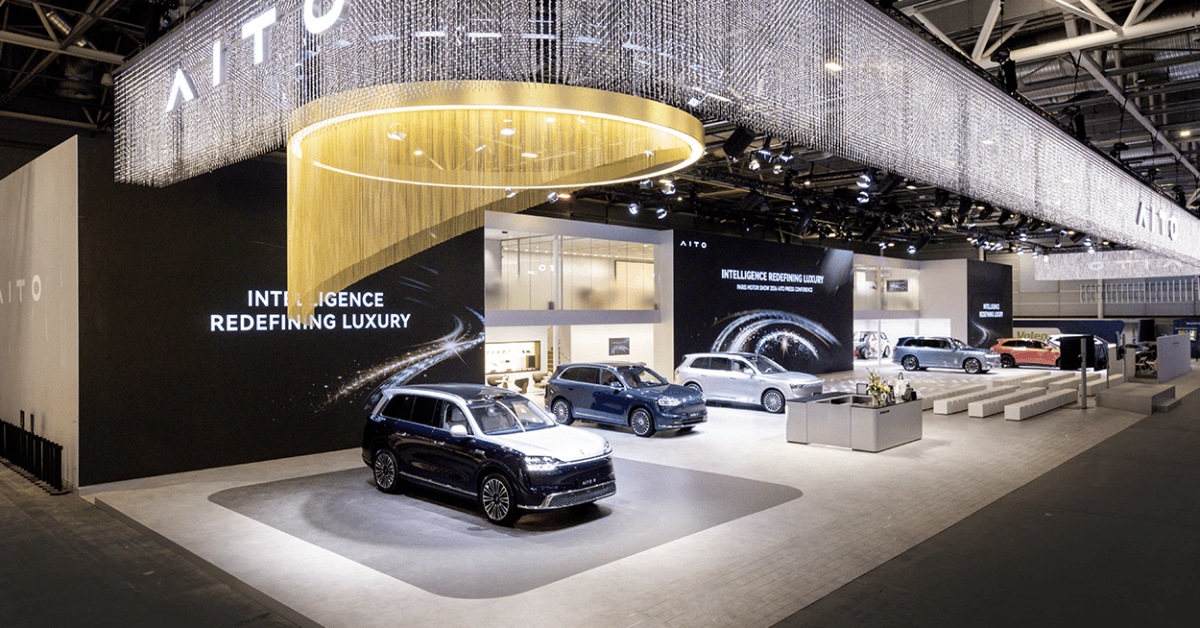
AITO has finally put a date on its long-anticipated European arrival. At the Paris Motor Show, the Chinese luxury marque — a joint effort between automaker Seres and tech giant Huawei — announced it will begin selling vehicles in Europe in autumn 2027, bringing four large SUVs to the region: the AITO 9, 8, 7 and 6. All four were displayed on the show floor in China-spec form.
The brand’s Chinese track record is genuinely substantial. AITO moved 426,000 vehicles in 2025, outselling every other domestic luxury nameplate, with the AITO 8 leading the lineup past 150,000 units and both the AITO 9 and AITO 7 clearing 110,000 each. It reached one million cumulative deliveries in just 46 months. This year, however, momentum has cooled: HIMA deliveries slid 29% year-over-year in September, a fourth consecutive monthly drop, and Seres posted a 1.72 billion yuan net loss in the first half of 2026 after recording a 2.94 billion yuan profit a year earlier.
What the Paris briefing did not include was the information buyers actually want. There are no prices, no named launch markets, no distribution or dealer partners and no European specifications. AITO says it is still working toward EU Whole Vehicle Type Approval and is chasing a five-star Euro NCAP result under the 2026 protocol across the range, along with GDPR compliance. Localization plans cover powertrain and chassis tuning for European roads, multilingual in-car voice control and a service network built with local partners and parts supply. Supplier names Bosch, CATL, Valeo and Pirelli are being highlighted to lend credibility with European customers.
The product itself is sizeable and quick. The flagship AITO 9 measures 5,285 mm long on a 3,125 mm wheelbase, placing it alongside the BMW X7 and Mercedes GLS, with up to 497 kW (666 hp), a 0-100 km/h time of 4.6 seconds, an 800V fully active suspension, rear-wheel steering and a CATL battery. Its five-seat configuration is the pure EV, while the six-seat version uses a range extender. The AITO 6, by contrast, is a 4,960 mm two-row SUV aimed at younger buyers, producing 340 kW in EV form and 345 kW as a range-extended model, with a 5.2-second sprint to 100 km/h. Every model in the European lineup will be offered as either a battery-electric vehicle or a range-extended EV.
A notable shift sits behind the launch strategy. In China, AITO functioned as Huawei’s de facto car brand — the first member of the Harmony Intelligent Mobility Alliance — with Huawei handling product definition, design, retail and its driver-assistance and HarmonyOS cockpit systems, while Seres manufactured the vehicles. That arrangement came at a cost: Seres reportedly paid roughly 10% per vehicle in licensing and channel fees, and its purchases from Huawei and affiliates reached 56.05 billion yuan (about $8.3 billion) in 2025. On September 15, Seres took over product definition, design, marketing, retail and service, with Huawei stepping back to a support role, and the two firms signed a fresh five-year cooperation agreement two weeks later. In Paris, the credit went to the “SERES MF Platform” and unnamed partners — a deliberate choice for a market where several governments have restricted Huawei equipment in 5G networks.
AITO also arrives into a crowded and complicated landscape. Chinese-built battery-electric cars face EU anti-subsidy duties of up to 35.3% on top of the standard 10% import tariff, and range-extended models — which Chinese brands have used to sidestep those charges — now face an EU-China agreement reached on October 9 to halve hybrid and plug-in hybrid exports to the bloc, with terms still unpublished. By late 2027, AITO will be contending with BYD, already the top-selling EV brand in several overseas markets, Xpeng’s European manufacturing ambitions, and the German premium brands on home turf. Without a price list, confirmed markets or partners, autumn 2027 remains a statement of intent rather than a firm launch.
What do you think?