
A Silent EV Doesn't Automatically Give You Better Podcast Sound
Electric cars have earned a reputation for hushed cabins, and it’s mostly deserved. But anyone who bought an EV expecting podcast conversations to suddenly sound like a studio control room has probably noticed something: the silence is only half the story.
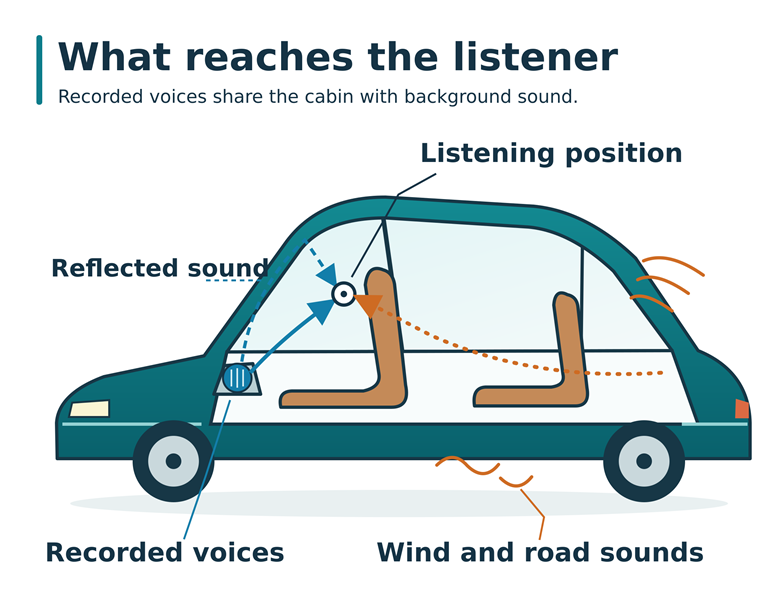
What actually reaches your ears during a drive is a mix of three things — the background noise of a moving car, the way the installed audio system reproduces a recording, and the reflections bouncing around the interior itself. A missing combustion engine removes one contributor to that mix. It doesn’t tune the rest.
Quiet Isn’t the Same as Accurate
A cabin can be whisper-quiet at a stoplight and still color a voice in ways the listener never consciously registers. In an August 2025 technical piece on automotive audio measurement, Steve Temme describes tests run inside an unnamed EV parked in a quiet underground garage. His finding is straightforward enough: microphone placement and surface reflections skew what gets measured, and frequency response — how strongly a system renders different pitches — shapes the tonal balance of everything you hear.
The distinction that matters: Low background noise and faithful reproduction are separate properties. One says nothing about the other.
Temme also found that measurements differed from seat to seat in the same car. Passengers share the recording and the speakers, but not necessarily the same sound. That alone should make anyone skeptical of a spec sheet listing a speaker count as proof of quality.
What a Moving Cabin Really Sounds Like
A documented road test makes the point concrete. In July 2026, Car and Driver put the 2027 Rivian R2 through its paces — specifically the Performance AWD Launch Edition on 21-inch wheels. The numbers: 31 dBA at idle and 67 dBA at 70 mph, with reviewers noting wind rush and suspension thumps at highway speed.
So the EV was near-silent standing still. At speed, it was a normal car with normal noises. For spoken-word listening, that gap matters more than any brochure claim.
Worth keeping in mind: those figures measure overall interior sound under specific conditions. They don’t tell you how clearly individual words came through, and they don’t separate wind from tires from suspension. Different test, different question.
When the Car Itself Makes Noise
There’s another wrinkle. In Temme’s parked test vehicle, a door panel rattled audibly once playback volume climbed. Speaker-driven vibration can set panels, wiring and fasteners moving, which adds sound that was never in the recording.
- Installation matters: Speakers are bolted into a structure, and that structure responds.
- Volume isn’t quality: Maximum output and useful output are different figures; distortion is what separates them.
- Position matters: You hear the system from a specific seat inside a specific space.
None of this has anything to do with the podcast’s subject or the absence of an engine. It’s about how the hardware is mounted and how the cabin behaves under load.
The Takeaway for Podcast Listeners
A quiet EV is a genuinely good place to start. It is not a finish line.
If clear dialogue matters to you — a long-form interview, something dense like the Kim Hughes conversation with bomb-disposal expert Hughes on the podcast of the same name — the useful questions are simpler than a spec sheet: can you follow the back-and-forth without straining, and does the system hold together when you turn it up? Everything else is marketing.
The motor, the road and the stereo each play a role. Only one of them shows up on the window sticker.
Source: Clean Fleet Report
Curious how this compares to other EVs? Try our comparison tool →What do you think?