
A 1977 Honda Z50A Monkey Bike That Survived the Minibike Craze
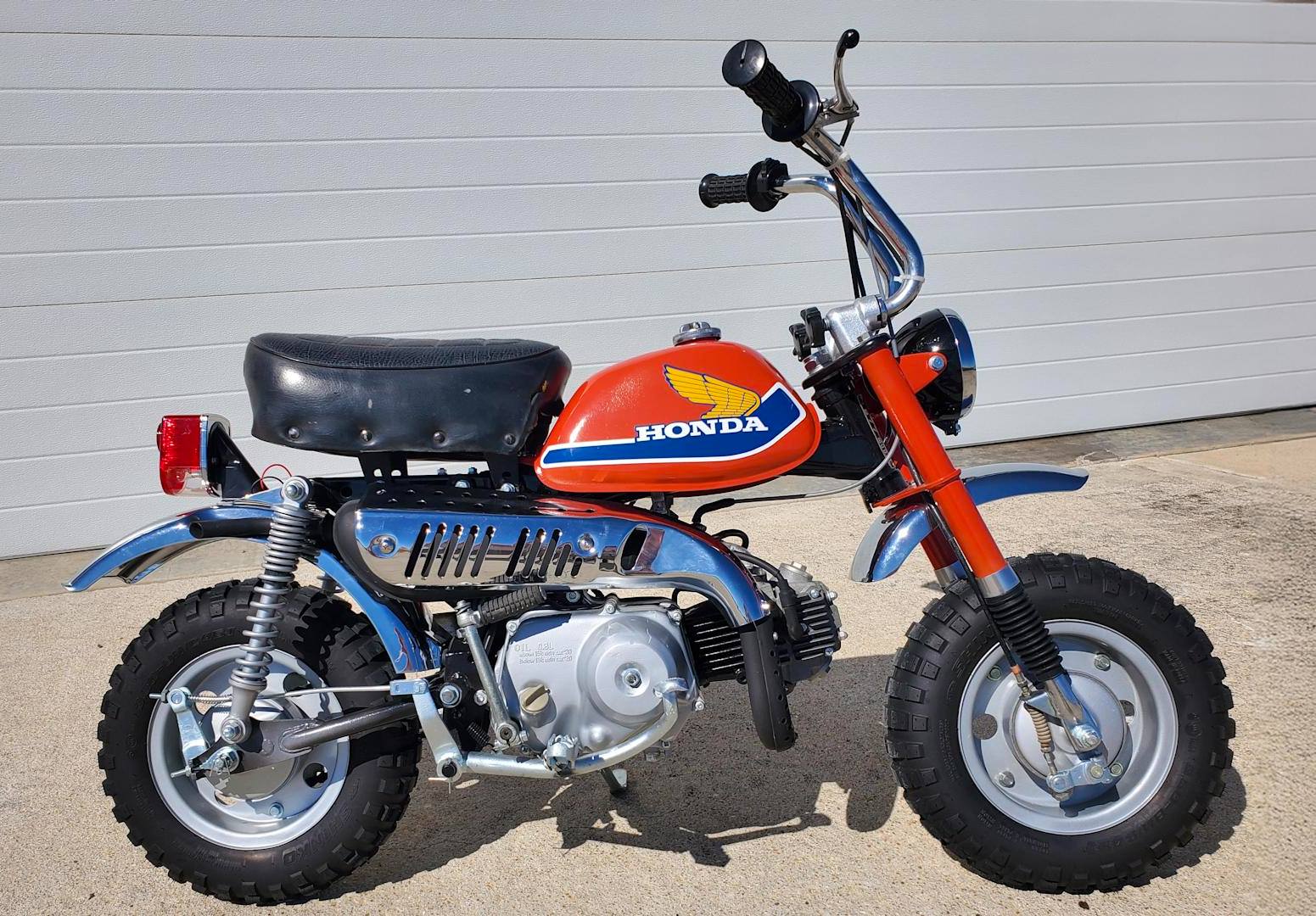
Plenty of kids in the 1970s learned to ride on a tiny Honda, and this one has just come back from a full frame-off restoration. Finished in Tahitian Red with the classic Honda wing graphics on the tank, the 1977 Z50A is heading to auction with Mecum in early December.
The bike has been stripped down and rebuilt with fresh paint, refurbished factory hardware, and its original seat retained. Its 49cc four-stroke single and carburetor were both professionally rebuilt, and the factory three-speed semi-automatic gearbox means you shift without ever touching a clutch lever. The seller lists it as running and working.
Key Specs: 49cc four-stroke single · 3-speed semi-automatic transmission · Tahitian Red repaint · Recent frame-off restoration
How a Fairground Ride Became a Cult Classic
The Z50’s story starts nowhere near a showroom. Back in October 1961, Honda opened two motoring-themed parks in Japan — Tama Tech outside Tokyo and Ikoma Tech in Nara Prefecture — and built a miniature bike called the Z100 so visitors could take a lap. It borrowed the Super Cub’s 49cc engine, ran tiny 5-inch tires, and earned the “monkey bike” nickname because full-grown adults looked ridiculous aboard it, knees up and elbows out.
Honda never intended to sell the thing. That plan flipped after the Z100 drew crowds at the Frankfurt and London motor shows in late 1962. Twenty units were shipped to Europe that December for evaluation, and the enthusiastic response led to the road-legal CZ100, built from 1964 in a small corner of the Suzuka plant where five workers turned out 20 bikes a day.
Japan got its own version with the 1967 Z50M, which added lights and a folding seat and handlebars so the bike could fit in a car trunk.
The Version That Took Over America
The American Mini Trail arrived just as a genuine minibike boom was sweeping the country. At its height, more than 150 companies were churning out minibikes, most of them lawn-mower engined machines sold through hardware stores and farm-equipment dealers. Honda’s advantage was obvious: three gears, an automatic clutch, front suspension, and a dealer network for parts and service.
By 1974, only about 10 minibike builders remained. Wisconsin collector Tom Drzewiecki, who owns more than 60 of the early machines, calls the Honda’s arrival “pretty much the end” for the homegrown American makers.
The Mini Trail also launched careers. The kid pulling a long wheelie in the opening minutes of the 1971 documentary On Any Sunday, filmed at Saddleback Park, was Jeff Ward — later an AMA Supercross and Motocross champion in the 1980s.
Honda kept refining the formula. The 1972 K3 swapped the rigid tail for a swingarm and twin shocks, a layout that lasted through the 1978 model year. The off-road Z50R took over for 1979 and ran until 1999, followed by the XR50R in 2000 and the CRF50F in 2004 — a bike Honda still sells today.
For anyone who grew up on one of these, the appeal here isn’t speed. It’s the paper trail: correct paint, correct graphics, original engine cases, and a rebuild done properly rather than hastily.
Photo: Honda / Silodrome · Official Press Kit / Editorial (Editorial / Press Kit)
Source: Silodrome
What do you think?