
1965 Greeves 24TFS Scrambler Heads to Auction After 12 Years of Near Silence
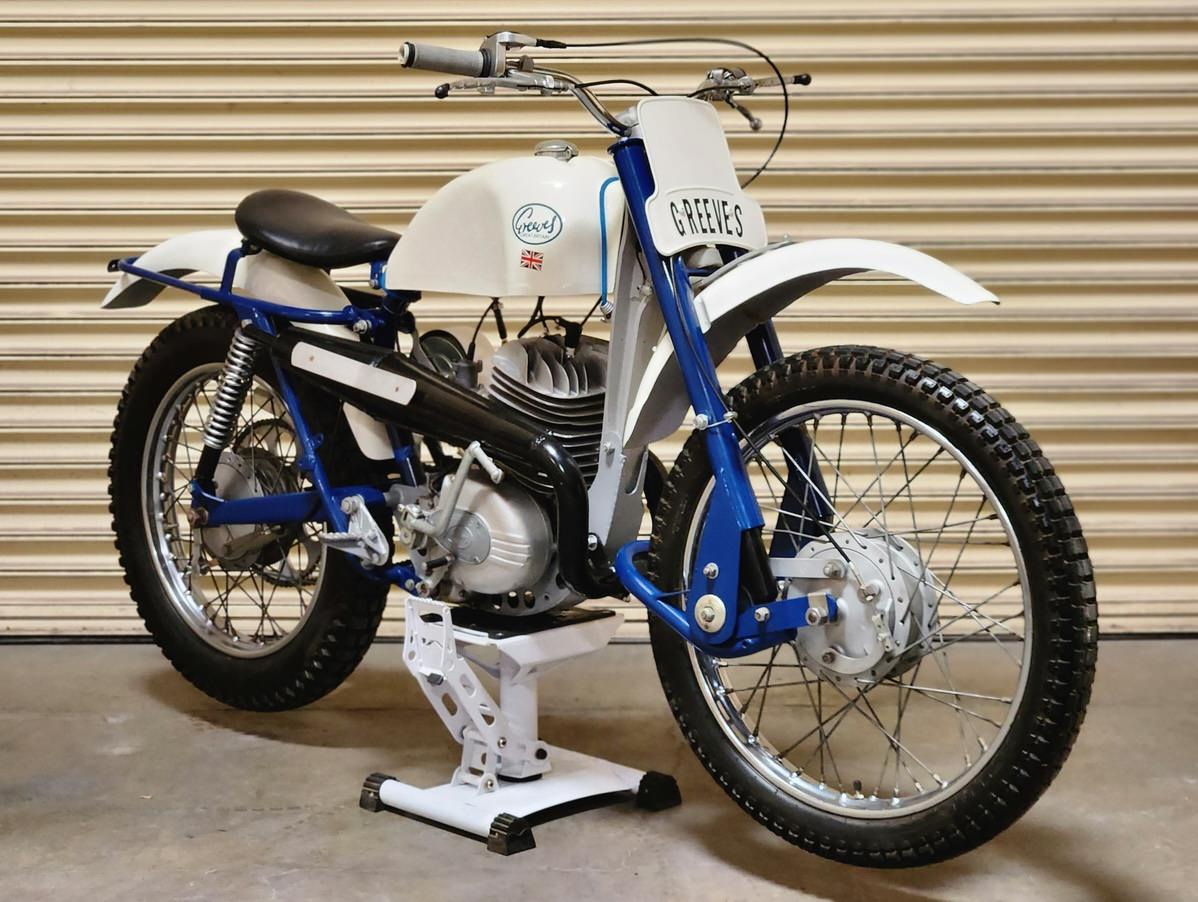
A genuine slice of British off-road history is up for grabs in California: a 1965 Greeves 24TFS, the Essex-built two-stroke that once gave four-stroke machines a serious headache in trials and scrambles competition on both sides of the Atlantic.
The bike is being offered with a bill of sale and sold strictly for off-road use, which is fitting — this is a competition tool, not a commuter. Its current owner reports roughly 35 minutes of running time across the last twelve years. In other words, it has spent most of its recent life as a display piece.
What the Restoration Left Behind
A 2014 refresh gave the multi-piece frame a coat of Moorland Blue, while the fuel tank and the high-mounted mudguards went white. The tank carries something a little more personal than paint: the signature of Dave Bickers, the former Greeves works rider who took the 250cc European Motocross Championship in 1960 and 1961.
There’s also a solo trials saddle, a front number plate, a side stand, a leading-link fork up front and a tapered steel swingarm at the back, damped by NJB shocks. Wire-spoke wheels measure 21 inches in front and 19 at the rear.
Key Specs: Villiers 37A 246cc two-stroke single · Amal concentric carburetor · Four-speed gearbox · Chain final drive · 21-inch front / 19-inch rear spoked wheels
The Engineering That Set Greeves Apart
The powerplant is a Villiers 37A 246cc two-stroke single, topped with Greeves’ own alloy square-barrel head and fed through an Amal carburetor, with a compression release on hand. A right-side-shifted four-speed gearbox sends drive to the rear wheel by chain.
What really separated Greeves from the crowd, though, were three design quirks: a cast LM6 aluminium-silicon alloy I-beam downtube standing in for the usual steel frame tube, rubber-in-torsion springing at each end, and the unmistakable “Banana” leading-link front fork. The package was light, odd-looking and remarkably hard to break off-road.
From Invacars to the World Stage
The company’s origins are stranger than most. Bert Greeves first fitted a lawnmower engine to the wheelchair of his cousin Derry Preston-Cobb after the Second World War, a project that grew into the Invacar — a petrol-powered three-wheeler for disabled drivers that won a major Ministry of Pensions contract in 1952.
That steady government income funded Bert’s real passion. A lifelong motorcyclist and trials rider, he built a prototype in 1951 around a 197cc Villiers two-stroke, borrowed the Invacar’s rubber-in-torsion suspension, and put the first Greeves machines on show at Earls Court in 1953.
Racing did the rest. Brian Stonebridge famously beat 500cc machinery on a smaller Greeves at Hawkstone Park in 1957. After his death in a car accident in October 1959 — with Bert at the wheel — the factory signed Bickers, and Greeves riders went on to win at the Manx Grand Prix, the Scott Trial and the Scottish Six Days.
“Greeves motorcycles were known for handling well and for helping to popularize two-strokes.”
By 1962 the Thundersley works was turning out eleven models, from roadsters to road racers, with a healthy export trade — especially in the United States, where the marque helped grow off-road riding as a sport. Fewer than 125 people ever worked there.
Bert retired in 1973, the company slipped, and a factory fire in the late 1970s closed the original chapter. Richard Deal bought the name in 1999 and revived it with a new 280cc trials machine in 2009.
As for this one, it sits in Morgan Hill, California, waiting for someone who wants a rare piece of two-stroke history — and doesn’t mind that it’s trailer-only territory.
Source: Silodrome
What do you think?