
- Explain the automated driving V&V test pyramid and the economic rationale behind the X-in-the-Loop (MIL/SIL/HIL/VIL) methodology.
- Distinguish which class of defect each of MIL, SIL, HIL and VIL uniquely catches, and which it structurally cannot.
- Describe how centimeter-accurate ground truth infrastructure is built for closed-course (proving ground) testing.
- Evaluate why public-road testing is both the most necessary and the most expensive/risky final tier of the pyramid.
- Relate large-scale cloud simulation versus real-world mileage — including the sim-to-real gap — to documented industry practice.
AD-22 — Verification and Validation: MIL, SIL, HIL, VIL, Track and Simulation
FACT — An autonomous driving software stack has a version that can be tested without ever touching its target ECU, its real sensors, or a real vehicle; a version tested with the full hardware stack in a lab; and finally a version driving a real vehicle on a real road. The gap between these three versions is pure engineering economics: running a million scenarios overnight in the cloud costs almost nothing, while driving a real vehicle a million kilometers in real traffic takes years and puts real people at risk. This lesson walks step by step through the verification and validation pyramid that bridges those two extremes — MIL, SIL, HIL, VIL, track, and public road.
In this lesson, you will learn:
- V&V Concepts and the Economic Logic of the Test Pyramid — why cost and risk compound at every tier.
- MIL (Model-in-the-Loop) — the earliest, cheapest validation, running against a pure mathematical model.
- SIL (Software-in-the-Loop) — actual production code, simulated sensor inputs.
- HIL (Hardware-in-the-Loop) — real ECUs, simulated signals, real-time fault injection.
- VIL (Vehicle-in-the-Loop) — a real vehicle, a partially simulated scene.
- Proving Ground (Closed-Course) Testing — fully real, but controlled enough to permit dangerous scenarios.
- Public-Road Testing — the pyramid’s most realistic, most expensive, and slowest final tier.
- Cross-Tier Comparison and Case Study — what each tier catches, and what it structurally misses.
1. V&V Concepts and the Economic Logic of the Test Pyramid
Systems engineering draws a strict line between two questions:
- Verification: “Did we build the system right?” — does the output conform to the engineering specification?
- Validation: “Did we build the right system?” — does the output actually satisfy real-world safety and user needs?
A control algorithm can be verified — perfectly correct against its specification — and still misjudge a real pedestrian’s behavior, i.e. remain unvalidated. Answering both questions drives the industry toward an X-in-the-Loop (XiL) pyramid that runs from cheap/fast/early tiers to expensive/slow/late tiers:
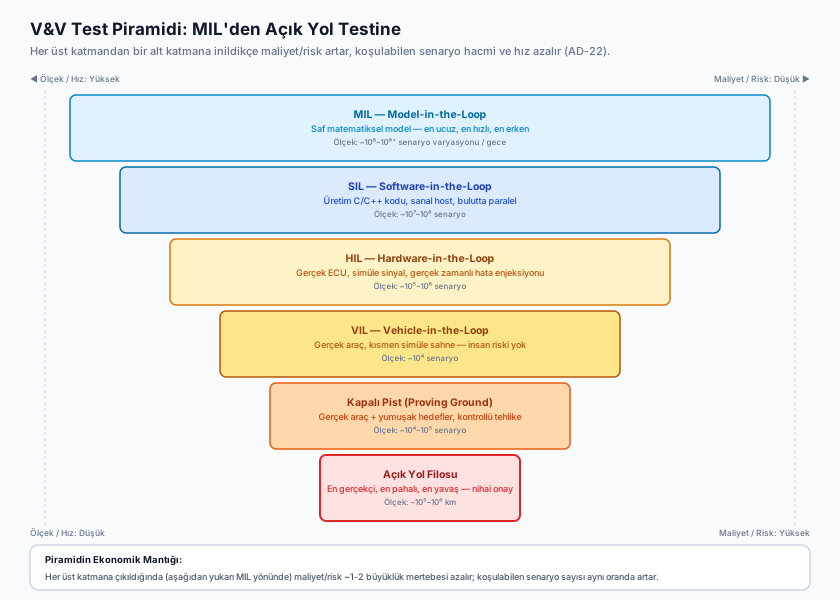
The Test Pyramid — Cost, Risk, and Realism Axis:

                 [ PUBLIC ROAD FLEET ]
                 Most realistic, most expensive, slowest
                /                                       \
               /          10^5 - 10^6 km                 \
              /------------------------------------------ \
             [ PROVING GROUND (CLOSED COURSE) ]
             Real vehicle, controlled hazard
            /                                             \
           /             10^4 - 10^5 scenarios             \
          /-------------------------------------------------\
         [ VIL — Vehicle-in-the-Loop ]
         Real vehicle, partially simulated scene
        /                                                   \
       /                  10^4 scenarios                     \
      /---------------------------------------------------- --\
     [ HIL — Hardware-in-the-Loop ]
     Real ECU, simulated signal, hard real-time
    /                                                         \
   /                  10^5 - 10^6 scenarios                    \
  /----------------------------------------------------------- -\
 [ SIL — Software-in-the-Loop ]
 Production code, virtual host, massively parallel in the cloud
/                                                                \
/                    10^7 - 10^8 scenarios                        \
/------------------------------------------------------------------\
[ MIL — Model-in-the-Loop ]
Pure mathematical model — cheapest, fastest, earliest
                 10^8 - 10^9+ scenario variations
CRITICAL — The pyramid’s reason for existing can be stated in one sentence: each step up costs roughly one to two orders of magnitude more and carries proportionally more physical risk, while the number of scenarios that can be run drops by a similar factor. So the industry pushes as much validation as it possibly can into the bottom tiers — MIL and SIL. Running millions of scenario variations overnight on cloud compute is a cheap substitute for something that is physically impossible with a real fleet: “a million test-drives in one night.”
But this pyramid is not a one-way hierarchy — each tier catches a class of defect that the tier below it structurally cannot. Throughout this lesson we’ll ask both “how cheap/fast is this tier” and “what can it never catch” for each layer.
2. MIL — Model-in-the-Loop
Environment: MATLAB/Simulink or equivalent symbolic modeling tools; no target microcontroller, compiler, or memory model is present.
What is tested: The pure mathematics of the control algorithm — whether an MPC (Model Predictive Control) trajectory tracker, a Kalman filter, or a PID speed controller correctly solves its continuous-time differential equations.
Why it’s the cheapest tier: There is no code compilation, target hardware, or real-time constraint; a laptop can sweep thousands of parameter variations in seconds. Parallelized in the cloud, hundreds of millions of scenario variations can be swept overnight — a scale that is never achievable on a physical test track.
What it structurally misses: MIL proves the algorithm is mathematically correct, but it never sees real-world noise, sensor bias, timing jitter, or the numerical quantization (fixed-point/floating-point) errors of the target processor. An algorithm that is flawless on paper can behave differently on real hardware once clock-cycle constraints kick in.
3. SIL — Software-in-the-Loop
Environment: The actual production C/C++ code, whether generated from the model or hand-written, compiled and executed on a virtual host (x86_64).
What is tested: Unlike MIL, this is no longer an abstract model — it’s the exact code that will ship: memory management, state machines, integer overflows, pointer errors, loop-timing assumptions. Simulated sensor inputs (recorded or synthetic) and a simulated vehicle dynamics model feed the code.
Why the next tier is needed: There is always a gap between the mathematical model validated at MIL and the code that actually gets compiled — bugs in code generation tooling, hand-added optimized routines, or numerical precision differences never show up in MIL’s abstract model. SIL is what catches these implementation bugs.
Scale: Because SIL is decoupled from the target processor’s clock, it too runs with heavy cloud parallelism — typically 5-50x real time across thousands of concurrent CPU cores.
What it structurally misses: SIL still does not model real hardware I/O timing, bus (CAN/Ethernet) latency, interrupt priorities, or the noise characteristics of a real sensor’s analog-to-digital converter.
4. HIL — Hardware-in-the-Loop
Environment: A real production ECU (e.g., an ADAS Domain Controller) is mounted in a physical test rig (real-time simulators such as dSPACE, Speedgoat, ETAS). The code now runs not on a virtual host, but on the target hardware’s own processor, at its own clock speed.
Subsystems:
- Sensor Emulation: Instead of real camera/radar/LiDAR hardware, synthetic signals are injected directly at the sensor’s physical interface (FPD-Link/GMSL deserializer, radar RF front-end) — for instance, a Radar Target Simulator produces a delayed 77 GHz microwave reflection.
- Bus Simulation: A real-time simulator drives CAN-FD/FlexRay/Automotive Ethernet traffic at microsecond precision, with realistic bus load.
- Fault Injection: Wire disconnection (open-circuit), short-to-chassis or short-to-supply faults, bus packet loss, and memory bit-flips are triggered at the hardware level to measure how quickly the ECU transitions to a safe state.
Why the next tier is needed: SIL can never model the target hardware’s real-time behavior — how many microseconds an interrupt routine actually takes, when a CAN bus actually saturates (bus load), or how a short circuit actually affects the ECU’s power rail can only be measured with real silicon.
WARNING — Do not conflate “open-loop” and “closed-loop” HIL testing. In open-loop mode, recorded sensor data is replayed to the ECU, but the ECU’s braking/steering command does not affect the virtual world — this only measures response correctness. In closed-loop mode, when the ECU issues a braking command, the vehicle dynamics model in the HIL rig actually decelerates, and the target distance fed back to the sensor emulators updates within milliseconds to reflect that deceleration — only this second mode validates a genuine closed-loop control response.
What it structurally misses: HIL cannot simulate real tire-road friction, real suspension compliance, the real pressure-buildup delay of brake hydraulics, or microscopic dirt/salt contamination on a real camera lens — because a physical vehicle body is still not in the loop.
5. VIL — Vehicle-in-the-Loop
Environment: A fully assembled, physical vehicle is genuinely driven on a chassis dynamometer or an empty test track, while some elements are still simulated — for example, a virtual pedestrian, a virtual lead vehicle, or virtual intersection traffic is overlaid onto an empty track and injected in real time into the vehicle’s perception layer.
Why this tier matters: VIL bridges HIL and track testing. The vehicle’s real suspension response, real brake hydraulic delay, and real steering actuator dynamics are now in the loop — but a dangerous scenario (e.g., a pedestrian suddenly stepping into the road) can be tested without putting a real person at risk, because the “pedestrian” is only a virtual object injected into the perception sensors.
EXAMPLE — In a VIL setup, while a vehicle genuinely travels at 50 km/h on an empty track, a synthetic child figure is injected into the camera feed and/or radar return as if it had just entered the road 30 meters ahead. The vehicle genuinely brakes, genuinely slows down — but no real human is ever present. This combination of “real physical response + zero human risk” is unique to this tier.
What it structurally misses: VIL is still a controlled track environment; it does not capture the unpredictability of real traffic, the behavioral diversity of real drivers, or the real geometric quirks of an unmapped intersection.
6. Proving Ground (Closed-Course) Testing
At the track, nothing is simulated anymore — the vehicle, the environment, and the other actors are all real; the only difference is that the environment is private and controlled. This makes it possible to safely run dangerous scenarios with trained test drivers and “soft targets.”
Ground Truth Infrastructure:
- Differential RTK-GNSS + Tactical IMU: Test vehicles and target platforms carry dual-antenna RTK-GNSS coupled to tactical-grade Fiber Optic Gyro (FOG) IMUs; positional accuracy is under 2 cm, heading accuracy under .
- Soft Targets: A GVT (Global Vehicle Target) is a foam vehicle target whose radar/LiDAR reflectivity matches a real car, and which breaks apart harmlessly on impact. A UFO (Ultra-Flat Overrunable Robot) is under 5 cm tall, safe to drive over without damaging a tire, and moves in RTK-synchronized trajectories.
FACT — Euro NCAP protocols require ground truth data logging at a minimum of 100 Hz and constrain relative-distance measurement error between the test vehicle and the target to under 5 centimeters — without this precision, whether an AEB system triggered at exactly the right moment cannot be objectively proven.
What it structurally misses: By definition, a track is controlled — it can never fully replicate the real-world diversity produced by an unexpected pedestrian, an unexpected driver, or an unmapped road sign.
7. Public-Road Testing — The Top of the Pyramid
The pyramid’s final and most realistic tier is testing in real traffic, real weather, with real human drivers and pedestrians sharing the road. This tier is also the most expensive, slowest, and riskiest — which is why permission to run public-road testing is typically only granted once a system has reached a defined maturity threshold across every tier below it.
INTERPRETATION — The rationale for public-road testing comes down to two things no amount of simulation can fully capture: the idiosyncratic, never-perfectly-modeled noise signature of real sensor hardware (every camera/radar has its own manufacturing tolerances), and the genuinely unpredictable diversity of the real world (no scenario library can enumerate every combination real traffic might produce). These two facts explain why, despite billions of simulated kilometers, real-world mileage remains indispensable — we will return to this as the “long tail” problem in AD-24 — Edge Cases and Rare Events in Autonomous Driving.
ASSUMPTION — Publicly disclosed reports from major autonomous driving developers state that, alongside real-world test mileage, they run simulation at the scale of billions of kilometers (e.g., simulation-mileage figures Waymo has disclosed in its public safety reports); this is a well-documented general industry pattern. However, exact figures, methodology, and model-year scope vary — for current, precise numbers, consult the relevant company’s latest published safety report.
8. Cross-Tier Comparison
| Tier | Hardware | Software Target | Speed Factor | Relative Cost | Primary Focus | Structurally Misses |
|---|---|---|---|---|---|---|
| MIL | None (PC) | Mathematical model | 10x–100x real time | Negligible | Algorithm mathematics | Code implementation, hardware timing |
| SIL | None (x86_64 host) | Production code (C/C++) | 5x–50x real time | Low | Software logic, memory safety | Real-time I/O, hardware faults |
| HIL | Real production ECU | Target binary | 1.0x (hard real time) | High | I/O timing, fault injection | Real vehicle dynamics, tire-road contact |
| VIL | Full physical vehicle | Fully integrated system | 1.0x real time | Very high | Actuator/suspension dynamics | Real traffic unpredictability |
| Track | Full physical vehicle + real targets | Fully integrated system | 1.0x real time | Very high | Controlled dangerous scenarios | Real traffic diversity |
| Public Road | Full physical vehicle | Fully integrated system | 1.0x real time | Highest | Final real-world validation | Scalability (statistical confidence needs years) |
Frequently Asked Questions (FAQ)
Q: If cloud simulation is this cheap and fast, why do we still need expensive track and public-road testing?
WARNING — Simulation models are always an abstraction. Details like micro-slip in tire-road contact, microscopic dirt/salt buildup on a lens, or a real GPU’s timing behavior under thermal load cannot be fully modeled. This gap is called the sim-to-real gap: a perception model that achieves 99.99% accuracy in simulation can produce unexpected false positives (e.g., ghost braking) in the real world. Sensor noise models must therefore be regularly recalibrated against real track data.
Q: Why is fault injection in HIL testing considered mandatory under ISO 26262? A: The only way to prove that an ASIL-D system transitions to a safe state upon failure is to deliberately induce the failure. For example, whether the system transitions to a backup controller or a safe state within the defined Fault Handling Time Interval when a CAN line shorts to chassis must be measured and proven on the HIL rig.
Q: Is each tier of the pyramid used sequentially, or in parallel?
INTERPRETATION — In practice it’s not linear. A feature is tested intensively in MIL/SIL when first developed; as it matures it moves to HIL — but SIL/MIL testing never stops. Every new code change runs through the cheapest tiers first (regression testing), and only critical changes are promoted all the way up to track/public-road testing.
Summary
- Verification (conformance to spec) and validation (conformance to real-world safety) are different questions, addressed with different emphasis at each tier of the pyramid.
- The pyramid’s economic logic is simple: each tier up costs and risks substantially more, while the number of scenarios that can be run drops — so as much validation as possible is pushed to the cheapest tiers (MIL/SIL).
- MIL tests pure mathematics, SIL tests the implementation correctness of the production code, HIL tests real hardware timing/fault behavior, and VIL tests real actuator dynamics without human risk.
- Track testing is controlled but fully physical reality; public-road testing is the final but most expensive/slow/risky tier, and it catches the sensor noise and world diversity that simulation can never fully replicate.
- The sim-to-real gap is the technical root of why real-world testing remains indispensable despite massive simulation investment.
Sources and Verification Note
The V&V pyramid structure presented in this lesson is grounded in ISO 26262-4 (system-level product development), ISO 21448 (SOTIF), and the test infrastructure standards within the ASAM OpenX ecosystem (see AD-23); ground truth accuracy requirements are drawn from Euro NCAP test protocols. Waymo’s publicly disclosed simulation-mileage figures are marked as ASSUMPTION — for exact current numbers, consult the company’s latest published safety report.
Next Lesson
- AD-23 — Scenario-Based Testing Methodology and Safety Metrics: We examine what actually runs at the MIL/SIL tiers of this pyramid — structured scenario libraries, the ASAM OpenSCENARIO/OpenDRIVE standards, and objective safety metrics such as TTC, PET, DRAC, and RSS.
Technical Diagrams
Quiz
What is the foundational architectural difference between HIL and SIL testing environments?
HIL (Hardware-in-the-Loop) connects physical target ECU hardware to real-time hardware emulators, whereas SIL executes compiled code on host virtual machines.
What is the key engineering characteristic of the Global Vehicle Target (GVT) used in Euro NCAP track testing?
GVT is an internationally standardized collapsible soft target that exhibits the radar, LiDAR, and optical properties of a real car without posing impact hazards.
What is the primary ISO 26262 justification for executing 'Hardware Fault Injection' on HIL test benches?
Fault injection verifies that the ECU detects electrical shorts, open circuits, and corrupted bus signals, executing safe-state transitions within strict timing boundaries.
What safety-critical vulnerability does the 'Sim-to-Real Gap' represent in autonomous driving development?
The Sim-to-Real Gap describes domain shifts where perception networks trained on synthetic data fail to generalize to subtle optical aberrations and physical noise in reality.
Glossary
| English Term | Definition |
|---|---|
| Hardware-in-the-Loop (HIL) | A verification stage where real physical ECUs/controllers are connected to a simulation rig that generates realistic sensor signals and reads actuator outputs in real time — validates real hardware timing/behavior without a physical vehicle. |
| Global Vehicle Target (GVT) | A radar/LiDAR-reflective, inflatable/soft, realistic vehicle target used in physical test/validation stages (including Euro NCAP protocols) for systems like AEB, allowing safe collision-risk testing without damaging a real vehicle if actually struck. |