
Volvo and Waabi Launch Autonomous Freight Hauls for Warp in Texas
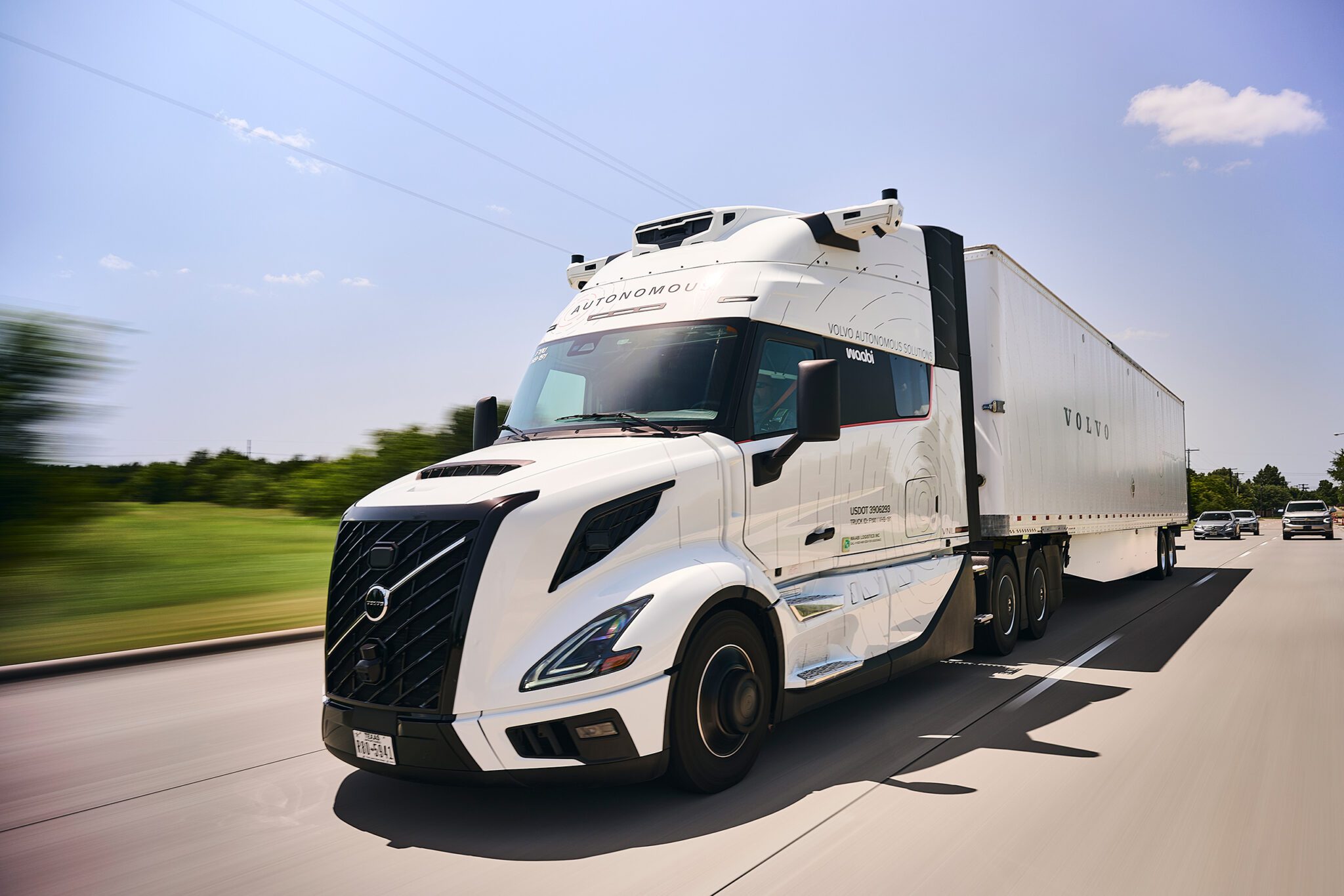
Volvo Autonomous Solutions and Waabi have kicked off commercial freight operations in Texas, hauling loads for the logistics platform Warp. This marks the first customer-facing deployment in the two companies’ partnership. The vehicles handling the work are Volvo VNL Autonomous trucks equipped with the Waabi Driver, and they are now running directly to third-party delivery locations along the Dallas–Houston corridor. For now, a human observer remains in the cab during every trip.
The operation stands out because it moves into less-than-truckload (LTL) territory, a segment where shipments from numerous shippers are combined and moved under strict deadlines. That setup is considerably more challenging than dedicated single-customer routes, and running point-to-point between facilities without relay handoffs gives LTL carriers a way to keep their schedules intact.
Volvo’s truck was engineered specifically for autonomous duty from the ground up. It carries redundant backup across six safety-critical systems and leaves space to integrate third-party software. Volvo bundles the vehicle with Waabi’s driving technology, fleet management tools, terminal operations and uptime assistance under its Autona offering.
Nils Jaeger, President of Volvo Autonomous Solutions, framed the launch as a significant step: “Together with Warp and Waabi, we are bringing autonomous freight into customer operations in one of logistics’ most demanding segments. This shows how quickly our ecosystem can adapt to new customers and more complex operations. What we learn on the Dallas–Houston corridor will help us strengthen our partnership and continuously improve the ecosystem as we scale.”
Warp serves customers including Walmart, DoorDash and Gopuff, and operates both LTL and full-truckload services through a single network. Insights gathered on the Dallas–Houston route will shape additional lanes as the partners expand. The broader significance is hard to miss: Volvo has built a driver-agnostic truck platform designed to host partners’ systems, working with Waabi alongside Aurora, which hints that the manufacturer intends to control the vehicle and logistics layers while preserving flexibility on the driving-software side. Running straight to facilities rather than through transfer hubs could also broaden autonomous trucking’s potential market well beyond the hub-to-hub model. Yet the continued presence of an observer in the cab suggests that Volvo and Waabi are still some distance from the fully driverless milestone that would deliver the biggest cost benefits.
What do you think?