
Two 1970 Chevrolet Novas, Two Very Different Fates, One Asking Price
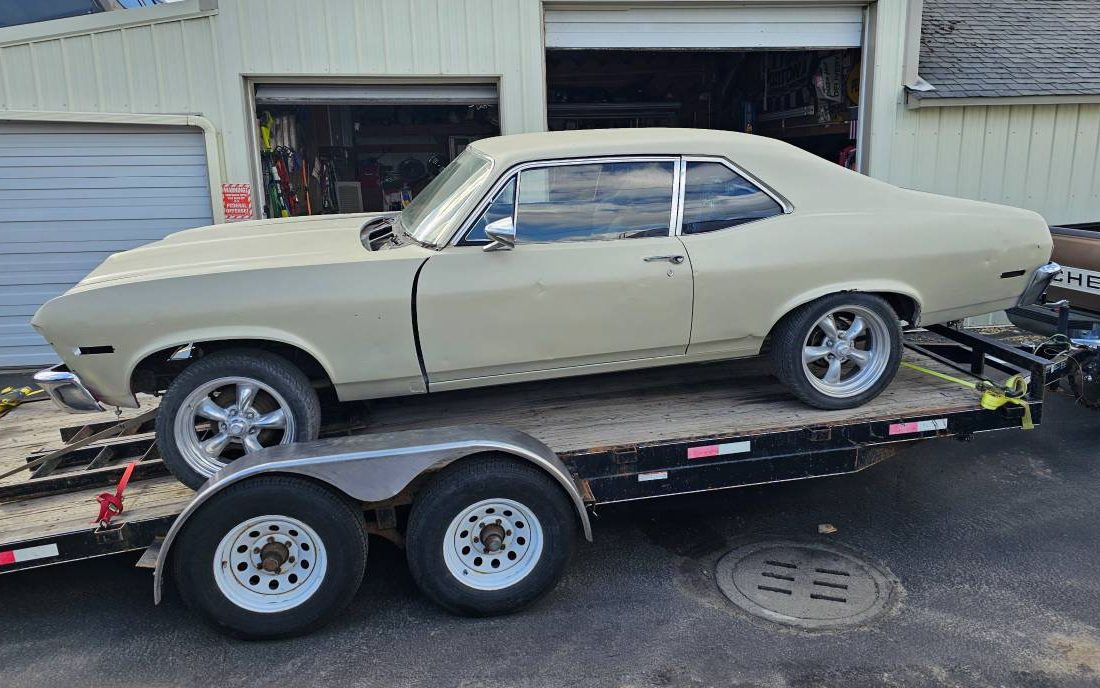
Collectors who like their projects served in pairs may want to look toward Spokane, Washington, where a seller is offering two 1970 Chevrolet Novas together for $10,000. The listing, placed on craigslist, groups a two-door coupe and a four-door sedan — cars that share a model year and a badge but little else. One reportedly runs, while the other is a stripped-down restoration candidate sitting on a trailer. It is a package designed for the buyer who wants a driver now and a long-term wrenching project on the side, rather than someone hunting a single turnkey car.
The Nova nameplate has deep roots at Chevrolet. It debuted in 1962 as the top trim of the Chevy II, the division’s second attempt at a compact, and it was distinguished from the Corvair by its conventional front-engine, rear-drive layout rather than the Corvair’s rear-mounted air-cooled setup. By 1969 the Nova badge had eclipsed Chevy II entirely, and the car settled into its role as a simple, affordable, rear-drive runabout that could be ordered with anything from a modest six-cylinder to a serious V8.
The 1970 model year brought only light revisions: larger, clear front turn signal lenses and revised side marker lights, with most of the car carried over from 1969. Buyers clearly did not mind. Nova sales climbed roughly 22 percent that year, from about 252,000 units to 307,000. That volume is one reason examples remain relatively easy to find today, and it is also why the car occupies an approachable corner of the muscle-era market — not as celebrated as a Chevelle or Camaro, but well supported by parts vendors.
Of the two cars on offer, the four-door sedan appears to be the usable one. Its front fender crest indicates a 307 cubic-inch V8, most likely backed by a Powerglide or a TH-350 automatic, and the seller says the car does run. Simple steel wheels with basic hubcaps give it an honest, unfussy look. The catch is documentation: no photos of the interior or the engine bay are included, so a buyer cannot judge whether this is a tidy driver or simply a car that starts.
The coupe is the bigger unknown. It is the car pictured on the trailer wearing aftermarket wheels, and the listing describes it as a V8 with an automatic — though which combination, and whether the powertrain is even present, is left unclear. The odometer has rolled over. Its body will need replacement quarter panels and a new panel between the taillights, and those parts are said to come with the sale. With no interior images provided either, the true scope of the work is hard to pin down. Both cars carry matching stripes on the deck lid, an odd shared detail. For anyone weighing the pair, an in-person inspection before money changes hands is the sensible first move — and the first question to the seller should be exactly what is still bolted under the coupe’s hood.
What do you think?