
Tesla Enables Home Backup for Model 3 and Model Y via Powerwall 3
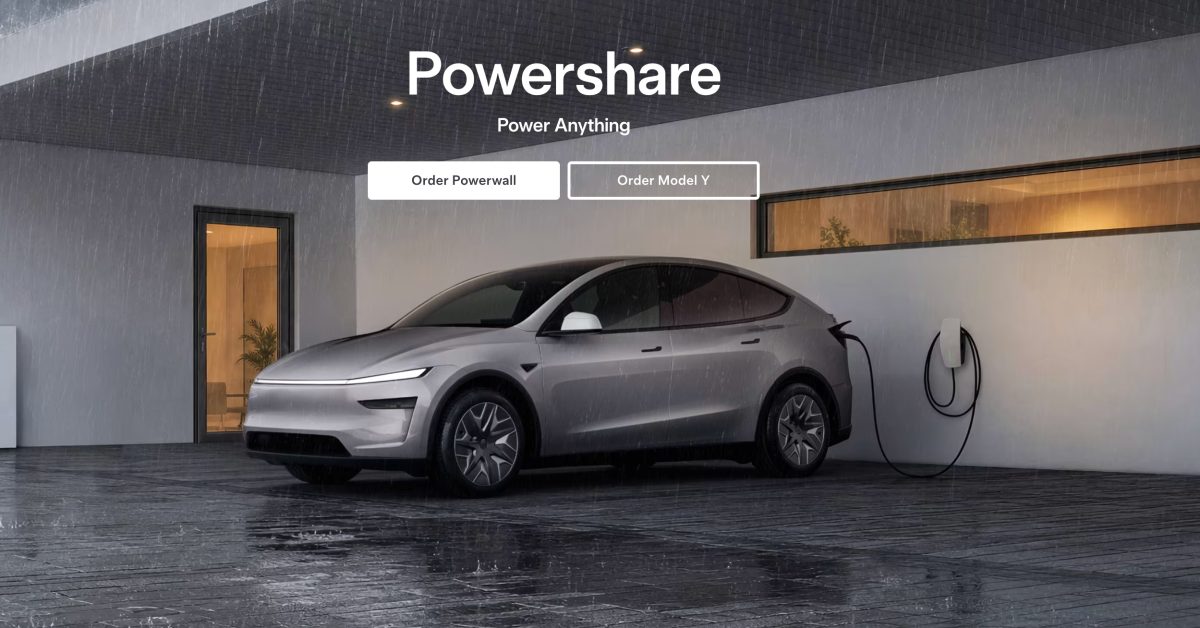
Tesla’s two best-selling vehicles can now send electricity back into a home during a blackout, but the feature arrives with a long list of conditions. Owners of the Model 3 and Model Y can use their car’s battery to keep the lights on — provided they also own a Powerwall 3, the company’s home battery unit, according to Tesla’s updated Powershare documentation. Until now, the Cybertruck was the only Tesla model capable of this kind of vehicle-to-home power delivery.
The mechanics are straightforward enough. A car plugged into a Tesla Wall Connector at a house equipped with a Powerwall 3 will extend the home’s backup power when the grid fails. Tesla says the setup delivers a maximum continuous output of 11.52 kW. For a household consuming roughly 30 kWh per day, a Model 3 or Model Y charged to 90 percent adds more than two days of backup, while standard trims are rated for up to two days. The Cybertruck, by comparison, stretches that past three days. Tesla notes that existing Powerwall 3 and Wall Connector owners need no additional hardware, though they must contact Tesla support to activate the capability.
Eligibility is where things get restrictive. Tesla’s guarantee applies only to Model 3 and Model Y vehicles ordered in the United States and Puerto Rico on or after October 1, 2026. Older cars are a mixed bag: the company says some, but not all, have the necessary hardware, which runs through an inverter Tesla calls PCS2 Lite. Owners can verify their car’s status on the touchscreen by navigating to Software and then Additional Vehicle Information, where an enabled “Powershare Support” entry indicates compatibility. Powerwall 2 and Powerwall+ support is described as coming soon. Without a Powerwall, home backup is unavailable, and unlike the Cybertruck, there is no Powershare Gateway alternative. Grid export is also off the table, and the Model S and Model X are not included. Canadian customers remain limited to Cybertruck functionality.
Tesla is entering a field its rivals staked out years ago. Ford introduced home backup on the F-150 Lightning in 2022 with 9.6 kW of output, while General Motors pledged in 2023 to bring vehicle-to-home capability to every Ultium-based EV by model year 2026 and has since rolled it out across Chevrolet, GMC and Cadillac models. Kia offers the feature on the EV9 through a Wallbox bidirectional charger. Tesla’s own timeline slipped: at its 2023 Investor Day, then-powertrain chief Drew Baglino suggested bidirectional charging was about two years away, pointing to 2025. At the same event, CEO Elon Musk argued few people would want bidirectional charging without a Powerwall — a view that now shapes how the feature has been shipped. Even third parties moved faster, with Sigenergy demonstrating vehicle-to-home on Tesla cars over DC last year.
There is real upside in the approach. Because the Model 3 and Model Y are Tesla’s highest-volume products, the update places home backup capability in a large number of driveways quickly, and owners who already have the required Powerwall 3 and Wall Connector face no extra equipment costs — a contrast with Ford and GM, which require separate inverters and backup hardware. The main drawback is that the guarantee covers only newly ordered cars rather than the millions of Teslas already on the road, leaving a substantial amount of potential backup capacity untapped. For now, the feature marks a meaningful if belated step toward making electric vehicles useful when the grid goes dark.
What do you think?