
SuperPanther Pushes eTopas 600 as Backbone of Its European Expansion
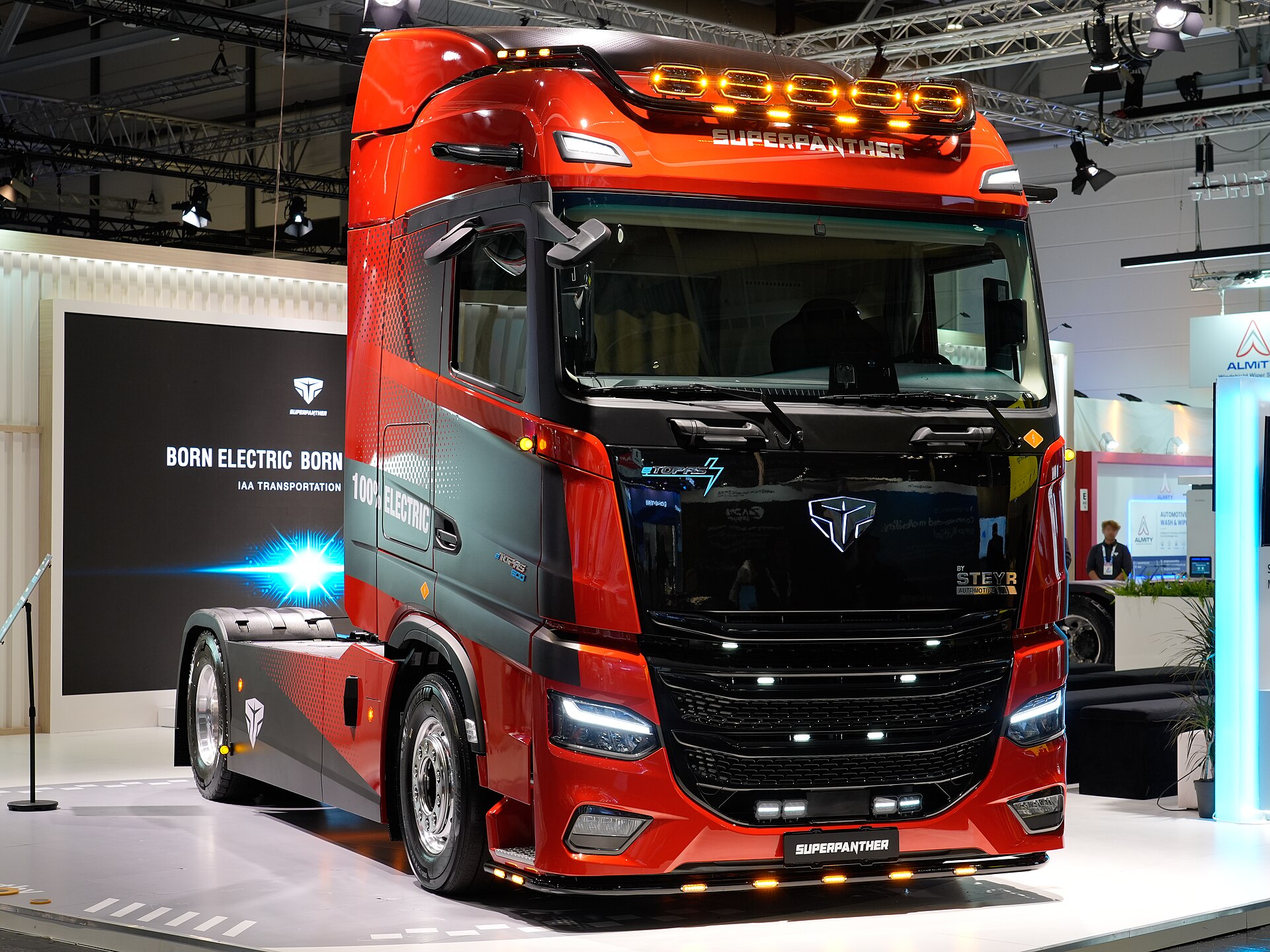
SuperPanther is moving from prototype promises to fleet reality in Europe, and the eTopas 600 electric long-haul truck sits at the middle of that shift. Two years after unveiling its first battery-electric tractor unit at IAA Transportation, the company now builds the vehicle at Steyr Automotive in Austria, has handed over initial units to customers, and reports that trucks are already working in six European markets: Germany, the Netherlands, Poland, Czechia, Austria and Switzerland.
According to Frank Schulz, who leads European sales for SuperPanther, early customer feedback has been encouraging. Isolated technical faults have come up, but he says the company’s mobile ‘Flying Doctors’ response crews have cleared them. One visible example is the DHL Freight deployment, where an eTopas 600 has been running between the Netherlands and Belgium since September and racking up roughly 2,000 kilometres a week.
Efficiency numbers are central to the sales pitch. SuperPanther quotes a maximum range of up to 560 km, and Schulz says vehicles in real service are averaging 91 to 95 kWh per 100 km while fully loaded. Work on the axle and on software is credited with helping achieve those figures. Weight has also been treated as a design target: Schulz says engineers were instructed to keep the tractor below eleven tonnes, and the achieved result is 10.875 tonnes including the integrated power take-off — a meaningful detail in heavy haulage, where every kilogram saved can be converted into payload.
On charging, SuperPanther is taking a pragmatic route. The eTopas 600 pairs two CCS connectors to reach a combined charging power of up to 660 kW, enough to move the battery from 20 to 80 per cent in about 38 minutes. Schulz calls that setup an interim step rather than an end goal, arguing that widespread MCS availability is still years away. The company is nonetheless already preparing for MCS and displayed an MCS-equipped vehicle at IAA; a vehicle-to-grid function is also part of the package. SuperPanther does not stop at selling trucks — it also works with several partners to help customers put charging infrastructure in place.
Service coverage is the other pillar of the European plan. Rather than relying purely on existing networks, SuperPanther says it is building or qualifying workshops along the routes its customers actually drive and near their headquarters, training customer-owned facilities as well. Mobile service teams and round-the-clock support round out the offering. On volumes, Schulz says the target for 2026 is 80 to 100 vehicles in Europe, with several hundred expected the following year. He also makes a confident economic claim: that in total cost of ownership terms, the electric truck is already significantly cheaper than a diesel. As more units accumulate real-world mileage, that assertion will be tested by the fleets themselves.
What do you think?