
Smart Reboots Its Two-Seater: The All-Electric #2 Lands at €19,990 With 290 km of Range
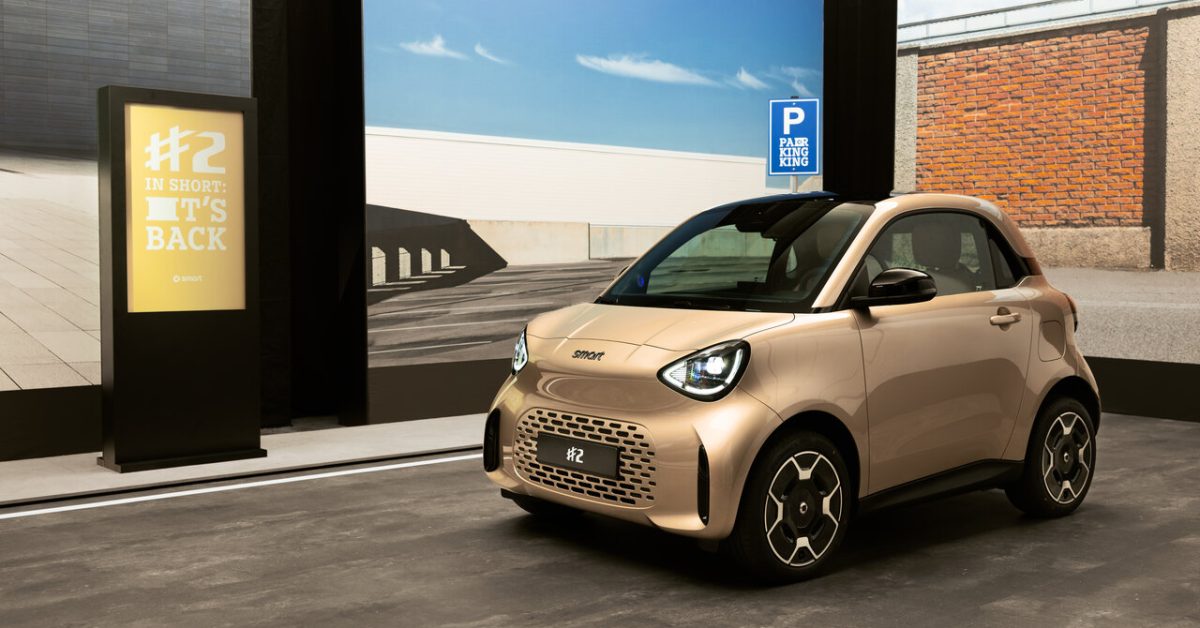
Smart has re-entered the city-car segment it practically invented. At the Paris Motor Show, the Mercedes-Benz and Geely joint venture pulled the wraps off the Smart #2 — a fully electric two-seater positioned as the spiritual successor to the Fortwo. It carries a 35.8 kWh LFP battery, a targeted WLTP range of 290 km (180 miles), and a starting price of €19,990.
The gap between this car and the one it effectively replaces is enormous. The last electric Fortwo made do with a 17.6 kWh pack and 133 km of range, and it never offered DC fast charging at all — a combination that confined it to short urban hops. The #2 more than doubles the battery capacity and adds a 65 kW DC port, which Smart says can go from 10 to 80 percent in roughly 20 minutes. The Pure entry trim sticks with a 7.4 kW single-phase onboard charger (about five hours for the same session), while higher trims move up to 11 kW. Vehicle-to-load is available, though it requires a separately purchased adapter.
The formula is familiar by design. At 2,746 mm long — about 5 cm more than the old EQ Fortwo — the #2 keeps its wheels pushed to the corners, a curb-to-curb turning circle of 6.95 meters, a split tailgate, and two-tone paintwork. Underneath, though, is a new Electric Compact Architecture (ECA) platform with the battery mounted in the floor. A 60 kW motor drives the rear wheels with 130 Nm of torque, matching the outgoing car’s output. Smart also claims a class-first five-link rear suspension. Inside, buyers get a bench-style layout, a 10.1-inch center display, an 8.8-inch driver screen, and adaptive cruise with stop-and-go as standard across the range. Four trims are listed for Germany, from the €19,990 Pure up to the €25,690 Couture Edition, limited to 999 units in Europe. Smart says the entry price also applies in France and Italy, with early orders opening now and deliveries in 2027.
That price bracket is where the conversation gets interesting. Renault’s new Twingo E-Tech also starts at €19,990 in Germany, but offers two more seats and five doors, with a 27.5 kWh pack and 262 km of range. The Smart counters with slightly more range and quicker charging — yet the fundamental trade-off is space versus footprint. In dense cities like Paris, Rome, or Amsterdam, a sub-2.8-meter car can slot into gaps nothing else can use, and that remains the two-seater’s core argument. It is a genuine advantage, but a narrow one. Volkswagen’s ID. Every1 is also expected to arrive at around €20,000 in 2027, right as the #2 begins reaching customers.
The #2 is the first model of the Geely era that resembles what most people picture when they hear the name Smart, following crossover offerings like the #1, #3, and the larger #5. Whether that nostalgia translates into volume is another matter. Buyers in North America should not hold their breath: Smart exited the US and Canadian markets in 2019, and a Chinese-built car with connected services has no realistic route back under current rules. Final specifications may still shift, as the #2 is undergoing EU homologation ahead of its launch.
What do you think?