
Road Test: The 2025 Karma Revero EREV Bows Out with a BMW Heart and American Luxe Ambitions
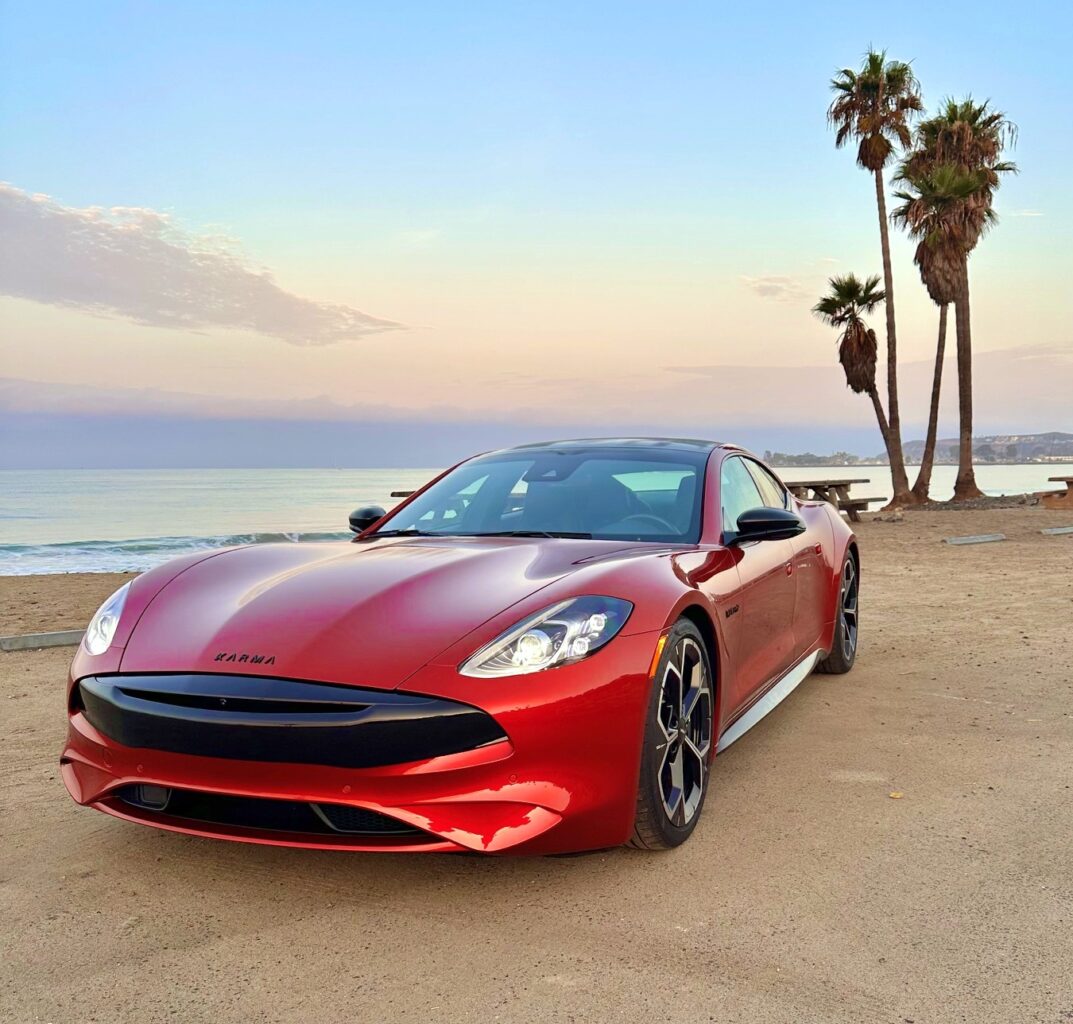
Karma Automotive is betting on an identity that few American brands dare to claim: ultra-luxury. In a conversation at the company’s Irvine, California headquarters, Alexa Harnett, vice president of global marketing and public relations, framed the mission plainly — Karma wants to be seen as the American exotic, a counterweight to the British and Italian marques that dominate the ultra-premium conversation today. The 2025 Revero EREV, which we drove in mid-2026, is a fascinating snapshot of that ambition, partly because it’s the end of the line: Revero production wrapped up a few months ago. Karma’s attention now shifts to the Gysera and Invictus sedans, both extended-range EVs, plus the Kaveya, a two-door, four-motor fully electric super coupe slated for late 2027 as a 2028 model.
So what exactly is an EREV? In the Revero’s case, it’s a 228-horsepower turbocharged 1.5-liter BMW inline-three gasoline engine that never drives the wheels. Instead, it spins a generator to top up a 28 kWh lithium-ion pack, which in turn feeds two electric motors. Combined output for the rear-wheel-drive sedan lands at 536 hp and 550 lb-ft of torque, enough for roughly 4.5-second 0-60 mph runs. Because the Revero also carries a 6.6 kW onboard charger, it doubles as a plug-in hybrid by most definitions — though the distinction matters. Where a conventional PHEV can be propelled by either its engine or its battery, the Revero only moves when there’s sufficient charge to turn the rear wheels. Plug in on a Level 2 240-volt source and a full charge takes four to six hours; a DC fast charger manages 10-80% in under half an hour at up to 45 kW, courtesy of a 358-volt architecture. Regenerative braking adds energy back three ways, with Stealth, Sustain and Sport modes tailoring the feel.
Efficiency figures are a mixed bag. The EPA rates the electric side at 62 MPGe, while the gasoline engine alone is rated at 22 mpg combined. Karma quotes up to 60 miles of pure-electric range and around 290 miles on the 10.25-gallon tank when the pack is depleted, putting total range near 350 miles. Over a week of Southern California driving, we covered roughly that distance and added five gallons of 87 octane as a precaution. On the move, the Revero is composed rather than explosive. At nearly 5,500 pounds, it doesn’t deliver the neck-snapping shove of a dedicated EV, but the steering has a pleasing heft, the chassis stays balanced through sweeping corners, and long highway stretches are where it feels most at home. Pirelli P Zero tires on 21-inch wheels help it stick.
Karma’s ADAS suite, branded KarPilot, enables limited hands-free driving but is not a point-to-point autonomous system — it bundles adaptive cruise, lane-keep support, departure warning, blind-spot monitoring and automatic braking, all activated through steering-wheel controls. The BMW-sourced three-cylinder is audible when it cycles on and off, a reminder that this isn’t a pure EV experience. Inside, the Revero is really a two-person car despite its four-passenger rating; rear seats are heated but low, deep and separated by a large battery tunnel, with no rear air vents. Visibility over the long hood is limited, and the low ride height (5.4 inches) makes entry and exit a careful exercise. Outside, the shape is genuinely distinctive — 0.313 Cd, swivel LED adaptive headlights, a nearly closed nose and a 52.4-inch roof line. With only 130 built in Moreno Valley, California, spotting one on the road is rare, and that exclusivity is precisely the point.
What do you think?