
Rivian Hands VW Its AI Voice Assistant as $5.8B Tech Alliance Deepens
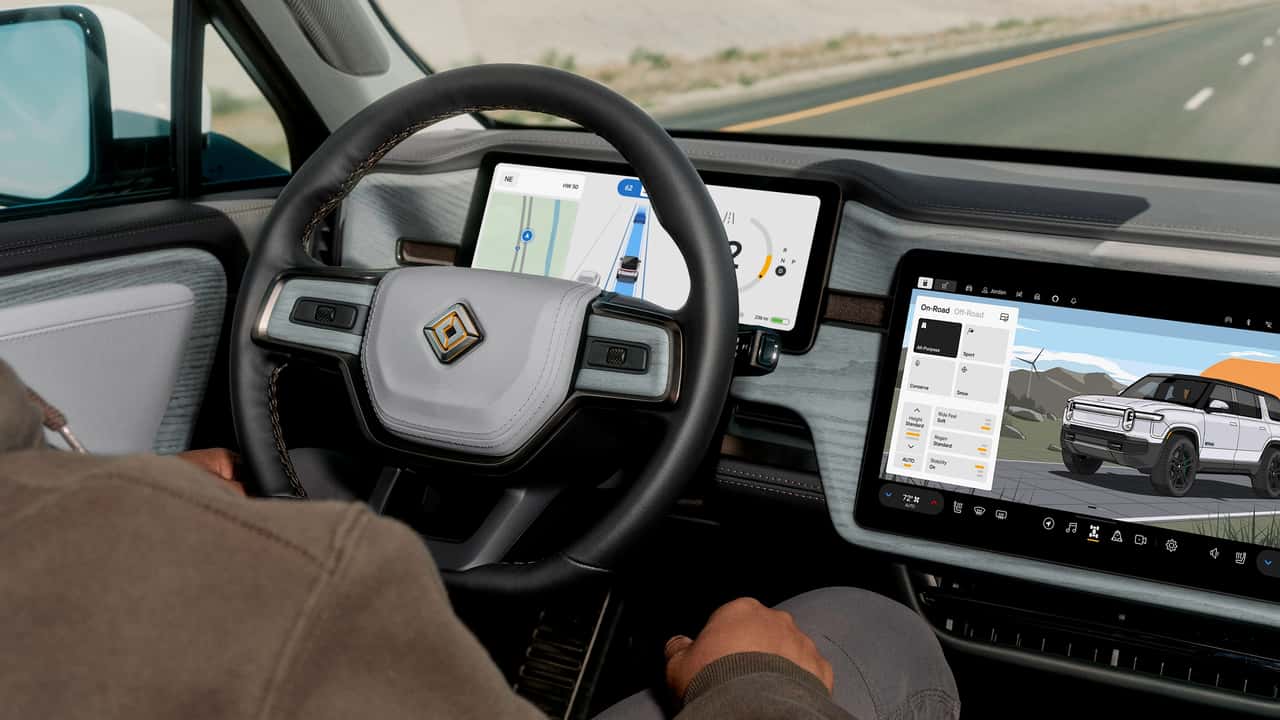
Rivian’s software partnership with Volkswagen Group just got a new layer: the American EV maker is now licensing pieces of its AI voice assistant to the German giant. Word of the arrangement came through Rivian’s third-quarter investor presentation, which landed Thursday.
The two companies have been tied together since 2024 through a joint venture initially valued at up to $5 billion. Volkswagen later raised its commitment to as much as $5.8 billion in Rivian stock through 2027. That first phase centered on Rivian’s electrical architecture and software stack going into VW’s next-generation vehicles.
Rivian isn’t saying what the licensing fees look like, how payment works, or which VW models will get the assistant. Still, there’s an obvious candidate. The ID EVERY1 — Volkswagen’s planned low-cost four-door electric hatchback — is already lined up as the first VW product to carry Rivian’s software and electrical hardware.
The Numbers Behind the Deal: Joint venture valued at up to $5.8 billion · VW investment commitment running through 2027 · Formation formalized November 2024
Two Years of Work, Now Open for Licensing
Rivian spent roughly two years building the assistant before showing it publicly last year. The rollout slipped past the original timeline, and the feature finally reached owners in September 2026 across the R1S SUV, R1T pickup, and the newer midsize R2 SUV.
The system lets occupants talk to the vehicle and control various functions by voice. Founder and CEO RJ Scaringe has described an in-house agentic framework underneath it — one that reads what a driver is asking for and sends the request to the right corner of the car’s software. In time, that setup could let outside developers’ AI agents run inside Rivian vehicles, Anthropic among the names floated.
For Rivian, licensing the assistant out is a way to prove the platform travels well beyond its own products. The company called the expansion “a proof point for the extensibility of the platform we’ve built in-house.”
Why Volkswagen Wants In
Volkswagen has spent years trying to close the software gap with Tesla, with mixed results. Buying into Rivian’s stack offered a shortcut.
Rivian has leaned hard on vertical integration as its selling point. When it reworked the R1T and R1S, the changes touched the battery pack, suspension, electrical architecture, sensor suite, and user interface. The new compute setup cut wiring and dropped the vehicle’s electronic control units from 17 down to seven.
That consolidation is the groundwork for heavier computing loads — advanced driver assistance, over-the-air updates that reach far past the usual fixes, and AI features that need real horsepower on board. Because Rivian controls compute, sensors, displays, lighting, and audio in-house, it argues it can push vehicle-wide OTA updates at a pace rivals can’t match.
- Architecture: Rivian’s zonal electrical system replaces 17 ECUs with seven
- First VW candidate: The entry-level ID EVERY1 hatchback
- Assistant debut: September 2026 on R1S, R1T, and R2
- JV scope: Software and electrical hardware, now with AI voice tech on top
Whether the assistant shows up in more VW models, and when, remains unanswered. For now the deal adds another revenue stream to a partnership that keeps widening — and gives Volkswagen a ready-made voice interface without building one from scratch.
Photo: Rivian / InsideEVs · Official Press Kit / Editorial (Editorial / Press Kit)
Source: TechCrunch - Transportation
What do you think?